My name is Jake Morrison, and the day Margaret Thornfield fined me two hundred dollars for parking my own truck at my own cabin was the day she accidentally detonated her entire little kingdom.
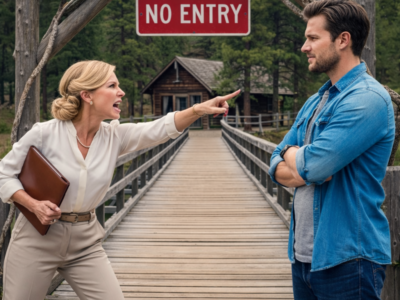
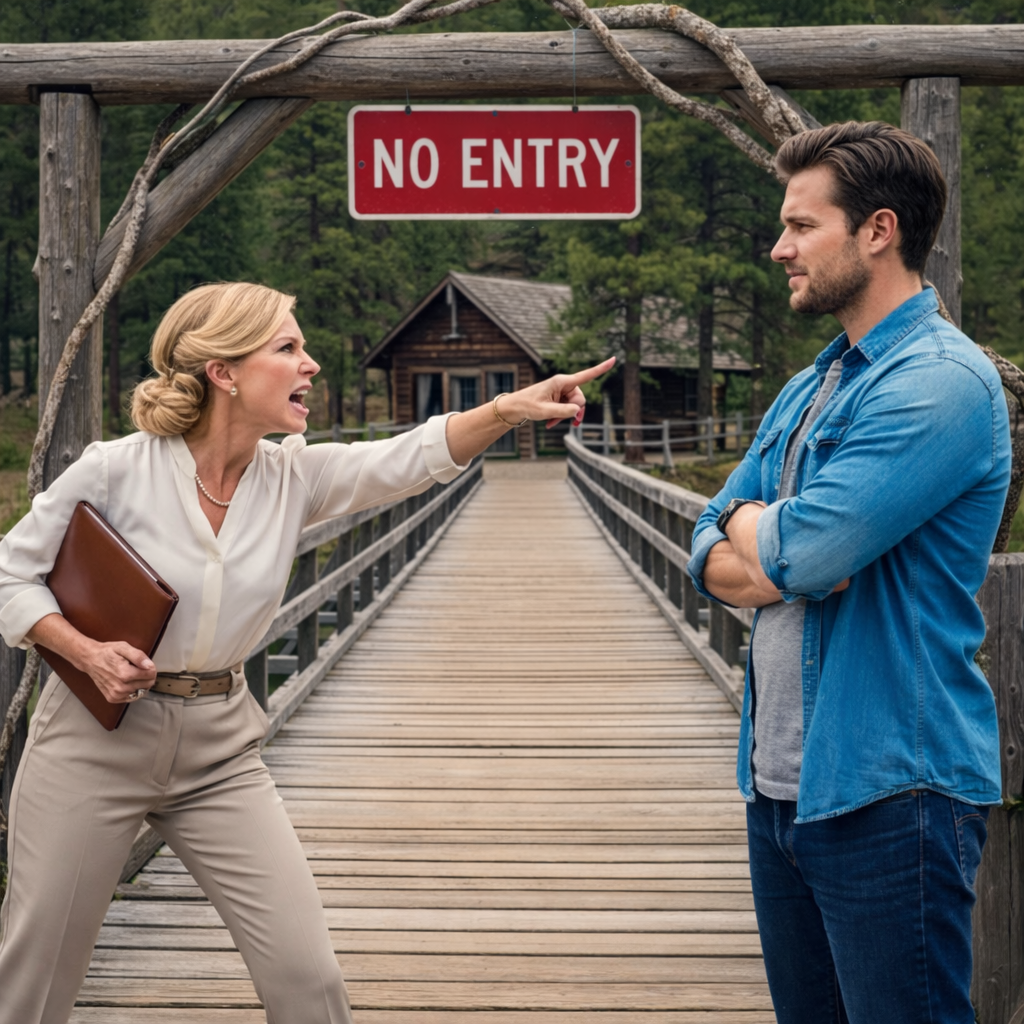
She stood there beside a brand-new steel gate, white BMW glinting in the autumn sun, holding a violation notice in one manicured hand like it was a royal decree. The wind carried the smell of pine and cold creek water, and somewhere below us Whisper Creek ran beneath the old bridge my grandfather built in 1943. Margaret smiled the way people smile when they think money and paperwork have finally made them untouchable.
“Unauthorized vehicle storage,” she said. “And because you’ve refused to comply with community standards, there will be daily penalties until this matter is resolved.”
I took the paper from her and looked past her shoulder at the gate. Concrete posts. Heavy locking mechanism. Decorative lanterns. It was expensive, permanent-looking, and completely illegal.
My truck was parked on my grandfather’s land. The bridge beyond that gate sat on my grandfather’s land. The approach road crossed my grandfather’s land. And the woman threatening me had apparently decided that an HOA formed less than three years earlier now controlled access to property that had been in my family since World War Two.
What Margaret did not know was that I build bridges for a living.
Not metaphorical bridges. Real ones. Steel, timber, concrete, load calculations, water tables, stress distribution, maintenance schedules, failure analysis. I’m thirty-four years old, a structural engineer, and for most of the last decade I’ve worked wherever the job took me, from flood-prone counties in the Midwest to renewable energy sites in Europe. I know exactly how much paperwork, surveying, liability, and legal specificity goes into a structure that carries people over water.
So when Margaret Thornfield, president of Lakeside Estates Homeowners Association, tried to tell me my family bridge was now “community infrastructure,” I knew two things instantly.
First, she was bluffing.
Second, she had gotten used to nobody calling that bluff.
I drove away without arguing. That surprised her. I could see it in the little crease between her brows as she watched me leave. She’d expected outrage. Maybe a shouted threat. Maybe the pleasure of seeing me lose control. Instead, I folded the violation notice, put it in my glove compartment, and drove to the county courthouse.
If you want to beat people like Margaret, you do not start with anger.
You start with records.
The courthouse smelled like dust, wax, and old paper. A clerk with half-moon glasses pointed me toward archived property documents, and three hours later I was sitting under flickering fluorescent lights with my grandfather’s original deed spread carefully in front of me. The pages were yellowed but intact, the legal description beautifully precise. Cabin parcel. Shoreline boundaries. Timber rights. Bridge structure. Approach road. Foundation pilings. Maintenance easement.
I read the whole thing twice.
Then I smiled.
Because Grandpa had not just owned the bridge. He had protected it.
The deed gave the owner of the cabin the obligation to allow reasonable passage across the bridge. But “reasonable passage” was not vague. It was defined. No more than twelve vehicle crossings per day without written authorization from the bridge owner, due to preservation concerns and maintenance limits associated with the original timber structure.
Twelve.
Lakeside Estates had forty-seven homes.
Every resident in Margaret’s precious subdivision crossed that bridge to get in and out.
I sat back in my chair and listened to the building hum around me. Grandpa, even from the grave, had handed me an engineering problem with a legal solution. Margaret had tried to weaponize paperwork against the wrong grandson.
By the time I got outside, late afternoon sunlight was slanting across the courthouse steps. I called Betty Chen.
Betty lived near the bridge and had slipped me a handwritten note earlier that morning that said only: Checked county record. Something’s fishy.
Turns out Betty was a retired paralegal who looked like somebody’s gentle aunt and thought like a cross between a prosecutor and a locksmith. She invited me over that night. Her kitchen smelled like jasmine tea and strong coffee, and she already had a yellow legal pad out by the time I arrived.
“I don’t like tyrants,” she said, without preamble. “And I especially don’t like suburban tyrants with leather portfolios.”
That was the beginning of what would later become the Bridge Club, though at the time it was just Betty and me sitting at her table while her refrigerator rattled in the background and autumn wind scraped branches across her window.
We built the timeline.
Two years earlier, my grandfather had died and left me the cabin on Pine Lake. I had been overseas for long stretches since then, checking on the place whenever work allowed. In that same time period, forest and farmland around the lake had been turned into a polished subdivision full of expensive homes, identical landscaping, and a homeowners association obsessed with appearances. Margaret Thornfield had moved in from the city, run for HOA president promising higher property values and stronger standards, and then proceeded to treat the neighborhood like a private fiefdom.
She cited people for mailbox colors.
She tried to regulate guest parking times.
She harassed one veteran over an oversized American flag.
She leaned on an elderly couple until they removed bird feeders she called “wildlife attractants.”
And now she had gone after my bridge.
The next escalation came fast.
Within a week, I received a cease-and-desist letter from a lawyer representing the HOA. According to the letter, my continued use of the bridge road amounted to trespass on community-maintained property. The fines had somehow expanded from two hundred dollars to four thousand four hundred and fifty. There were phrases like public endangerment and nuisance conduct and emergency enforcement action, all designed to scare me into compliance.
I read the letter once, scanned it, filed it, and called the law firm from a number they would not recognize.
We live in a one-party consent state.
That matters.
Because twenty minutes into the conversation, the lawyer, probably tired and assuming I was ignorant, said the sentence that changed the whole temperature of the fight.
“Look,” he sighed, “we know your client’s family has some historical claim, but these situations usually resolve because people don’t want expensive litigation.”
Historical claim.
Meaning they knew.
They knew I owned the bridge.
They just thought I would fold.
I had the admission recorded, backed up, and transcribed before dinner.
Meanwhile, Margaret got more theatrical. She installed a camera aimed directly at the bridge approach. She started keeping a visible clipboard log every time my truck crossed to the cabin. She spread whispers around town that I was unstable, threatening, and suspiciously absent due to “mysterious foreign work.” Apparently spending six months in Denmark on renewable energy projects made me sound like an international criminal to people inclined to believe nonsense.
But her campaign had one flaw.
People talk.
Especially in small towns.
Tom Hendricks, a Vietnam veteran with a voice like gravel, told me Margaret had threatened him over his flag. Sarah Walsh, a reporter for the local weekly paper, told me Margaret had once tried to pressure her editor after Sarah wrote a story about resident property rights. The Kowalskis told me about the bird feeders. Betty heard from three different neighbors that Margaret had been asking questions about whether I could afford a lawsuit.
When someone starts asking whether you can afford to fight, what they usually mean is they cannot afford for you to fight.
So I kept digging.
The original bridge deed was only the beginning. Betty pulled the HOA charter. Buried in the formation documents was a clause stating that all preexisting private property rights remained unaffected by the formation of the association. In plain English, Lakeside Estates could create all the committees and landscaping rules it wanted, but it could not retroactively seize my bridge, road, or access rights.
Margaret’s entire theory of control died right there.
The problem was that women like Margaret do not back down when cornered.
They escalate.
First came the county complaint. According to Margaret, my bridge was structurally unsafe and required immediate inspection at my expense.
I laughed when I read that one.
I inspect bridges professionally. I have crawled under corroded steel in freezing wind and stood on temporary scaffolds over floodwater with a clipboard in one hand and a wrench in the other. Telling me to inspect a bridge is like telling a dentist to look at teeth.
So that Saturday I gave Grandpa’s bridge the most thorough inspection of its life. I photographed every beam, every fastening point, every timber joint, every bearing surface. I documented foundation integrity, deck wear, moisture exposure, and load tolerance. The old creosote smell in the timbers pulled me straight back to childhood, to summer days when Grandpa taught me how to tighten hardware and check rot before trouble started.
The structure was gorgeous.
Grandpa had overbuilt it by the standards of his time, and by mine too. He believed in things lasting. The bridge could handle far more than ordinary residential traffic. If anything, the real safety issue in that neighborhood was Margaret’s elevated deck, which had visible railing spacing violations and one corner sagging enough to make me wince from fifty yards away.
I filed my professional report and attached a second opinion from a colleague at my engineering firm.
Margaret responded by trying to condemn the bridge through the town council anyway.
That hearing ended badly for her.
She arrived with a petition she claimed represented unanimous neighborhood concern. Under basic questioning, it became obvious that many of the signers had not understood what they were signing, and several signatures looked suspiciously inconsistent. When the judge asked whether the HOA had any deeded interest in the bridge itself, Margaret launched into a speech about aesthetics and public safety.
He cut her off.
“Do you own the bridge, Mrs. Thornfield?”
“No, but the community—”
“Do you own the bridge?”
“No.”
“Then you do not control the bridge.”
That should have ended it.
Instead, it enraged her.
Three days later, I returned to the cabin road and found “decorative barriers” installed along the bridge approach: concrete blocks positioned just tightly enough to stop my truck from getting through. Margaret was there in a tan blazer and boots too clean for gravel, explaining that the architectural committee had approved a beautification project.
The architectural committee, of course, was Margaret and two residents too intimidated to disagree with her.
That time I did get angry.
Not loud angry. Cold angry.
The kind that sharpens everything.
I photographed the barriers from every angle, called my attorney friend in Cedar Falls, and filed for an emergency injunction before sunset. In court the next morning, armed with the deed, survey maps, and photographic proof of blocked access, I barely had to speak. The judge ordered the barriers removed within twenty-four hours and fined Margaret for obstructing legal property access.
She kept talking after he ruled.
He added contempt.
Standing outside the courthouse afterward, I watched her face shift from righteous fury to something tighter and meaner. She had expected institutions to protect her because she wore professionalism like a costume. Instead, the system was beginning to notice what she actually was.
That was when the harassment turned personal.
Anonymous complaints to county inspectors.
Noise reports on nights I was not even in town.
A complaint to the state engineering board claiming I was mentally unstable and unfit for licensure.
That one annoyed me more than anything else. My license matters. I earned it the hard way, and my professional record is clean.
The board reviewed her complaint, looked at my background, and dismissed it.
Then something interesting happened.
People stopped whispering and started helping.
Tom organized what he jokingly called the Bridge Defense Committee. Sarah began asking sharper questions about the HOA’s financials. Betty dug deeper into public records. One evening at Betty’s kitchen table, while my orange tabby Diesel slept in a sun spot like he paid property taxes, Sarah spread out the HOA’s budget statements and tapped a row of numbers with one red fingernail.
“These reserves don’t make sense,” she said.
The HOA was spending nearly twice its intake. Landscaping invoices were bloated. Consulting fees appeared regularly. Maintenance expenditures did not match visible work. One line item kept repeating under slightly different descriptions, but always leading back to the same recipient.
Thornfield Consulting Services.
Margaret’s company.
For a long moment nobody spoke. The only sound was Betty’s old wall clock ticking above the stove.
My bridge dispute had never been just about control.
It had been cover.
Margaret needed money.
The subdivision’s finances were in trouble, and she had apparently decided to solve that problem by squeezing residents, manufacturing fees, and steering HOA funds into her own pocket through fake consulting invoices.
Everything she had done to me made more sense after that. The gate. The fines. The fake safety panic. The lawyer pressure. The public smears. She had needed a distraction and a source of new revenue, and I had handed her a target simply by inheriting land she could not control.
Once we saw that clearly, the fight changed.
I was no longer defending just a bridge.
We were exposing a theft.
Betty requested banking records through channels only a retired paralegal with a grudge and too much coffee could navigate. Sarah used public records requests to trace payment histories. Tom spoke quietly with neighbors who had once backed Margaret and discovered many of them had been bullied, misled, or simply worn down by her relentless certainty.
Then Betty found the missing reserve fund transfers.
Twenty-three thousand dollars had moved from HOA accounts to Thornfield Consulting Services with no supporting contracts, no deliverables, and no board-approved documentation. Sarah found more. There were landscaping overcharges, irregular reimbursements, and evidence Margaret had handled financial matters personally while sidelining the HOA’s usual accountant.
My hands were shaking by the time I finished reading the compiled folder.
Not from fear.
From clarity.
Bullies are dangerous. Thieves are dangerous. But a bully who steals from people while pretending to protect them is something worse. That kind of person does not stop on their own.
You stop them.
Margaret must have sensed the atmosphere changing, because her lawyer abruptly withdrew from representation citing ethical concerns. Two HOA board members began avoiding public appearances. Even Margaret’s husband, according to neighborhood gossip, had started asking questions about sudden household cash flow.
Still, she did not stop.
At three in the morning one cold Thursday, my security camera caught her on the bridge with a crowbar.
The footage was almost absurd. Margaret Thornfield, defender of community standards, in a dark coat and gloves, trying to damage a seventy-year-old timber bridge with the upper-body strength of an irritated flamingo. She scraped at a support bracket, hit one railing post, and accomplished almost nothing except recording clear evidence of criminal vandalism.
I filed a police report but held back the footage strategically. Betty thought we should wait. Sarah agreed. Tom grinned and said, “Let her keep digging.”
So we did.
Margaret’s behavior spiraled. Anonymous social media accounts appeared attacking my reputation. Fake reviews of my engineering work surfaced online. Neighborhood posts accused me of threatening families, endangering children, and plotting to block the entire subdivision from emergency services.
I screenshotted everything.
Then Betty uncovered the loan documents.
Margaret had attempted to secure an emergency loan against HOA reserves without full board authorization. When the bank refused, forged signatures appeared on the paperwork.
Forgery changes the game.
Embezzlement is one thing. Forgery drags in bigger attention.
The moment we had that, my attorney friend stopped sounding amused and started sounding professionally delighted. The state attorney general’s office became interested. Fraud investigators became interested. The sheriff’s department became interested.
And Margaret, who had spent months bluffing with fake authority, suddenly found out what real authority sounds like when it starts asking for records.
That was when she called to bribe me.
Her voice on the phone was softer than I had ever heard it, stripped of perfume and posture. She offered fifteen thousand dollars if I would “let the misunderstandings go” and “move on privately.” I let her talk. I let silence stretch. People will fill silence if they are scared enough.
She did.
By the end of that conversation she had admitted to “mistakes with HOA funds,” referred to “paperwork mix-ups,” and effectively confessed to financial misconduct in the hope I would take money and shut up.
I recorded every second.
By then our little group had become a machine.
Betty organized evidence into color-coded binders so precise they could have been submitted to the Supreme Court.
Sarah prepared a story with enough documentation to survive a libel war.
Tom built a coalition of residents willing to appear publicly.
I compiled a bridge report so complete it looked like the structure was being nominated for sainthood.
We planned for the town hall meeting.
That was where Margaret would break.
Not because we would shout louder than she did.
Because facts, placed carefully in public, have weight.
The town hall was packed beyond capacity. News cameras lined the back wall. Residents filled folding chairs, stood along the side aisles, and crowded the doorway. The mayor sat grim-faced near the front. A sheriff’s deputy stood by one exit. Margaret arrived with a court-appointed attorney, a silk scarf, and the expression of a woman still convinced presentation might save her.
I was calm when I walked to the podium.
Truly calm.
Some fights wear you down. This one had clarified me. I knew what I had. I knew what she had done. And most importantly, I knew Grandpa’s bridge was still standing behind me, solid as principle.
I began with the deed.
Then the timeline.
The gate. The fines. The fraudulent property claim. The obstructed access. The false safety complaints. The harassment campaign. The financial irregularities. The forged signatures. The consulting transfers. The bribery recording.
Every document was projected overhead.
Every date was sourced.
Every accusation had evidence under it.
The room stayed silent until I played her voice offering money to make the matter disappear.
That was when Margaret stood up.
“This is a conspiracy,” she shouted. “He’s manipulated everyone. He’s trying to destroy this community.”
Her lawyer pulled at her sleeve. She shook him off.
Betty took the microphone next and calmly explained the HOA charter clause preserving preexisting property rights. Tom described her harassment of residents. The Kowalskis spoke. Sarah spoke. Two former board members spoke. A retired accountant explained the reserve fund discrepancies. Sheriff Martinez outlined the criminal investigation now underway.
Margaret kept interrupting until the mayor banged his gavel and ordered her silent.
Then I delivered the sentence I had been saving.
“Margaret, the only thing I destroyed was your ability to keep stealing from people who trusted you.”
The applause hit like weather.
Not polite applause. Not courtroom restraint. The kind of applause people give when months of fear finally crack and blow out of them all at once.
Margaret started yelling again, pointing wildly around the room, accusing neighbors, officials, me, anyone within range. It was not strategy anymore. It was collapse. A person held together by intimidation was discovering that fear works only while people stay isolated.
The sheriff moved in.
Her attorney said something low and urgent to her. She ignored him.
When she was led out of that room, cameras flashing, she looked smaller than I had ever seen her.
The charges came hard after that.
Embezzlement. Fraud. Forgery. Filing false emergency reports. Civil liability from the HOA itself. Restitution claims. Tax inquiries. Her real estate license was suspended pending review. Her husband moved out with their kids. Even the residents who once defended her started describing themselves as misled rather than loyal.
Still, Margaret managed one final act of public humiliation.
At two in the morning, hoping to frame me as a danger, she called emergency services claiming the bridge was actively collapsing. Fire trucks, ambulances, and county crews tore down the road with sirens screaming. Captain Rodriguez, the fire chief, woke me with the call and asked for immediate assessment.
When I arrived, Margaret was there in a bathrobe, dramatically pointing at a perfectly stable bridge under floodlights.
I walked the structure with Rodriguez beside me. Ten minutes later he announced to everyone present that the bridge was safer than most county roads. Then he informed Margaret that filing false emergency reports was a crime.
If credibility has a sound, it is the silence that follows a lie collapsing in public.
The forensic audit finished the next morning.
Thirty-one thousand dollars in improper expenditures tied to Margaret’s accounts.
That number spread through town faster than gossip ever had. Regional stations picked up Sarah’s article. Statewide property-rights groups called. Online the story became a symbol, partly because everybody loves a petty tyrant falling apart, but mostly because too many people recognized the pattern.
When airport security stopped Margaret days later trying to leave with cash and documents tied to the HOA accounts, the story went from local scandal to statewide spectacle.
And then, finally, it ended where it should have ended much earlier.
In court.
Margaret pleaded guilty to embezzlement and fraud. The plea deal spared everyone a drawn-out circus, though the sentencing hearing still drew a crowd. She received prison time, probation, and a restitution order large enough to gut whatever image of herself she still had left. Her licenses were revoked. Her finances were wrecked. Her authority was over forever.
The real victory, though, was not seeing Margaret punished.
It was seeing Cedar Falls come back to life.
Within a month a new HOA board was elected, with Betty Chen as president. Transparent budgeting. Independent accounting. Open records access. Residents who had spent a year avoiding one another started talking again. The Bridge Defense Committee became a permanent community advocacy group. Tom turned into a local folk hero. Sarah won an award for her reporting. Kids drew chalk art near the bridge during what became the first annual Bridge Festival.
They wanted me on the HOA board.
I declined with gratitude and mild horror.
I had not fought a despot to become a committee man.
Instead, I stayed.
That surprised me more than anyone.
I had expected to return overseas, back to contracts and job sites and hotels where every room smells faintly of detergent and loneliness. But the fight had changed something in me. I opened a consulting firm in Cedar Falls focused on small-community infrastructure and property access issues. Turns out there is no shortage of places where decent people need help understanding what belongs to them and how not to get bullied out of it.
The land around Grandpa’s bridge was eventually protected as a small habitat corridor in partnership with conservation groups. Property values in Lakeside Estates rose, not fell. Buyers liked the idea of a community that had faced corruption and cleaned house.
Even Margaret’s daughter, poor kid, showed up at the first Bridge Festival with a handwritten apology. None of what happened was her fault. I told her so. Later, when I started an engineering scholarship fund for local students, she was the first recipient.
Sometimes the cleanest ending is not revenge.
It is repair.
Now, on autumn evenings, I sit on the porch of the cabin and listen to the same creek my grandfather once listened to. Whisper Creek still moves under the bridge with that steady, patient sound water makes when it knows time is on its side. Kids laugh on the far bank. Diesel, older and fatter, patrols the windows like a unionized sheriff. The bridge stands where it always stood, carrying people home.
Margaret tried to turn my inheritance into leverage, then revenue, then a weapon.
Instead, she revealed exactly who she was and handed an entire town the reason to stop being afraid.
Grandpa used to tell me that if you build something right, it keeps doing its job long after the person who built it is gone.
He was talking about bridges.
But he might as well have been talking about backbone.
The airport arrest happened on a gray Thursday that smelled like rain and jet fuel. I was at Betty’s kitchen table reviewing financial records when Sarah’s phone buzzed. She looked at the screen and muttered, “You have got to be kidding me.”
Margaret had tried to leave town.
Security at the regional airport flagged one of her bags for a large amount of cash. Local police, already alerted by investigators, met her before she reached the gate. In the luggage they found HOA check copies, partial ledgers, and handwritten notes that looked like a panicked attempt to track or erase the money trail.
I did not go to the airport. I had learned by then that watching a person collapse too closely is a good way to breathe in their chaos. Instead, I stayed with Betty and Tom while Sarah worked her sources. Tom paced by the stove, muttering that people like Margaret always run when facts finally catch them.
For the next few weeks, the neighborhood lived in a strange suspended state. Margaret was out on bail, barred from HOA meetings, stripped of access to records, and avoided by almost everyone. Her once immaculate BMW sat in the driveway more often than not. Curtains closed. Porch empty. The same neighbors who used to flatter her now crossed the street rather than risk being seen near her.
Some evenings, after calls with lawyers and investigators, I would walk Grandpa’s bridge at dusk and let the repetition settle me. Heel on plank. Water below. Pines moving in the wind. The bridge had its own honest logic. Weight goes here. Stress resolves there. Weakness can be reinforced. Rot can be cut out. Truth, in engineering, does not care about ego. A structure either holds or it does not.
One night Betty came out carrying two mugs of coffee in a thermos caddy and found me checking the railing bolts with a flashlight.
“You know you already won,” she said.
I looked down at the creek. “Doesn’t feel finished.”
“It never does,” she said. “That’s the inconvenient thing about real victories.”
She was right. I had been waiting for one dramatic moment when everything would feel resolved, but real life does not do endings that neatly. Victory had come in pieces: a dismissed complaint, a forged signature exposed, a resident finally speaking up, a bully learning that institutions can answer back.
The sentencing hearing was quieter than the town hall and heavier in a different way. Margaret wore conservative navy and tried to look misjudged rather than guilty. Her attorney talked about stress and administrative errors. The prosecutor answered with numbers, records, and the fact that she had stolen from her own neighbors while using HOA authority as cover.
I gave a victim impact statement, but I kept it plain. I told the judge that Margaret had not just harassed me. She had divided an entire community, targeted vulnerable residents, abused public resources, and tried to strip lawful property rights through intimidation. This was not a misunderstanding between neighbors. It was prolonged abuse of entrusted power.
Betty spoke after me. Calm as ever, she described what it felt like to watch people become afraid to answer their doors because the HOA president might be standing outside with another demand. Tom said, “A bully with a clipboard is still a bully,” and even the judge almost smiled.
Then the sentence came.
Prison. Probation. Restitution. Professional ruin.
Margaret cried, and for the first time I felt nothing at all about her. No anger. No satisfaction. Just distance. She had spent months trying to make herself the center of everyone’s life. Now the law had reduced her to what she actually was: a defendant answering for theft.
After that, the healing began.
The first residents’ meeting under the new HOA board felt like stepping into a house after the windows have been opened. Betty ran the meeting with transparent budgets, independent audits, open records access, and actual bids for actual work. It was not dramatic. It was sane. After months of Margaret’s theater, sanity felt revolutionary.
The first annual Bridge Festival happened exactly one year after Margaret tried to block the road. Families brought picnic coolers and folding chairs. Kids covered the bridge approach with chalk drawings of fish, loons, and little timber bridges. Tom handled the flag ceremony like it was a military operation. Sarah ran a donation table for veterans’ programs. Betty wore a hat wide enough to create its own weather system and directed parking with terrifying authority.
At sunset I stood in the middle of the bridge and looked both ways.
To one side was the cabin, the dock, the trees, the history that raised me.
To the other was the subdivision that had nearly become Margaret’s personal empire and instead became something better: a neighborhood that learned what happens when ordinary people stop being afraid together.
Grandpa’s bridge connected both.
Later, after the last cars rolled off and the lantern light trembled over the creek, Betty sat on the railing with a paper plate and said, “Most people spend their inheritance on something much dumber.”
I laughed. “I inherited a bridge and a war.”
“No,” she said. “You inherited a reason not to look away.”
There are people who think justice arrives like thunder, loud and instant and impossible to miss. Sometimes it does. But more often it arrives the way water moves under old timber, steady and patient, wearing down lies until the structure holding them finally gives way.
Margaret thought she controlled access, fear, appearance, and eventually truth.
She controlled none of it.
In the end, she was temporary.
The bridge was not.
THE END
News
I Built a Fence on My Family’s Texas Land, Then the HOA Sent Fake Security and Learned My Boundary Came With Voltage
I did not start that war. I built a fence. That is the first thing folks need to understand before they start telling the story wrong. I did not go…

My Mother-in-Law Said Daniel Needed a Wife Who Built Something Real, Then His Divorce Lawyer Learned I Owned the House, the Portfolio, and the Future
You deserve someone who actually built something with her life, Daniel. Not someone who rearranges furniture for a living. My mother-in-law said it loud enough for three nearby tables to…

A Senator’s Daughter Spit in My Face at the Diner—Then the Most Feared Man in Town Stood Up and Changed Everything
The bell over the door of Miller’s Diner jingled just as Lisa Smith balanced three coffees on a tray and reminded herself that surviving another shift still counted as progress….

My Wife Served Divorce Papers at Christmas Dinner While Her Family Applauded—Then One Black Card Exposed the Man They Had Mocked for Eight Years
My father-in-law once told me a man’s worth could be weighed by the thickness of his wallet. He said it over Thanksgiving turkey, with a crystal glass in one hand…

She Told Me I Was No Longer Family the Night Before My Son’s Wedding, but by Noon Her Perfect Ceremony Had Already Collapsed
After tomorrow, you are not part of this family anymore. Those were the exact words my son’s fiancee whispered to me the night before her wedding, and for one terrible…

My Mother-in-Law Forced Me to Wash Dishes at Her Birthday Gala—Then a Rolls-Royce Arrived, a Powerful Man Bowed, and Her Entire World Collapsed
By the time the first violin note floated through the ballroom, Evelyn Hart was already being erased from the evening. Outside the service corridor, Victoria Sterling’s sixtieth birthday gala glittered…
End of content
No more pages to load