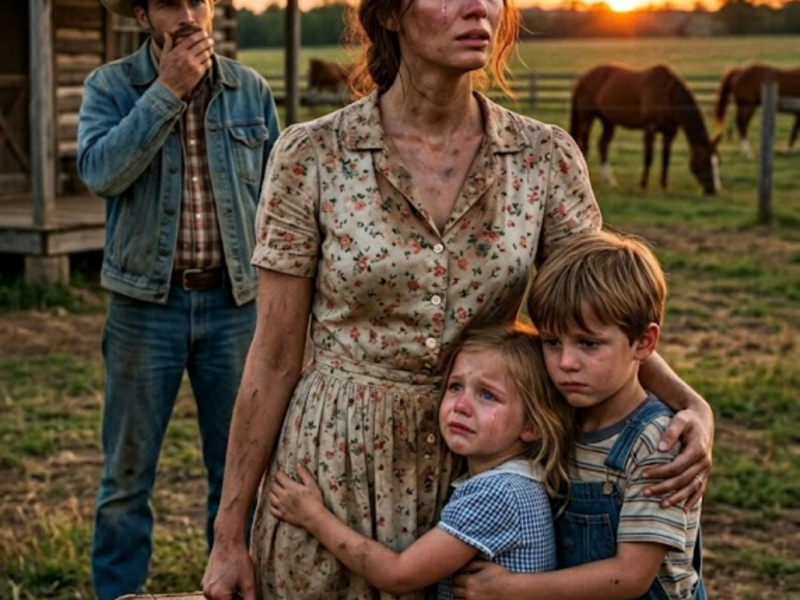
QA-Sold at 18 to a Lonely Rancher — But His Twin Kids Loved Her Before He Did…
The first time Norah Finch understood that the frontier did not care about goodness, she was twelve years old and standing in the doorway of her family’s cabin watching her father count coins on the table.
He wasn’t counting them like money. He was counting them like days left to live.
The lamp smoked, the wick too high, and the light made his hands look older than they should have. Outside, the wind pushed dust through the cracks in the logs, and the creek a mile away made no sound at all. No water. Just stones baked pale under a sky that hadn’t bothered to rain in weeks.
“Pa?” Norah asked, voice cautious. She’d learned to measure her father’s moods the way other children measured weather.
Her father didn’t look up. “Go on to bed,” he said, soft but final.
Norah obeyed, but she stood in the hall long enough to hear the sound that came next—her father’s slow exhale, the kind men make when they’ve run out of answers.
That was the year the drought began to win.
It didn’t win all at once. It never did. It took a little each month: grass turning brittle, the well dropping lower, cattle ribs showing, neighbors riding into town more often with their hats pulled down and their eyes avoiding yours. The frontier didn’t kill you with spectacle. It killed you with arithmetic.
Her father, Amos Finch, had been a steady man once. He’d been the kind who fixed fences before sunrise and still had enough patience to teach a child how to mend a tear without making her feel clumsy. He told Norah stories at night—clever foxes and stubborn girls who didn’t wait for rescuers. He believed in work. He believed in promises. He believed a man could earn his way through anything if his hands stayed busy and his heart stayed clean.
Then Judge Pritchard came to Cold Water Ridge.
Pritchard didn’t arrive with a gun. He arrived with paper.
He arrived with new taxes, new fees, new “regulations,” all written in clean ink and explained in sermons about order. He arrived with a clerk who smiled kindly while he slid debt notices under doors. He arrived with the kind of authority that made men who’d never bowed their heads suddenly bow.
At first, Amos Finch tried to outwork it. He took odd jobs. He sold a few calves early. He took on repair work at the general store for credit. He told Norah, “We’ll be fine,” and she wanted to believe him because she was a child and children are built for believing.
Then the bottle appeared.
Not in a dramatic way. Not as a monster at the door. It came in small, explainable doses. One drink at the saloon after a day of hauling water. One drink after Pritchard’s clerk returned with another notice. One drink when Amos came home with shoulders too tight and eyes too empty.
At first, Amos still told her stories. Then he forgot the endings. Then he stopped telling them at all.
By the time Norah was sixteen, she understood how a man could die before his body did.
She also understood what people meant when they whispered about “trouble” in certain families. They didn’t mean evil. They meant poverty. They meant the way misfortune clung to you and made other people afraid of being touched by it.
Norah’s mother had died when Norah was little—fever, quick and merciless—so it was just her and Amos. It had always been just them, a small unit against a wide, indifferent world.
And then, one late summer night, it wasn’t.
Norah found her father on the saloon floor.
She didn’t even go inside at first. She stood in the doorway with the smell of sour whiskey and sweat rolling out at her, thick as fog. Men looked up and then looked away, suddenly fascinated by their boots. Someone muttered, “Go on home, girl.”
Norah pushed past them anyway.
Her father lay on his side, face slack, one hand curled like he’d been reaching for something and missed. His shirt was stained. His boots were half off. The room spun slightly, not from alcohol but from the sudden shift in her world.
“Pa,” she said, dropping to her knees. She pressed her fingers to his neck, just like she’d seen women do for sick children.
Nothing.
A man with a gray beard—one of the ranchers—touched her shoulder awkwardly. “He’s gone,” the man said, voice low. “Heart.”
Norah didn’t cry then. Her body didn’t know how to do it yet. She sat there with her hand on her father’s chest and stared at his face as if staring hard enough could pull him back.
Someone fetched the preacher. Someone fetched the undertaker.

And before the sun rose, Judge Pritchard’s clerk appeared at Norah’s cabin.
Debt doesn’t mourn. Debt collects.
The clerk stood on Norah’s porch with a polite smile and a stack of papers. He didn’t remove his hat. He didn’t lower his voice. He treated Amos Finch’s death like a line item.
“Miss Finch,” he said, as if the title made it gentle, “your father’s outstanding obligations have not been resolved. Under county authority, the estate must be settled.”
Norah stared at him, her father’s body still in the next room.
“What estate?” she managed.
The clerk’s smile didn’t change. “Property. Tools. Livestock. Personal items. If those do not cover the debt, the court will proceed with alternative measures.”
Alternative measures.
Norah didn’t know the full meaning of the phrase until two days later when Mrs. Harlan, the widow from down the road, grabbed Norah’s arm and hissed, “Don’t go into town alone.”
“Why?” Norah asked.
Mrs. Harlan’s eyes were wet and furious. “Because Pritchard auctions girls,” she said. “And he’ll pretend it’s mercy.”
Norah’s stomach turned to ice.
She tried to run. She truly did.
She walked to the mercantile to sell her mother’s Bible and her grandmother’s quilt. She sold her father’s locket. She sold the small iron kettle he’d bought when she was born, the one he’d used to boil water for her baths.
She sold everything that wasn’t nailed down, and then she pried up nails.
It wasn’t enough.
On the morning of the auction, Norah stood in front of the mirror in her cabin and braided her own hair with fingers that wouldn’t stop shaking. She pulled on the only decent dress she had left—pale blue cotton, faded from too many washings, loose on her frame because hunger had been eating her from the inside out.
She told herself she wouldn’t cry.
Her father had raised her to be strong. But he hadn’t imagined this. Nobody imagined this for their daughter.
The courthouse porch was already crowded when they marched her into town.
Judge Pritchard sat in his chair like he owned the air. Tom Garrett leaned on a post nearby, chewing tobacco and watching Norah like a man watching a game. The auctioneer—Mr. Potter—stood on the platform with a ledger and a grin.
Norah stood where he told her, under the sun that felt like punishment.
She fixed her eyes on a knot-hole in the railing and listened to men bid on her like she was a horse.
Two hundred. Two-fifty. Three hundred.
She didn’t look down until the new voice cut in—quiet, reluctant.
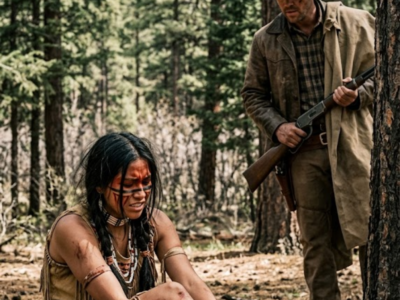
At the back of the crowd stood a tall man in a dusty brown hat. He didn’t look at her like he wanted to own her. He looked at her like he hated this place and all the men in it.
Three-fifty, the tobacco-man countered, stepping forward with a grin.
The tall man’s jaw tightened.
Four hundred.
The square went silent.
“Sold!” the auctioneer shouted. “Sold to Mr. Calhoun!”
Norah almost collapsed, but she caught herself. Then she walked down off the platform and through the crowd that stared like brands.
Daniel Calhoun waited by a wagon.
“Can you cook?” he asked.
“Yes, sir.”
“Clean. Mend clothes.”
“Yes, sir.”
He nodded once. “Get in. We’re losing daylight.”
Norah climbed onto the bench beside him and watched Cold Water Ridge shrink behind them.
She expected the worst.
She expected bruises. Demands. Ownership.
Instead, she got silence.
The first hour passed with only the creak of leather and the rattle of the wagon. The landscape shifted from dusty flats to rolling hills dotted with mesquite. The air smelled like dry grass and distant rain that would never come.
Daniel broke the silence once.
“I have two children,” he said.
Norah swallowed. “Yes, sir.”
“Twins. Six.”
Their mother died of fever, he added, voice flat.
“I’ve had housekeepers,” he said. “None lasted.”
“Why?” Norah asked before she could stop herself.
“The children ran them off,” Daniel said. “They don’t take well to strangers.”
Norah understood then that Daniel hadn’t bought her for pleasure. He’d bought her because he needed someone stubborn enough not to leave.
“Didn’t ask you to promise anything,” Daniel said when she tried to warn him she wasn’t good with children. “You’ll do your best or you won’t. Either way you’ve got a roof and food. Better than what you had.”
It was blunt. It was true. It wasn’t kind, but it wasn’t cruel either. Norah didn’t know what to do with a man who wasn’t either angel or monster.
The ranch appeared at dusk—big, worn, well-kept in the way places are kept when someone refuses to let them fall apart even if they’re tired. House, barn, corrals, bunkhouse. Chickens. A dog that barked until Daniel told it to hush.
“Lizzy. Sam,” Daniel called.
Two children came out like wind. Thin, freckled, eyes sharp. They stared at Norah like she was a test.
“This is Miss Finch,” Daniel said. “She’ll be staying. Respect.”
Sam crossed his arms. “The last lady said we were demons.”
“The one before that cried,” Lizzy added. “Every night.”
Daniel’s jaw tightened. “Enough.”
Sam looked at Norah. “You gonna cry?”
Norah crouched. “Maybe,” she said honestly. “But I won’t cry because of you.”
The twins exchanged a glance.
“Stories?” Lizzy asked.
Norah surprised herself by remembering her father’s fox tales. “I know good ones.”
“Braid hair?” Yes.
“Shoot?” Norah hesitated. “I can learn.”
Sam nodded like that mattered.
Inside the house smelled of woodsmoke and old coffee and loneliness. Norah’s room was small but clean. Water and a towel waited. A mercy without words.
Work became her refuge.
The twins tested her. Salt in sugar. Chickens out. Shoes hidden. Lies told sweetly. Norah didn’t yell. She didn’t cry. She met every challenge with calm patience because she recognized fear wearing mischief as armor.
Daniel watched from a distance, wary, as if he feared caring.
One night the twins got sick with fever. Norah worked through the night sponging them down. Daniel came in with raw fear in his eyes and the ghost of his wife’s fever behind him. Norah put her hand on his arm and said, “They’re fighters.” It was the first time she said his name. He didn’t pull away.
By dawn, the fever broke.
Trust settled into the house like warmth.
Winter came. The twins laughed in snow. Norah watched from the kitchen window, something in her chest stirring that frightened her.
Daniel watched her watching.
“They’re happy,” he said. “Haven’t been like this since Mary.”
“They needed—”
“They needed you,” Daniel said.
Then he said what he’d been choking on for weeks: he was falling in love with her.
Norah told him she loved him too, because safe had never saved her, only truth had.
The twins caught them kissing and cheered.
Six weeks later, they married in the small church. Norah wore a cream dress Daniel bought her. The twins stood proud. Ranch hands came. Some neighbors came. Even the preacher looked moved.
Tom Garrett watched from outside like a vulture.
Norah didn’t look at him.
She said “I do” like a declaration.
Daniel kissed her like a vow.
“Now you’re really ours,” Lizzy whispered loudly.
That night, on the porch under stars, Norah finally said, “I’m home.”
Daniel kissed her temple. “So am I.”
But love did not erase the world outside the fence.
Judge Pritchard did not lose control without retaliation. Tom Garrett rode to the ranch and claimed Norah was still “under lien.” He threatened Daniel’s taxes.
Daniel refused. He took Norah to a real lawyer—Samuel Hargrove—who drafted papers and recorded land in Norah’s name.
Pritchard escalated anyway. Notes. Men in the dark. Rope shown in lantern light.
Then a widow arrived weeping: another girl to be auctioned.
“No,” Norah whispered. “No more.”
Daniel stood with her. They paid the debt and stopped the auction in daylight, forcing the sheriff to admit the court had no claim once money was paid.
That night a message was nailed to Daniel’s barn: STOP PLAYING HERO. NEXT TIME WE BURN IT ALL.
Sheriff Watson finally broke and confessed: Marshal Weaver was murdered for accusing Pritchard of fixing deeds. The proof was in ledgers hidden behind the judge’s bench.
They went after it.
Under moonlight, they crawled through a drainage grate and pulled leatherbound books from a false wall.
They rose behind Pritchard’s bench while his men drank and bragged.
Norah held the ledger up like a lantern.
Names. Dates. Theft written in the judge’s own hand.
Guns wavered when men recognized their own losses.
Sheriff Watson arrested Judge Pritchard in front of the county.
Tom Garrett tried to flee and was stopped.
The porch that sold women swallowed the man who profited from it.
Spring softened into summer.
The marriage auctions were declared illegal. Debts were reviewed, some erased, some exposed as fraud. Families got land back. Not all—damage doesn’t reverse cleanly—but enough to shift the balance.
Norah planted a garden that grew. Lizzy and Sam helped, dirt under their nails, laughter in their mouths.
Norah returned to the courthouse porch once and stood where she’d been sold. The chair was gone. The platform empty. Only wind.
“Not anymore,” Daniel said.
“Not anymore,” Norah agreed.
They stopped at her father’s grave. A stone now marked it. Norah pressed her palm to the cool rock.
“I didn’t forget you,” she whispered. “And I didn’t let them turn me into what they wanted.”
Daniel stood behind her, hat in hand.
Later, under stars, Daniel asked, “Still happy?”
Norah leaned into him and listened to the sounds of her family inside the house.
“Yes,” she said. “I’m home.”
And this time she believed it without fear, because she’d learned something stronger than survival:
how to fight,
how to love,
how to stand,
and how to make sure no other girl ever had to listen to an auctioneer measure her future in dollars again.
The trouble didn’t end just because Pritchard went to chains.
People in towns like Cold Water Ridge didn’t change overnight. They didn’t suddenly become kind because the law finally caught up. Some were relieved. Some were ashamed. Some were furious because the judge’s fall threatened the way they’d survived. A few men had benefited from Pritchard’s “fees” and “favors.” Those men didn’t cry for justice. They looked for someone to blame.
They looked at Norah.
The first time Norah rode into town after the arrest, she felt it before she saw it—the way conversation stalled as if someone had cut the string of a fiddle. Men leaned on porch posts and watched her pass with eyes that had once looked at her from beneath a bidding platform. Women looked away, then looked again, unsure whether Norah was still “that girl” or something else now.
Daniel rode beside her, quiet, steady, rifle across his saddle, not displayed like a threat but carried like the truth: they were not helpless anymore.
Lizzy and Sam bounced in the wagon behind them, excited to see town again now that the fear had eased. They didn’t understand politics, but they understood when grown-ups stopped whispering. They understood when the ranch stopped locking doors at night. They understood, in the way children do, that the monster under the bed had been dragged into the light.
At Morrison’s store, Chester Morrison stood behind the counter with his hands folded, face red and tight. He had always liked power. Without Pritchard, his power felt smaller.
“Mrs. Calhoun,” he said stiffly.
Norah didn’t answer with her head bowed the way she used to. She met his gaze and said, “Morrison.”
The name without honorific landed like a slap. Morrison’s mouth tightened. “You need something?”
“Flour,” Norah said. “Salt. Coffee. And feed.”
Morrison’s eyes flicked to Daniel, then back. “Cash up front,” he muttered out of habit.
Norah reached into her purse and set coins on the counter. Not timid. Not ashamed. Just coins, paid like any other customer.
Morrison counted them too quickly, afraid of being seen doing what he’d once enjoyed doing slowly. He shoved the goods across the counter.
As Norah turned, she caught a woman standing near the window, a widow she recognized from Hargrove’s affidavit meetings. The woman’s name was Elsie Boone, and her hands shook when she held her shopping basket. Her eyes flicked to Norah with a cautious hope.
Norah stepped toward her.
“Mrs. Boone,” Norah said gently.
Elsie’s lips trembled. “Miss Finch—”
“Norah,” Norah corrected softly, and offered her arm. “Walk out with me.”
Elsie hesitated, glancing around as if expecting someone to punish her for standing too close to trouble. Then she slipped her hand through Norah’s arm.
Outside, the sunlight felt sharp.
Elsie swallowed hard. “They say the judge is going to trial,” she whispered.
“He is,” Norah said.
“And they say,” Elsie added, voice lowering, “that if he falls all the way, some of the debts will be… undone.”
Daniel stood a few steps away letting the women speak, watching the street like a man who’d learned the cost of looking away.
Hargrove’s words echoed in Norah’s mind: Paper doesn’t heal people. People heal people. Paper just gives you room to do it.
Norah squeezed Elsie’s hand. “We’ll make sure it’s undone,” she said.
Elsie’s eyes filled. “I lost my husband’s land,” she whispered. “My boy’s only eight. I don’t— I don’t know how to keep him from being hungry.”
Norah’s chest tightened, not with pity, but with recognition. She had been that fear. She had been that hunger.
“Come to the ranch,” Norah said. “We can’t give everyone everything. But we can give you work, and you can give yourself a future.”
Elsie blinked. “Work?”
Norah nodded. “A garden needs hands. Chickens need tending. And a boy needs somewhere he can be a boy without the world selling him.”
Elsie’s breath shuddered out. She looked toward Daniel as if needing his permission.
Daniel stepped closer. “It’s Norah’s call,” he said. “She runs this house as much as I do.”
The statement was simple, but in a town like this, it was rebellion.
Elsie’s shoulders sagged with relief. “Thank you,” she whispered.
Norah shook her head. “Don’t thank me yet,” she said. “Thank me when your boy laughs again.”
That was how it began—not with speeches, not with grand plans, but with one woman walking another woman out of a store so she didn’t have to do it alone.
By late summer, the Calhoun ranch had new rhythms.
Elsie and her son arrived with a wagon of cracked dishes and a blanket bundle. Norah set them up in the small cabin near the barn that Daniel used to store tack. Sam and Lizzy immediately claimed the boy—Caleb—like he was a stray dog they’d decided was theirs. They taught him how to climb fences without ripping trousers and how to steal cookies without getting caught.
Norah watched it with something that felt dangerously like hope.
At night she and Daniel sat on the porch and listened to children’s laughter float out through open windows. It sounded like a thing you didn’t have to pay for. It sounded like freedom.
But there were still men in town who missed the old order. Men who liked knowing where power lived. Men who didn’t want a widow and a formerly auctioned girl teaching others how to stand.
One of those men was Tom Garrett.
Garrett didn’t vanish with Pritchard. He fled at first, hiding with cousins in the hills, then returned when he thought the dust had settled. He still had friends. He still had men who owed him favors. And he had a hatred for Norah that burned hotter than fear.
The first sign came as a fire.
It was late August when the grass turned brittle again, when a single spark could turn into a blaze. Daniel and the ranch hands were out repairing a fence line when smoke rose from the lower pasture.
Norah saw it first from the kitchen window—thin gray ribbon against blue sky. Her stomach dropped.
She ran outside, dress whipping around her legs, and saw flames licking at dry grass near the creek bed. Wind pushed the fire toward the chicken coop.
“Daniel!” she screamed, and her voice tore out of her like a weapon.
The hands came running. Daniel arrived on horseback, face hard.
They fought the fire with shovels and wet burlap sacks, beating flames down, choking them with dirt. Norah’s arms burned, smoke stung her eyes, and fear tightened around her throat because she knew what it meant.
This wasn’t lightning.
This wasn’t accident.
When they finally put it out, Daniel walked the perimeter with narrowed eyes. He found the proof at the edge of the blackened patch: an oil-soaked rag wrapped around a splinter of wood.
Arson.
A message.
Daniel held the rag up and looked at Norah.
Norah didn’t speak. She didn’t have to.
That night, Daniel doubled the night watch. He moved the children into the main house, beds lined up in the big room like a fort. Norah sat with Lizzy until she fell asleep, hand tangled in Norah’s sleeve.
“Mama Norah?” Lizzy whispered in the dark.
Norah’s throat tightened at the name. It was new. It was heavy. It was everything.
“Yes, sweetheart.”
“Are bad men coming back?” Lizzy asked.
Norah swallowed. “Maybe,” she admitted. “But bad men don’t get to decide what happens to us anymore.”
Lizzy’s voice was small. “Promise?”
Norah pressed her lips to Lizzy’s hair. “I promise.”
Outside, Daniel sat on the porch with his rifle across his knees, staring into the dark like he could see enemies in the wind.
Norah stepped out with a blanket and draped it over his shoulders. He didn’t flinch. He reached up and caught her hand, holding it.
“They’re testing,” Daniel said quietly.
Norah’s voice was calm. “So are we.”
Daniel turned his head slightly. “If Garrett comes,” he said, “I don’t want you between.”
Norah’s mouth tightened. “I won’t be behind you either,” she said.
Daniel exhaled a humorless laugh. “Stubborn,” he murmured, and there was love in it.
Norah sat beside him, shoulder to shoulder, watching the night. She realized then that being brave wasn’t loud. It was sitting still when fear wanted to make you run.
Two nights later, the test came.
Hooves. Distant at first. Then closer. A low murmur of men’s voices. The dog’s growl.
Daniel rose silently, rifle ready. Norah moved too, grabbing the lantern, lifting it high enough to throw light across the yard.
Three riders appeared near the fence line. Shadows with hats pulled low. One of them raised a hand as if waving.
Tom Garrett’s voice carried across the yard like smoke.
“Evening, Calhoun,” he called. “Evening, Finch.”
Norah’s skin went cold at the way he said her old name, as if he could peel her out of marriage and throw her back onto a platform.
Daniel’s voice was a blade. “You’re trespassing.”
Garrett laughed. “Just visiting. Heard you’re running a sanctuary now. Widows and children. Ain’t that sweet.”
Norah stepped onto the porch, lantern held steady. She didn’t hide behind Daniel. She stood beside him.
Garrett’s gaze fixed on her. Even in the dark, she could feel it like a hand.
“You look comfortable,” Garrett said. “Almost like you forgot what you are.”
Norah’s mouth tightened. “I know exactly what I am,” she said. “A free woman.”
Garrett’s laughter snapped sharper. “Free? In a county where men decide what’s free? You really think Pritchard going to chains changes the world?”
Daniel shifted, rifle lifting. “Leave.”
Garrett’s horse took a step forward. “We could,” he said slowly. “Or we could collect. There’s a price on troublemakers now. Some men miss the old ways.”
Behind Garrett, a second rider lifted something that caught the lantern light—a coil of rope.
Norah felt the children behind her on the porch, their small breaths, their fear. She heard Lizzy’s whisper: “Mama Norah…”
Norah didn’t move. She lifted her chin.
“You come onto this land,” she said clearly, “and you’ll have to ride home carrying your dead.”
Silence hit.
Garrett’s grin faltered for the first time.
Daniel’s rifle was steady. “Last warning,” he said.
Garrett spat into the dirt. “All right,” he drawled. “Keep your little fort. We’ll come back when your luck runs out.”
He tipped his hat mockingly and turned his horse away.
Norah watched them disappear into the dark, lantern still held high.
Only when the hoofbeats faded did she lower her arm. Her muscles trembled from holding steady too long.
Daniel looked at her, eyes dark. “You weren’t bluffing,” he murmured.
Norah exhaled slowly. “No,” she said. “I was promising.”
After that night, the ranch became more than home.
It became a line.
Daniel and Norah rode to the next county to speak with a territorial marshal—a real lawman not owned by local judges. Hargrove went with them, carrying copies of the ledgers and affidavits. The marshal listened with a hard face and said, “If what you’re saying is true, we can make it stick.”
Norah understood then: justice wasn’t a single moment in a courthouse. It was a chain of decisions, each one risking something.
They returned to Cold Water Ridge with a deputy marshal behind them.
That changed the air.
Men in town stopped laughing as loudly. Women stared with something like hope. Garrett’s allies grew quieter.
Still, Garrett didn’t stop. He just grew careful.
The next strike came not with fire or rope, but with whispers.
A rumor spread through town that Norah had seduced Daniel, bewitched him, stolen his ranch with “woman tricks.” A rumor that she had been with men before the auction, that she was “used,” that Daniel had married filth.
Norah heard it in the mercantile one afternoon when she walked in to buy cloth. Two women stopped talking when she entered. One of them murmured, “Shame.”
Norah’s cheeks burned. Old shame tried to rise like a sickness.
Then she remembered the porch. The ledgers. The way Pritchard’s power collapsed when truth entered the light.
She walked straight to the women and set her coins on the counter.
“Say it loud,” Norah said calmly. “Or don’t say it at all.”
The women blinked, startled by her directness. One looked away. The other flushed.
Norah didn’t wait. She collected her cloth and left.
That night she sat on the porch and told Daniel what she’d heard. Daniel’s jaw clenched.
“I’ll ride into town and—”
Norah stopped him with a hand. “No,” she said quietly. “We don’t win by becoming them.”
Daniel stared. “Then how do we win?”
Norah’s eyes hardened. “We keep living,” she said. “We keep standing. We keep helping people. We make the rumor look stupid by being undeniable.”
Daniel studied her, then nodded slowly. “All right,” he said. “Undeniable.”
In October, the territorial marshal came back to Cold Water Ridge with warrants.
Judge Pritchard was formally charged. His assets seized. His clerk arrested. Tom Garrett named as accessory in intimidation and arson, wanted for questioning.
Garrett fled again.
This time he didn’t come back.
The county, once stitched together by fear, began to breathe.
It didn’t become perfect. Nothing did. But it became possible.
Norah opened the ranch kitchen twice a week to women who needed work and bread. She taught them how to make biscuits and how to read simple accounts. She taught them what Hargrove had taught her: paper could be a weapon if you knew how to hold it.
Lizzy and Sam grew taller. Caleb grew louder. The children learned they could trust adults to stay.
One winter morning, Norah woke to the smell of coffee and bread and the sound of Daniel laughing with Sam in the kitchen.
She paused in the doorway, heart full and startled.
Daniel caught her gaze and held it.
“You all right?” he asked.
Norah’s throat tightened. “I am,” she said.
Daniel’s eyes softened. “Still happy?” he asked, the question now a ritual between them.
Norah walked into the warmth and leaned into him. “Yes,” she whispered. “I’m home.”
Years later, when travelers passed through Cold Water Ridge, they stopped on the courthouse porch and saw something different.
No auction platform.
No iron chains.
No judge’s chair.
Instead, a notice board with posted laws, posted rights, posted schedules for hearings—real hearings, with a visiting circuit judge who didn’t drink whiskey with ranchers at night.
And sometimes, on summer afternoons, a woman with dark hair and a steady gaze would bring children into town to buy flour. People would nod at her respectfully, not because she was married to Daniel Calhoun, but because she had helped drag the truth into daylight.
Norah Finch had once been measured in dollars like a plow.
Now she measured her life in different things: the sound of children laughing through open windows, the weight of a ledger in her hands, the steady warmth of Daniel’s palm in hers, the garden rows pushing green shoots through hard earth.
The frontier still held storms.
But Norah had learned that storms could be survived.
And that sometimes, the hardest thing you do isn’t riding away from cruelty.
It’s turning back and breaking it so no one else has to stand on that platform again.
For a long time afterward, Norah would remember the sound of the rope coil in lantern light.
Not because she wanted to keep fear alive, but because she wanted to remember what she had survived. People in towns like Cold Water Ridge loved to pretend that danger arrived with gunfire and shouting. They liked clean stories. Heroes. Villains. A single shot that fixed everything.
But most danger came quieter.
It came with a grin. A joke on a courthouse porch. A “visit” at night. A hand on a belt where a man pretended it belonged only to his pants and not to the pistol waiting there.
And the hardest thing Norah ever learned was this: courage was not the absence of trembling. Courage was stepping forward with trembling hands anyway.
The morning after Garrett’s riders came to the fence line, Norah woke before dawn and found Daniel already dressed, boots on, coffee untouched on the table.
He looked like he hadn’t slept at all.
Norah stood in the doorway and watched him for a moment, chest tight. A part of her—still the girl who had learned to measure men by how quickly they turned—waited for him to blame her. To say, “This is what you brought.”
Instead Daniel reached into the pocket of his coat and pulled out a folded paper.
He set it on the table between them like a confession.
Norah stared at it. “What is that?”
Daniel’s voice was rough. “Bill of sale,” he said.
The words made Norah’s stomach flip. Even after marriage, even after papers in her name, that bill existed somewhere in the world like a ghost.
Daniel unfolded it. The ink was blunt and ugly: Norah Finch, sold for four hundred dollars. Signed by the auctioneer. Stamped by the court.
Norah’s fingers curled.
Daniel looked at her across the table. “I kept it because I didn’t want to pretend it didn’t happen,” he said. “I wanted to remember what I was part of, even if I hated it.”
Norah’s throat burned. “And?”
Daniel’s hand moved. He tore the paper slowly, deliberately, down the center. The sound of ripping parchment was loud in the quiet kitchen.
He tore it again. And again. Until the bill was nothing but scraps.
Then he carried the pieces to the stove, opened the iron door, and fed them to the embers like he was feeding a beast he’d finally decided to starve.
Norah watched the paper curl and blacken, watched the ink disappear into fire.
Daniel closed the stove door and turned back to her.
“I can’t undo what they did,” he said quietly. “I can’t undo what the town did. I can’t even undo what I did, bidding on you in that square. But I can promise you this: no paper will ever own you again.”
Norah swallowed hard. “I already told you I chose you,” she whispered.
Daniel stepped closer, careful, giving her space to step back if she wanted. “I know,” he said. “And I will spend my whole life proving I understand the difference between choosing and taking.”
Norah’s eyes stung. She reached out and rested her palm against his chest, feeling the steady beat beneath.
“You’re not like them,” she whispered.
Daniel’s jaw tightened. “I’m a man,” he said, almost angry. “And men can become like them if they stop watching themselves.”
Norah held his gaze. “Then don’t stop,” she said.
That day, Norah did something she hadn’t planned.
She took the twins down to the pasture after breakfast, away from the house, away from Daniel’s tense shoulders and the echo of riders in the dark. She sat with them in the grass while the sun warmed their backs.
Lizzy leaned against her. Sam picked at a clump of dirt like he was pretending not to listen.
“Mama Norah,” Lizzy asked, voice small, “were you really… bought?”
Norah’s throat tightened. Children heard everything in small towns. They heard whispers. They saw looks. They pieced together truths from scraps.
“Yes,” Norah said simply.
Sam’s head snapped up. “Pa bought you?”
Norah nodded. “Yes.”
Sam’s face twisted with confusion, anger, and something like fear. “Did he… make you?”
The word make hung heavy. It carried all the wrong meanings a child could imagine.
Norah took a breath and chose truth carefully, like placing stones across a river.
“No,” she said firmly. “He never did. He bought me because the world was ugly, and he wanted to pull me out of it. But he didn’t own me. Not in his heart.”
Lizzy’s voice trembled. “But the judge said—”
“The judge says lots of things,” Norah cut in gently. “The judge said women were property because it made him powerful. But it was always a lie.”
Sam’s fists clenched. “I hate him.”
“I do too,” Norah admitted softly. “But hate isn’t what fixes things. Truth does.”
Lizzy looked up at her, eyes wide. “Is that why you’re fighting?”
Norah nodded. “Yes,” she said. “So no one can sell girls again.”
Sam’s jaw set like a little man’s. “If they come back,” he said fiercely, “I’ll fight too.”
Norah smiled sadly. “I hope you won’t have to,” she said, smoothing his hair. “But I’m proud you’d want to.”
Later that week, when Norah and Daniel rode into town to meet Hargrove and Sheriff Watson, Norah carried that conversation with her like armor. She wasn’t just fighting for herself anymore. She was fighting for the children who were learning what the world was.
The night they went into the courthouse to retrieve the ledgers, Norah’s hands shook only once.
Not from fear—fear was already there, woven into her ribs. Her hands shook because she thought of the first time she’d stepped onto that porch in chains and the way the town had looked away.
Now she stepped toward that same porch with purpose.
The courthouse looked smaller at night, but more dangerous. Lanterns glowed inside. Voices rumbled like thunder contained behind walls. Norah could smell whiskey and sweat and smoke from the men gathered there—Pritchard’s last little congregation of power.
Sheriff Watson led them to the drainage grate under the porch. His face was gray, eyes haunted.
“I should’ve stopped him,” Watson whispered.
Hargrove’s voice was flat. “Then stop him now.”
Daniel pried the grate free. The metal groaned like it didn’t want to open. Norah went first, sliding into the dark crawl space, belly pressed to dirt, cobwebs snagging her hair. The space smelled of damp wood and old secrets.
She crawled toward the sliver of light between floorboards and heard Pritchard’s voice above her.
“Men like Calhoun,” Pritchard was saying, tone dripping amusement, “think virtue makes them strong. Virtue makes them predictable.”
Garrett laughed. “We should string the girl up first. Remind the town what happens when women get ideas.”
Norah’s stomach went cold, but she kept crawling. She felt Daniel’s boot brush her heel behind her, steady, present.
They reached the loose board. Daniel levered it up. Hargrove’s hands slipped into the hollow and pulled out the first ledger—leatherbound, heavy, warm from being hidden close to men’s bodies.
Norah held it for a moment, feeling the weight of ink and theft. It was strange how paper could feel like a weapon.
Mara had once told Cain that truth was dangerous. Norah understood it now. Truth was dangerous because it threatened men who built their lives on lies.
They slid the ledgers into the burlap sack. Then Norah nodded toward the trap door behind the bench.
“We go up,” she whispered.
Daniel’s eyes met hers in the dark. He nodded once. No hesitation.
When they rose behind Pritchard’s bench, the room froze so completely that for one heartbeat Norah heard only her own breath.
Pritchard turned, face blanching, rage following instantly.
“Shoot—”
Norah opened the ledger and stepped forward into lantern light.
The bruises on her skin were gone, but the memory of chains lived in her posture.
“You’ll want to hear this first,” she said, voice steady.
She read names out loud. Widows. Ranchers. Men who’d lost property they couldn’t afford to lose. She read amounts, dates, forged signatures. She read the line that mattered most: the night Marshal Weaver was paid in cash to “inspect” records, then vanished.
Sheriff Watson held up a second ledger and his voice cracked when he said, “It’s all here.”
When the guns turned, they turned because men recognized themselves on the page.
That was the power of evidence. It didn’t care about charisma.
After Pritchard was dragged away, the courthouse porch looked wrong—empty without his chair. The air felt cleaner. Not because the town was healed, but because one infection had been cut out.
A week later, Cold Water Ridge held its first town meeting without Pritchard.
The church was packed. Men stood in doorways. Women sat in the front rows like they’d been waiting years to be allowed there.
Hargrove stood at the pulpit with a stack of documents. Sheriff Watson stood beside him, badge catching the light.
Daniel and Norah sat with the twins and Caleb, the children swinging their legs under the bench, whispering to each other.
Hargrove spoke first, his voice sharp.
“The debts will be reviewed,” he said. “The auctions are illegal. Any attempt to sell people under the guise of debt settlement will be prosecuted.”
Murmurs rippled. A few men scowled. But more looked relieved, like a weight had been lifted.
Then Hargrove stepped aside and Norah found herself standing without meaning to.
She didn’t plan a speech. She didn’t rehearse.
She just looked out at the faces of a town that had once watched her being sold and felt her throat tighten.
“I’m not here to forgive you,” Norah said calmly.
The room went still.
“I’m not here to pretend this didn’t happen,” she continued. “I’m here because some of you are still hungry. Some of you are still afraid. And the only reason Pritchard owned us was because we stayed silent.”
Her voice didn’t shake now. It filled the church the way wind fills a canyon.
“If you want this town to change,” Norah said, “then you don’t get to look away anymore.”
A woman in the front row started crying quietly.
Norah’s eyes swept the room. “You see a widow struggling, you help her. You hear gossip about a woman, you ask for truth. You see a child with fear in his eyes, you remember that children shouldn’t have to learn hunger and shame before they learn joy.”
She paused. “I was sold because my father drank and died and debt ate my life. But debt didn’t sell me. People did.”
The words landed heavy.
Norah looked down at Lizzy and Sam, then back up.
“If you want to call yourselves decent,” she said quietly, “then be decent when it costs you something.”
Silence stretched. Then, from the back, Mrs. Harlan stood.
Her voice was rough with grief and grit. “She’s right,” she said. “We let him.”
One by one, others stood. Not all. But enough.
That night, as they rode home under stars, Daniel glanced at Norah and said, “You just changed this town more than any gun could.”
Norah exhaled slowly. “We did,” she corrected.
Daniel’s hand found hers on the saddle horn. “Yes,” he said. “We did.”
Later, on their porch, the children asleep inside, Norah leaned into Daniel and listened to the wind moving through grass.
“Still happy?” Daniel asked, voice soft.
Norah smiled, tired and full. “Yes,” she whispered. “I’m home.”
And for the first time in her life, the word didn’t feel like a wish.
It felt like a fact.
The end.