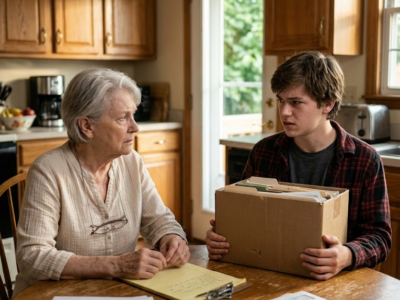
During Dinner, Mom Compared Me To My Sister-Again. “She’s The One We’re Proud Of.” I Quietly Helped With Dishes And Said Goodbye. The Next Day, I Got A Message: “Mom’s In Tears And Won’t Talk To Anyone. What Did You Do?”
Part 1
If you’d asked me at thirteen what my role in the Martinez family was, I would’ve told you without blinking: I was the background. The quiet one. The helper. The girl who held the wrapping paper trash bag at Christmas so the living room didn’t turn into a landfill, who washed the serving spoons while everyone else lingered at the table, who learned to smile in photos even when the praise was never meant for me.
My sister Sarah didn’t have to learn any of that.
Sarah was two years older, and she moved through life like the world was custom-built for her. She could make a grocery-store cashier laugh. She could walk into a room and it would rearrange itself, chairs turning toward her like sunflowers. She’d married David Mitchell, a lawyer with a jawline straight out of a billboard and a laugh that sounded expensive. They had two kids, Lily and Michael, and a house that always looked staged, even on a random Tuesday.
I was twenty-eight, single, and a graphic designer who’d clawed my way up from freelance scraps to something I’d dreamed about since college. I’d just been hired by Morrison Digital Solutions, a marketing firm known for the kind of work people wrote case studies about. My role wasn’t just design. It was digital forensics in marketing: tracking fraud, exposing shady campaigns, protecting brands from getting ripped apart by bad actors. It was investigation and pattern recognition and careful documentation. It was the kind of job that made my brain light up and my hands shake a little when I told my best friend.
I walked into my parents’ house on Sunday, October 15th, with that news wrapped up inside me like a gift I’d been waiting years to hand over.
Mom’s dining room smelled like roasted chicken and thyme, like butter and warm bread. The windows were cracked open because fall in New Jersey was doing that crisp, golden thing, and the air carried a hint of leaf smoke from someone’s fire pit down the street.
Everyone was already there. Dad sat at the head of the table, shoulders a little slumped the way they got after a long week. Aunt Lynn—my mother’s sister, technically also Linda, but everyone called her Lynn—was bouncing baby Michael on her hip. Uncle Bob had his phone out, showing someone a video of Lily singing in a preschool recital.
Sarah sat like she belonged in the center of the picture, hair glossy, cheeks flushed from the cold, David’s hand resting on the back of her chair like a claim.
“Oh, Em is here,” Aunt Lynn said when I stepped in, her eyes flicking up and then away again like she’d glanced at a wall clock. “Sarah, tell Emma about the PTA thing!”
Sarah smiled, modest but pleased. “They voted me as fundraising coordinator,” she said, like she’d accidentally won something. “I didn’t even ask. The other parents just… you know. They said I’m organized.”
Mom—Linda Martinez, queen of church committees and neighborhood book club—beamed so hard it looked like it might hurt. “She’s going to make such a difference,” Mom said. “When you have someone like Sarah, you know things will be done right.”
Dad nodded. “That’s my girl.”
There it was. That familiar warmth poured over Sarah like sunlight. It always happened so naturally. Like breathing.
I slid into my usual seat near the end of the table and waited for the moment to speak, the way you wait for a gap in traffic that never comes. Conversation kept looping back to Sarah: her house hunting in Westfield, the school district, David’s promotion chatter, Lily’s reading level.
Finally, there was a pause when Mom stood to refill iced tea, and I took it.
“Actually,” I said, keeping my voice light, excited. “I have news too. I got a job offer from Morrison Digital Solutions. They want me to lead a fraud investigation team. It’s a big step—”
“That’s nice, honey,” Mom said, not unkind, just absent. She set the pitcher down and turned back toward Sarah like a magnet snapping into place. “Sarah, did you tell everyone about the Westfield open house next weekend? Can you imagine? Westfield.”
My smile froze and then softened into something practiced. I tried again anyway. “They found me because of that anti-fraud campaign I did for Henderson. The one that got featured in Marketing Week. I’ll have a company car and—”
David laughed a little. “Wow. Fancy.”
But the laugh didn’t land as admiration. It felt like a pat on the head.
Dad cleared his throat. “Remember when Sarah graduated top of her class? That was a proud day.”
And just like that, I was watching my own news shrink. Not because it was small, but because nobody was willing to hold it up to the light.
Dinner went on. Chicken passed, potatoes scooped, baby bottles warmed. Sarah’s life stayed at the center. My job offer sat in my lap, unopened.
It wasn’t until dessert that Mom said the thing that cracked something in me.
She’d made a chocolate cake with raspberry filling—Sarah’s favorite—and she served generous slices around the table. When she got to me, she placed a smaller piece down like she was rationing supplies.
“Emma’s watching her figure,” Mom said with a smile that was a little too sharp. “Unlike Sarah, who can eat anything and still look perfect.”
Sarah’s cheeks pinked. “Mom…”

Mom waved her off. “It’s true. Look at you two. Sarah’s got the husband, the kids, the beautiful house. She has her life figured out.”
Then her gaze shifted to me. It wasn’t rage. It wasn’t cruelty in the movie-villain way. It was something worse: disappointment as a default setting.
“And Emma,” Mom said, voice almost sweet, “well… Emma’s still trying to figure out what she wants to be when she grows up.”
The table went quiet. The kind of quiet that feels like a spotlight.
Heat rushed up my neck. I could hear my own pulse over the clink of forks.
“I do know,” I said, my voice shaking just a little. “I’m going to be leading fraud investigations at one of the most respected firms in the city. This job is real. It matters.”
Mom’s smile stayed in place, but her eyes didn’t soften. “Oh, Emma. These little jobs come and go. What you need is stability. A husband. Children. A real life like Sarah has.”
Something inside me went still.
“My career is real,” I said, louder than I meant to.
Mom set her fork down. “Sarah’s the one we’re proud of.”
It wasn’t shouted. It was stated, like a fact everyone should accept.
Sarah looked like she’d been slapped. Dad stared at his plate. Aunt Lynn suddenly found her coffee fascinating.
I sat there for a moment, feeling that sentence settle in my bones like cold water.
Then, strangely, I didn’t cry.
I stood up.
“You’re absolutely right,” I said, my voice calm in a way that surprised even me. “Sarah is the one you should be proud of.”
I walked into the kitchen and started clearing plates. My hands moved with deliberate, careful precision. The way I always did when I wasn’t allowed to take up emotional space.
Sarah followed me, hovering in the doorway. “Emma… I’m sorry. You know Mom doesn’t—”
“It’s fine,” I said, rinsing a plate. My tone was quiet, almost gentle. “She means it. And honestly? It’s okay. I get it.”
Sarah’s eyes were wet. “Your job sounds incredible.”
I looked at her, really looked. She did seem genuinely upset. But something in me had shifted past comfort.
“It doesn’t matter,” I said. “Mom said what she said.”
I finished the dishes. I hugged everyone goodbye with polite arms and a polite smile. I told Lily she looked adorable. I kissed baby Michael’s head. I thanked Mom for dinner.
Then I left.
On the drive home, the fall leaves blurred like orange sparks against the night. I kept both hands on the steering wheel, jaw clenched, and I could feel something building behind my ribs—not a tantrum, not a breakdown, but a decision.
If my family wanted to be proud of appearances, I was about to show them what they were actually applauding.
Part 2
My apartment was quiet in the way that always comforted me. No family noise. No forced laughter. Just the hum of my refrigerator and the city’s distant traffic like a steady heartbeat.
I kicked off my shoes, set my purse down, and stood in my living room for a full minute without moving. The kind of stillness you get right before a storm.
I wasn’t a hacker. I wasn’t interested in breaking into anything. My work lived in the legal lanes: open-source intelligence, public records, brand protection research, pattern analysis, documentation that could hold up under scrutiny. Companies paid Morrison to be careful and thorough and boringly compliant.
But I also knew something my family didn’t: “private” is often just “not looked at closely.”
David had always bothered me. He was charming in a way that felt practiced, like he’d rehearsed empathy in front of a mirror. Over the years, I’d caught tiny flashes of something colder: the way his attention slid away from Sarah when he thought nobody was watching, the way he checked his phone at the table, the way expensive gifts appeared after he’d been “busy” for weeks.
So I started where I always started: with what someone chose to show the world.
David’s social media was clean at first glance. Family photos. Vacation sunsets. A suited grin at a law firm event. The kind of profile that screams, Nothing to see here.
But what people forget is that their interactions tell stories too. Who they follow. What they like. When they’re active. Patterns are louder than posts if you know how to listen.
David followed a lot of young women. Not friends. Not colleagues. Not clients. Influencers, fitness models, “lifestyle” accounts. It wasn’t one or two stray follows; it was a curated feed of twenty-somethings posing by pools and mirrors.
And he wasn’t just lurking. He was engaging. Likes in clusters. Comments that crossed the line from friendly to personal. A few “🔥” emojis dropped like breadcrumbs at two in the morning.
One name kept appearing: Madison Rodriguez.
She was twenty-three, with a bright smile and a feed full of gym selfies, smoothie recipes, and motivational quotes layered over sunsets. Fifty thousand followers, give or take. Enough to get free leggings. Not enough to buy luxury real estate.
Her posts included her apartment a lot. Tall windows. A view of downtown. Marble countertops. The kind of place that doesn’t come from discount codes.
And I recognized it instantly.
Meridian Towers. A new luxury building downtown, the one Morrison had competed to market last year. I’d actually done preliminary design work for a pitch deck when I was freelancing, so I’d seen the staging photos. Madison’s “home workout corner” had the same skyline angle as Meridian’s penthouse models.
That didn’t prove anything. But it pulled a thread.
Public records are a gift. Counties don’t hide property ownership; they just make you work a little to find it. I located the unit with a cross-reference of building permits and recent deed filings and, after a couple of hours of careful matching, I found what I needed: Madison Rodriguez listed as the owner of a unit in Meridian.
Purchase price: high.
Down payment: very high.
Buyer’s funding source: an LLC I’d never heard of.
That was where the story stopped being gossip and started being a problem.
I built a timeline, the way I would for any case. Date of purchase. Date of LLC formation. David’s public-facing announcements about “expanding real estate services.” The overlap wasn’t perfect, but it was close enough to make my skin prickle.
It still wasn’t proof. But it was enough to dig deeper, carefully, legally, and with the kind of documentation that doesn’t fall apart the moment someone lawyers up.
I didn’t need to “break in” anywhere. Most financial misconduct leaves traces in plain sight: lawsuits, filings, liens, business registrations, unusual patterns in public disclosures. David worked with developers. Developers were often messy. Messy didn’t always mean illegal, but it meant you paid attention.
And the more I paid attention, the more I found: shell-company names that showed up in multiple contexts, property transactions that felt like puzzles missing pieces, public court references to David’s firm representing clients in disputes involving “asset transfers” and “financial restructuring.”
He had a client base that lived in gray zones.
Then I found something that made my stomach turn: a civil complaint filed months earlier by a small contractor accusing one of David’s developer clients of nonpayment. Buried in the complaint was a mention of “consulting payments routed through intermediary entities.” That phrase, sitting quietly in a PDF, was the kind of phrase investigators circle in red ink.
It didn’t name David. It didn’t have to. It told me the ecosystem he moved in.
I sat back and rubbed my eyes. It was past midnight. My apartment smelled like cold coffee now. My hands were steady, but my chest felt tight.
Because the thing about digging is that you don’t get to choose what you unearth.
And if David was doing what I suspected, Sarah was either a victim… or complicit… or willfully blind. None of those options felt good.
Still, I kept going. Not because I wanted to destroy her, but because my entire life had been shaped by the lie that Sarah’s world was spotless. The lie Mom worshipped. The lie that made me “less.”
I opened a new folder on my laptop and labeled it simply: Family.
Then I created subfolders: David. Sarah. Mom.
My cursor hovered over Mom’s name for a second.
And then I clicked.
Part 3
If David was the unease under the surface, Sarah was the glitter on top.
Sarah had started her “photography business” two years earlier. She’d announced it with a flurry of posts: a logo, a website, photos of her holding a camera like it was an extension of her identity. Mom had bragged about it at church like Sarah had invented art.
I’d always assumed it was real. Sarah had been good at pictures when we were kids. She had an eye. And wedding photography, if you’re actually doing it, is hard work.
But when I treated her business like a case instead of a sibling’s hobby, the pieces didn’t line up.
Her website was polished, yes. But polished in a way that felt… generic. The testimonials were glowing but vague. The venues in her “portfolio” were recognizable, but the photos themselves had a stock-photo sheen.
I ran a reverse-image search on a handful of her showcase shots. Not all. Just enough.
Several came back as licensed images from stock libraries.
My stomach sank.
Sometimes businesses use stock photos for filler. Sometimes they don’t have enough real content yet. But Sarah’s site was built like she’d been operating for years.
So I looked for the thing real businesses can’t fake easily: community reputation.
In local wedding groups, I found posts that made my throat go dry.
Brides asking, Has anyone heard from Sarah Mitchell Photography? She stopped responding. Couples saying she took the deposit and then claimed “equipment failure” the week of the wedding. People posting blurry screenshots of emails begging for their photos.
Not dozens. Not enough to go viral. But enough to make a pattern.
A scam doesn’t have to be huge to be real. Sometimes it lives on the edge of embarrassment, where victims don’t pursue it because they don’t want the extra stress.
Then there was the PTA.
Sarah being “fundraising coordinator” sounded wholesome. Bake sales and silent auctions and cheerful flyers. But PTA finances are public enough that you can spot irregularities if you look: budget summaries, meeting minutes, fundraising totals posted in parent newsletters.
I found a few PDFs and scanned images floating around the preschool parent portal and community posts. Sarah’s name showed up next to expense reimbursements. Small ones. Consistent ones. Decorations. Supplies. “Administrative costs.”
None of it was a smoking gun.
But the numbers were strangely padded. A receipt for $150, reimbursed for $500. A catering bill that didn’t match the vendor’s listed pricing. Little differences that could be mistakes… if they weren’t always leaning in the same direction.
I stared at my screen until my eyes blurred and finally leaned back, exhaling. I wanted to stop. I wanted to believe I’d found coincidences and nothing more. Because the alternative was ugly.
And then I turned to Mom.
Mom’s world was, on the surface, the cleanest of all: church volunteer work, tidy flowerbeds, handwritten thank-you notes. She lectured me about budgeting and responsibility like it was her religion.
So I looked for what a person like that wouldn’t want seen: money stress.
I didn’t need private access to anything. I didn’t need to break a rule. I just needed the trail she’d left in public places and family conversations.
The first clue was a memory: Dad mentioning, more than once over the past couple of years, that certain items were “misplaced.” A pocket watch. A pearl necklace. An old vase from Grandma’s estate. I remembered Mom’s voice in those moments: Oh, it must’ve gotten packed away. Oh, maybe it broke.
I searched resale listings the way I would search a suspect’s aliases: broad at first, then narrow. Old listings, local groups, auction archives, “sold” pages. It took hours and a lot of dead ends. But then I found a listing photo that punched the air out of me.
A pocket watch, open-faced, with a tiny engraving on the inside of the lid.
My grandfather’s pocket watch.
The seller’s username wasn’t “Linda,” but the background was familiar: Mom’s kitchen counter. The same speckled granite. The same little chip by the edge near the sink.
I stared at it until my vision sharpened with anger.
If that was real, it wasn’t “misplaced.” It was sold.
I found two more listings over time that matched items from our house. Nothing that could be chalked up to coincidence. I didn’t have full proof of where the money went, but I had enough to know: something had been happening under Dad’s nose.
And that meant the moral universe Mom preached at me was a performance.
It was three in the morning when I sat in my chair, laptop open, notes scattered, my throat dry.
I could do nothing. I could swallow the humiliation of that dinner and go back to being the quiet daughter who helps with dishes.
Or I could act like the professional I’d fought to become.
In my line of work, you don’t drop bombs for entertainment. You document. You verify. You report the right things to the right people. You let systems handle what they’re built to handle.
But family makes everything messier. Family makes you hesitate.
I thought about Sarah’s kids. I thought about Dad, trusting and tired. I thought about Mom saying, Sarah’s the one we’re proud of, and the way it had landed like a verdict on my life.
I opened a document and began writing, not in rage, but in structured paragraphs:
What I observed.
What I could support.
What I suspected.
What I could not prove.
By sunrise, I had a plan.
Part 4
Monday morning, the city looked washed clean by a thin rain. I wore my new blazer to Morrison Digital Solutions like armor. The lobby was glass and steel and quiet confidence. People walked with purpose. Nobody asked me when I planned to “grow up.”
At my desk, I did my onboarding. I smiled at my new teammates. I pretended my family wasn’t cracking apart behind my ribs.
Then, during lunch, I stepped outside and made calls.
Not dramatic ones. Not screaming ones. The kind of calls that start processes.
For David, I compiled what I had into a tip package: timelines, public records, references, and specific concerns about potential financial misconduct tied to clients and intermediary entities. I submitted it through the appropriate channels for financial fraud reporting. If there was nothing there, it would die quietly. If there was something, it would surface with time.
For Sarah’s photography deposits and client complaints, I reached out to a couple of the couples whose posts I’d found and asked, gently and privately, if they were willing to file reports together. Three said yes almost immediately. One cried in her message, relieved she wasn’t alone.
For the PTA discrepancies, I sent a careful report to the school district’s ethics and audit office with the publicly available documents attached, highlighting the inconsistencies without making claims I couldn’t support.
Then I called Dad.
My hands shook a little when he answered. Not because I didn’t know what I was doing, but because I knew exactly what it would do to him.
“Hey, Em,” he said. “Everything okay?”
“No,” I said quietly. “And I need you to listen. Are you somewhere you can sit down?”
There was a pause, then the sound of a chair scraping. “Okay.”
I told him what I’d found about the listings. I told him about the pocket watch photo. I told him I suspected Mom had been selling things and that it might connect to a bigger issue like debt or gambling, but I didn’t pretend I knew everything. I offered to sit with him, to help him go through statements, to look for patterns the way I did for work.
Dad didn’t say anything for a long moment.
Then he exhaled, slow and heavy. “How long have you known?”
“Since last night,” I said. “I didn’t want to believe it.”
Another pause. His voice went rough. “Thank you for telling me.”
It wasn’t gratitude like a gift. It was gratitude like someone handing you a flashlight in a dark basement.
After we hung up, I sat in my car in the Morrison parking garage and let my forehead rest against the steering wheel. I didn’t feel triumphant. I felt sad. I felt furious. I felt… done.
The next couple of weeks were quiet in the way that warns you something is moving underground.
Mom didn’t call. Sarah didn’t text. Dad sent one message: Working on it. Love you.
I went to work. I learned systems. I met my boss, who treated my expertise like it mattered. I built my first case file on a real client issue and felt the clean satisfaction of solving something that made sense.
Then, three weeks after that dinner, my phone buzzed with a message from Sarah.
Mom’s in tears and won’t talk to anyone. What did you do?
I stared at the words until they blurred.
I could’ve lied. I could’ve smoothed it over like I always did. I could’ve said, I don’t know, maybe she’s just stressed.
Instead, I typed:
I didn’t do anything to Mom. I told Dad the truth. That’s all.
Sarah called immediately.
“Emma,” she said, voice sharp with panic. “What truth? Dad’s sleeping in the guest room. Mom won’t leave her room. Nobody will tell me what’s going on.”
“Maybe you should ask them,” I said, calm enough to surprise myself.
“I tried!”
“Then maybe ask yourself why they’re hiding it from you,” I said.
Silence.
Sarah’s voice softened, wary. “You sound… different.”
“I am,” I said. “I’m tired.”
“Tired of what?”
I almost laughed. Not because it was funny, but because it was absurd that she didn’t know.
“Tired of being the person who keeps everything comfortable,” I said. “Tired of pretending I don’t notice what I notice.”
Sarah’s breath hitched. “Emma, what are you talking about?”
I could’ve told her everything right then. About David. About her own business. About the PTA. About Mom. But something in me refused to do the emotional labor for her anymore.
So I asked, gently, “Has David been working late a lot?”
Sarah went quiet. Too quiet.
“Why would you ask that?” she whispered.
“I’m just curious,” I said. “And how’s photography? Getting a lot of repeat clients?”
Her voice snapped back sharp. “What is that supposed to mean?”
“It means you should look,” I said. “All of you should.”
She hung up.
The next day, Dad called. His voice sounded older than I’d ever heard it.
“Emma,” he said. “Can you come over? We need to talk. All of us.”
I looked out my apartment window at the gray sky and thought, This is the part where the façade collapses.
“Okay,” I said. “I’ll be there after work.”
Part 5
My parents’ living room looked the same as always—family photos, the worn armchair Dad refused to replace, the little ceramic pumpkins Mom set out every October.
But the air felt different. Heavy. Charged.
Mom sat on the couch clutching tissues, her eyes swollen and red. Dad stood near the fireplace with his arms crossed like he was holding himself together by force.
Sarah was there too, sitting rigidly beside David.
David looked immaculate, suit crisp, hair perfect. But his knee bounced like a nervous metronome.
“Sit down,” Dad said when I walked in.
I did, in the chair across from them—the chair that used to mean I was in trouble.
Dad cleared his throat. “Your mother has something she wants to say.”
Mom looked up at me. Her voice shook. “Emma… I owe you an apology. What I said at dinner was cruel. It was wrong. I’m sorry.”
I waited. My heart didn’t rush to forgive. It just beat steady.
Mom swallowed. “And… I need to thank you. For telling your father.”
Sarah’s head snapped toward her. “Telling Dad what?”
Dad’s eyes closed for a second, like he was bracing. Then he spoke, slow and controlled. “Your mother has a gambling problem, Sarah.”
Sarah blinked like she’d misheard. “What?”
Mom’s face crumpled and she started crying harder. Dad took over, voice strained. He explained the missing heirlooms. The money. The debt. The way trust had been used like a blindfold.
Sarah stared, horrified. “Mom… how could you—”
David shifted beside her, swallowing.
And in that moment, something clicked so clearly in my mind it felt like a bell: David was terrified not for Mom, but for himself.
I leaned forward, resting my hands on my knees. “Dad,” I said quietly, “are we doing honesty today?”
Dad’s gaze cut to me, sharp. “Emma—”
“No,” I said. My voice didn’t rise. It didn’t need to. “We’ve been pretending for too long. If we’re putting things on the table, we’re putting things on the table.”
David’s eyes narrowed. “Excuse me?”
I looked directly at him. “How long have you been seeing Madison?”
Sarah jerked like she’d been shocked. “Who’s Madison?”
David laughed once, too loud. “This is ridiculous.”
I didn’t argue. I didn’t accuse with drama. I reached into my bag and pulled out a small folder. Printouts. Timelines. Public documents. The kind of thing people dismiss until they’re staring at their own name.
“I’m not here to argue,” I said. “I’m here because I’m done being lied to, and I’m done watching Sarah be lied to while everyone applauds the lie.”
Sarah’s voice climbed, frantic. “Emma, what are you saying?”
“I’m saying your husband has been funding another woman’s life,” I said, looking at Sarah now. “And the money doesn’t look clean.”
David’s face went pale. “You have no idea what you’re talking about.”
“I know enough that the right people will have questions,” I said.
Sarah stood up, trembling. “David?”
David stood too, posture stiff. “This is insane. Emma’s always been jealous—”
That word hit like a familiar slap.
Jealous. The family’s favorite explanation for my existence.
I turned to Sarah. “I’m not jealous,” I said softly. “I’m tired of being the one you step over without noticing.”
Sarah’s eyes filled. “Tell me the truth.”
David’s mouth opened, then closed. His composure slipped for half a second. That half-second told me everything.
Sarah’s hand flew to her mouth. A sound came out of her that wasn’t a word. It was grief.
Mom sobbed harder. Dad looked like someone had finally cut the last rope keeping him anchored.
David grabbed his jacket. “I’m not doing this,” he snapped. “You’re all out of your minds. Lawyers will be involved.”
He stormed out, the door slamming so hard the picture frames rattled.
Sarah sank back onto the couch like her bones had dissolved. She stared at me like she didn’t recognize me.
“Why?” she whispered. “Why would you do this?”
I stood up, smoothing my skirt the way Mom used to make me do when guests were over. A reflex of being “proper.”
“Because three weeks ago,” I said, voice steady, “Mom looked me in the eye and told me you were the only one she was proud of. That my life wasn’t real. That I was nothing compared to you.”
Mom choked out, “Emma—”
“And I realized,” I continued, “that I’d spent my whole life protecting a story that wasn’t true. I’d been the quiet one. The fixer. The one who cleans up. And I’m done.”
Sarah’s eyes flicked up, defensive pain mixing with shame. “So you’re punishing all of us.”
“No,” I said. “I’m stopping the cover-up. There’s a difference.”
Dad’s voice cracked. “Emma…”
I looked at him, and the grief in his face pulled at me. This wasn’t fun. This wasn’t revenge the way people imagine revenge. This was consequences.
I turned back to Sarah. “And before you make me the villain,” I said, “you should look at your own mess too.”
Sarah stiffened. “What?”
I didn’t list every detail like a lecture. I didn’t savor it. I said it plainly.
“Your photography business,” I said. “People have been posting complaints. Deposits taken, no service delivered. And the PTA finances? The numbers don’t match. If it’s a misunderstanding, you’ll want to address it before someone else does.”
Sarah’s face drained of color.
Mom made a strangled sound. “Sarah… is that true?”
Sarah’s mouth opened. Closed. Her eyes dropped.
And there it was: the golden child, suddenly human.
The room dissolved into chaos. Sarah crying and insisting it wasn’t like that. Mom begging. Dad trying to keep his voice calm and failing. Words colliding like broken glass.
I backed toward the door.
Mom looked up at me, sobbing. “I am proud of you,” she said, desperate. “I was wrong. I was so wrong.”
I paused with my hand on the doorknob.
“It’s too late for that sentence to fix the past,” I said quietly. “But it’s not too late for you to mean it in the future. If you’re willing to change.”
Then I left.
I drove home with my hands steady on the wheel, my chest aching, and my mind strangely clear.
For the first time in my life, I wasn’t carrying the family’s comfort on my back.
Part 6
The fallout didn’t happen in a neat, cinematic montage. It happened the way real fallout happens: slow, relentless, in phone calls and paperwork and sleepless nights.
David’s world started shrinking first. The law firm put him on leave while “questions” were addressed. Then he stopped answering Sarah’s calls. Then, eventually, he showed up at my parents’ house with a lawyer and a face that looked like he’d been sleeping on a stranger’s couch.
Sarah filed for divorce after she found messages she couldn’t explain away. She moved back in with my parents with the kids, her pride packed away in boxes alongside Lily’s stuffed animals. Mom tried to act like a wounded saint, but the recovery meetings she began attending made her quieter, more honest. Less polished. More real.
Dad took over their finances completely. It broke something in him to realize how much trust had been turned into a weapon, but it also gave him a steadiness I hadn’t seen in years. He started saying “no” out loud, as a complete sentence.
The PTA did an audit. It wasn’t dramatic. It was thorough. Sarah sat across from administrators and answered questions with hands that shook. She agreed to restitution. Community service. Classes about financial responsibility. It was humiliating and, for the first time, appropriate.
The photography victims came forward in a cluster once they realized they weren’t alone. Sarah had to face them, had to apologize, had to pay what she could. Some forgave her. Some didn’t. She stopped posting curated perfection online. She stopped pretending.
Mom’s recovery was the hardest to watch. There were days she looked at me with eyes that begged for the old dynamic to return—Emma, please make it comfortable again. But I didn’t.
I set boundaries and held them.
If Mom started comparing, I ended the conversation. If Sarah started blaming me for the consequences instead of her choices, I stopped responding. When Dad tried to mediate by asking me to “just be patient,” I reminded him gently that patience wasn’t the same thing as self-erasure.
And while my family untangled itself, my work life did something I hadn’t expected: it held me up.
At Morrison, people cared that I was competent. They didn’t care whether I was married. They cared that I could see patterns and document them and protect clients from getting ripped off. My boss listened when I spoke. My team asked for my input. The respect was simple and clean.
A month into the job, I led an investigation that stopped a fraud ring from hijacking a client’s ad budget. I was praised in a meeting in a way that made my throat tighten. Not because praise was new, but because it was earned and specific and unwrapped fully, not dismissed with “that’s nice.”
A few months later, I was promoted. Senior Investigation Director. The title sounded unreal in my mouth when I said it out loud.
Around the same time, I started getting coffee with James, a lawyer from Morrison’s legal department. He wasn’t flashy. He was steady, funny in a dry way, and he asked questions that showed he actually cared about the answers. When I told him the truth about my family—careful, not sensational—he didn’t flinch. He didn’t call me cruel. He said, “That sounds like you stopped sacrificing yourself for people who were comfortable with your pain.”
That sentence felt like a hand on my shoulder.
By the time spring arrived, the world had shifted.
Sarah and I talked, not as rivals, but as two adults standing in the wreckage of what we’d been taught. She apologized for dinner. Then, later, she apologized for years of letting Mom’s favoritism stand unchallenged.
“I didn’t realize it was that bad,” she said one day while Lily colored at the kitchen table and Michael babbled in his high chair.
I looked at her and didn’t soften the truth for her comfort. “You didn’t realize because it benefited you.”
Sarah flinched, then nodded. “Yeah,” she whispered. “It did.”
Mom apologized in a different way—not with grand speeches, but with changed behavior. She stopped talking about what made people “worthy.” She started asking about my work and actually listening. She joined a support group and went even when she didn’t want to. When she slipped, she admitted it. When she was ashamed, she didn’t lash out at me. She sat in it.
Dad, for his part, called me one evening in late May. I was walking home from the train station, the air warm and smelling like rain-soaked pavement.
“Emma,” he said, voice gentle, “I need to tell you something.”
“Okay.”
He cleared his throat. “What you did… it was harsh. It hurt. But you were right about everything that mattered. And I’m proud of you for standing up for yourself.”
I stopped walking.
The words hit me differently than Mom’s apology had. Maybe because Dad didn’t say them to fix the room. He said them because he meant them.
My eyes burned. “Thanks, Dad,” I managed.
In November, a year after that dinner, I hosted Thanksgiving in my apartment.
Not because everything was healed, but because I wanted to be the center of my own life for once. I wanted my home to be the place where the rules were different.
Dad came first, carrying a turkey he’d insisted on making. Mom came next, nervous, holding a pumpkin pie like a peace offering. Sarah arrived with the kids and a cautious smile.
Before anyone sat down, I said, “One rule.”
They looked at me.
“No comparisons,” I said. “Not between me and Sarah. Not between anyone and anyone. We talk about ourselves, and we speak with respect. If that can’t happen, this ends early.”
Mom swallowed. “Okay,” she said. And for once, she didn’t argue.
Dinner wasn’t perfect. There were awkward silences. There were moments Sarah looked like she wanted to retreat into old defensiveness. There were times Mom’s face tightened like a habit trying to return.
But there was also laughter that didn’t feel forced. Lily tugged my sleeve and asked if I’d draw her a unicorn, and I did. Michael smeared mashed potatoes on his cheeks like war paint and everyone laughed. Dad told a story about his first job that made me realize I’d never heard it before.
After dessert, Mom stood in my kitchen while I washed dishes—old habits die hard—and she said quietly, “I used to think pride was something you earned by looking a certain way.”
I didn’t answer right away. I let the water run.
Mom’s voice trembled. “I was wrong. I missed you. I missed seeing you.”
I turned off the faucet and looked at her. Her eyes were clear. Tired, but clear.
“I’m here,” I said. “But I’m not going back to who I was.”
Mom nodded. “I know.”
Later, when everyone left, my apartment went quiet again. But it wasn’t the lonely quiet I’d grown used to. It was the quiet of a life that belonged to me.
I sat on my couch, phone buzzing with a message from James asking how dinner went, and I realized something with a calm certainty:
My family hadn’t been destroyed by one comment at dinner.
It had been changed by the truth.
And for the first time, the person I was proud of didn’t depend on anyone else saying it first.
It was me.
Part 7
In the weeks after Thanksgiving, I learned a strange truth about upheaval: the loud part is brief, but the quiet consequences can last for years.
David didn’t disappear like a villain walking off-screen. He lingered at the edges of our lives like smoke that seeped under doors. He sent Sarah emails about “protecting the children from family conflict.” He hinted at custody battles. He talked in the language lawyers use when they want to intimidate without saying anything you can quote.
Sarah forwarded me one of his messages late one night, a single line added above the thread: Is this your fault too?
I stared at it for a long time. My first instinct was to type something defensive, something sharp and satisfying. Instead, I set my phone down and walked to my kitchen, where the sink still held a few rinsed plates from my own dinner.
I remembered that night at my parents’ house, the cake, the smaller slice, the sentence that had cracked my life open. I didn’t want to become someone who only knew how to cut.
So I called Sarah.
She answered on the second ring, voice thick with exhaustion. “What?”
“Bring that email to your lawyer,” I said. “Don’t reply yourself. Don’t negotiate alone.”
There was a pause, then a shaky exhale. “I hate him.”
“I know,” I said. “But hate is a feeling. Custody is paperwork. Keep it separate.”
She didn’t thank me. She didn’t need to. The old me would’ve needed gratitude like proof I mattered. The new me just needed to do what was right and then go back to my own life.
My own life was, for the first time, solid.
At Morrison, my days filled up with the kind of work that made time disappear. I built case summaries that were clean enough to hand to a legal team without fear. I trained two junior analysts on how to document everything: no assumptions, no leaps, no dramatic language. The facts had their own gravity if you let them.
My boss, Karen, called me into her office one afternoon in February and slid a folder across her desk. “We’ve got a client who thinks their ad spend is being siphoned,” she said. “We need someone who can spot the seams.”
I opened it and felt my brain click into that familiar mode, the one that never cared whether I was anyone’s favorite. “Give me forty-eight hours,” I said.
Karen’s eyebrow lifted. “Confident.”
“Prepared,” I corrected.
I found the seams. I traced the siphoning to a subcontractor’s subcontractor, a chain of small “consulting fees” that looked harmless until you stacked them side by side. It reminded me too much of David’s world—intermediary entities, plausible deniability, the cozy comfort of people assuming nobody would look closely.
When I presented the findings, the room got very quiet, then very focused. The client’s general counsel asked me how I’d caught it so fast.
I considered telling the truth—that I’d spent years training myself to read what people didn’t want seen. That I’d grown up in a house where appearances mattered more than reality. That I’d learned to survive by noticing what others ignored.
Instead I said, “Patterns repeat. You just need to know where to look.”
Karen pulled me aside afterward. “You’re not just thorough,” she said. “You’re calm. That’s rare. Don’t lose it.”
I smiled and promised I wouldn’t, but the truth was, calm wasn’t my nature. It was my choice. It was what I’d built out of a lifetime of being dismissed.
At home, the family continued to try to find its new shape.
Mom stayed in her recovery meetings. Some days she sounded lighter, like she’d taken off a heavy coat she didn’t realize she’d been wearing. Other days she sounded brittle, like a person walking across thin ice.
In March, she relapsed.
Dad called me in the afternoon. His voice was steady, but I heard the tremor underneath. “She gambled,” he said. “Not a lot. But enough.”
I closed my eyes. “Is she safe?”
“She’s crying. Saying she ruined everything again.”
“And you?” I asked.
A pause. “I’m angry,” Dad admitted. “But I’m not leaving. I’m setting rules.”
Rules was not a word Dad used easily.
I drove over that evening, and Mom looked smaller than I remembered, wrapped in a sweater even though the house was warm. She sat on the couch with her hands folded tight, like if she loosened them, she’d fall apart.
“I messed up,” she whispered when she saw me.
“Yes,” I said. “You did.”
Her eyes widened. The old family script expected me to soothe, to soften. Mom’s breath hitched, waiting for the comfort I used to hand out like napkins at a spill.
I didn’t give it.
But I didn’t punish her either.
“Recovery isn’t a straight line,” I said. “But it’s also not an excuse. What are you doing next?”
She blinked. “Next?”
“Next,” I repeated. “You tell your sponsor. You go to a meeting. You hand Dad your cards again. You sit in the shame without making it everyone else’s job to carry.”
Dad watched me from the doorway like he couldn’t decide whether to be proud or afraid of my bluntness.
Mom’s lip trembled. “I’m trying,” she said.
“Try is good,” I said. “Do is better.”
Later, after Mom went upstairs, Dad poured two coffees and sat with me at the kitchen table. “You used to cushion everything,” he said quietly.
“I know.”
He looked down at his mug. “I didn’t realize how much you were doing.”
The apology sat there between us, unfinished but real. Dad wasn’t a man of speeches. For him, naming a truth was as close as he got to poetry.
In April, Sarah asked me to meet her for lunch. She chose a small café near my office, the kind with chalkboard menus and mismatched mugs. She showed up with under-eye circles and a careful expression.
“I started therapy,” she said after we ordered.
“That’s good,” I said.
She nodded, fingers twisting around her napkin. “My therapist asked me something, and it’s been stuck in my head.”
“What?”
She swallowed. “She asked me if I ever wondered why Mom needed a golden child.”
I stared at her. “And?”
Sarah’s eyes watered. “And I realized… she used me like proof she was a good mother.”
I didn’t jump in to reassure her. I let her finish.
“And you,” she said, voice cracking, “she used you like proof that somebody had to be wrong so I could be right.”
The café noise faded for a second. I felt something in my chest loosen, something that had been clenched so long it felt normal.
Sarah’s hands shook. “I’m sorry,” she whispered. “Not just for dinner. For… for not seeing you.”
I looked at her across the table and saw my sister without the spotlight. Just a woman who’d been raised inside the same dysfunction and hadn’t questioned it until it burned her.
“I accept your apology,” I said carefully. “But we’re not going back to what we were.”
Sarah nodded, tears slipping. “I don’t want to.”
Outside, spring rain tapped the windows. The world kept moving, indifferent to our family drama. And in that indifference, I felt something close to peace.
I wasn’t fixing the family. I wasn’t carrying it.
I was simply standing in the truth and letting everyone else decide what to do with it.
Part 8
David’s legal consequences didn’t arrive with sirens or dramatic courtroom scenes. They came like a slow tide, paperwork piling up until even he couldn’t charm it away.
In early June, Sarah called me while I was walking through a park near my apartment. The trees were fully green now, sunlight scattered through the leaves like coins.
“He wants mediation,” she said.
“Of course he does,” I replied.
“He says we can keep it ‘civil’ if I agree not to cooperate with any investigations.”
I stopped walking. “Did he actually say that?”
“Not in those words,” Sarah admitted. “In his words. Lawyer words.”
“Tell your lawyer,” I said. “And don’t meet him alone.”
Sarah’s voice turned small. “I feel stupid.”
“You’re not stupid,” I said. “You trusted your husband. That’s not stupidity. That’s what marriage is supposed to allow.”
A pause. Then, “He says you’re poisoning me against him.”
I almost laughed, but it came out as a tired sigh. “Sarah, he cheated. That’s not poison. That’s fact.”
Another pause. “I miss who I thought he was,” she whispered.
I understood that. Grief isn’t always about what happened. Sometimes it’s about what you believed you had.
Two weeks later, I got a letter in the mail with an official seal. My stomach dropped before I even opened it.
A request for information.
Not a threat. Not a lawsuit. Just a formal request connected to an investigation. My documentation, my timelines, my sources. The careful work I’d done now mattered in a way that could shape someone’s future.
I sat on my couch with the letter in my lap and felt an unexpected wave of nausea—not because I was afraid of being caught doing something wrong, but because I realized how permanent truth can be once it leaves your hands.
James came over that night. He didn’t ask me to smile. He didn’t tell me to “stay positive.” He read the letter twice, then looked up.
“This is normal,” he said. “It means they’re taking it seriously.”
“And if it ruins him?” I asked.
James’s gaze held mine. “Emma… he made choices. You documented. That’s not the same thing.”
I swallowed hard. “I keep thinking about Lily and Michael.”
“I know,” James said. “And that’s why it’s good the adults finally stopped pretending. Kids don’t need perfect parents. They need honest ones.”
He said it like it was obvious, like it wasn’t something I’d had to learn the hard way.
In late summer, Sarah finalized her divorce. No fireworks. Just signatures and exhausted relief. She kept the kids primarily, David got scheduled visitation, and for the first time in years, Sarah’s house—or rather, her old bedroom at my parents’ place—felt quieter. Not peaceful yet. But no longer staged.
Mom hovered over Sarah like she was trying to sew her back together with casseroles and forced cheerfulness. Dad, to his credit, didn’t let Mom turn Sarah into a new project. He enforced routines, boundaries, and rest.
Mom remained in recovery, and after her relapse, she took it more seriously. She stopped acting like meetings were a punishment. She started acting like they were oxygen.
In September, she asked me to go with her to a family support session.
I almost said no out of instinct. My entire nervous system wanted distance. But something in her face looked different—less performative, more honest.
So I went.
The room was plain: folding chairs, bad coffee, tissues on a table like an admission. People spoke in careful, halting sentences. A man said he’d stolen from his wife. A woman admitted she’d lied for years. A daughter talked about the rage of being made into a caretaker.
When it was my turn, I surprised myself by speaking.
“I was the quiet one,” I said. “I thought being good meant being invisible. And I got praised for it—because my invisibility made everybody else comfortable.”
Mom’s eyes filled with tears beside me, but she didn’t interrupt, didn’t defend herself.
“And then,” I continued, “I realized comfort was not the same thing as love.”
The facilitator nodded slowly like she’d heard that sentence a hundred times and still respected it every time.
Afterward, Mom and I stood outside in the parking lot under a pale evening sky.
“I didn’t know you felt like that,” Mom whispered.
“Yes, you did,” I said gently. “You just didn’t want to.”
Mom flinched, then nodded. “You’re right.”
That was new. Mom agreeing without turning it into a debate.
Later that fall, Morrison asked me to lead a new initiative: an internal training program on fraud detection and ethical documentation. Karen framed it as an opportunity. It felt like an affirmation.
“You’re building something here,” she said. “Not just solving cases. Building standards.”
I thought about my family and the way standards had been used as a weapon—how Mom’s “values” had been used to control rather than guide. I thought about the difference between morality as performance and morality as practice.
So I built the program the way I wished my upbringing had been: clear expectations, real accountability, compassion without enabling, honesty without cruelty.
By December, I was tired in a good way.
That month, James took me to a small restaurant and slid a tiny box across the table after dessert.
I stared at it, then at him. “Is this what I think it is?”
He smiled, nervous. “Only if you want it to be.”
My first thought wasn’t romance. It was fear—fear of being trapped in a dynamic where I shrank to keep someone else comfortable.
James seemed to read it on my face.
“You won’t have to become smaller with me,” he said quietly. “I’m not asking you to.”
My throat tightened.
I opened the box. The ring was simple, clean, nothing flashy. Something chosen to last rather than impress.
“Yes,” I whispered.
When I told my family, Mom cried—quiet tears, not dramatic ones. Dad hugged me so hard my ribs ached. Sarah smiled with a sadness that didn’t feel jealous anymore, just wistful.
And for the first time, a major moment in my life didn’t get rerouted into Sarah’s spotlight.
It stayed mine.
Part 9
Five years after that October dinner, I hosted another family meal—this time in a house James and I bought just outside the city, with a small backyard and a kitchen big enough for more than one person to cook without bumping elbows.
The first time I’d walked through it, I’d felt a strange ache in my chest: not envy of Sarah’s “perfect life,” but grief for the version of me who’d believed I’d never get anything like this because I wasn’t the one anyone was proud of.
Now the house smelled like garlic and roasted vegetables, and James was in the living room trying to assemble a toy drone Michael had begged for. Michael was ten now, lanky and loud. Lily was twelve, tall and sharp-eyed, already developing that preteen ability to spot hypocrisy from across a room.
Sarah arrived with them, carrying a tray of rolls. She looked different—not just older, but realer. Her hair wasn’t always perfect anymore. Her clothes weren’t curated for photos. She laughed more easily, without checking whether anyone was watching.
She’d rebuilt her life slowly. Community service had humbled her. Therapy had forced her to look at herself without the family mirror.
The first year after the divorce, she’d tried to “reinvent” herself with a new brand, a new online presence, a new narrative. It hadn’t lasted. Eventually she stopped trying to sell an image and started trying to build a life.
She took a job at a local nonprofit doing event coordination—real work, unglamorous, steady. At first, she hated being “ordinary.” Then she discovered something that surprised her: ordinary could be peaceful.
She also apologized, more than once, not with dramatic speeches but with consistent behavior. She showed up for my wedding without turning it into a pity party. She asked about my work and listened to the answer. She stopped using Mom’s approval as currency.
Mom and Dad arrived together. Dad moved slower now, but his eyes were clearer than they’d been when I was in my twenties. He’d retired fully and taken up woodworking, his hands making sturdy things—tables, shelves, birdhouses—as if he needed physical proof that broken things could be rebuilt.
Mom carried a pie, her hands steady. She’d been in recovery for years now, and she wore it the way people wear humility after it’s been earned. She still volunteered at church, but she no longer used morality like a weapon. She listened more than she spoke.
And she never, ever compared me and Sarah anymore.
Not because she’d learned a polite rule, but because she’d finally understood the cost.
We ate at a long table James and I had saved up for, solid oak, the kind that could take scratches and still be beautiful. Conversation flowed in fits and starts. Michael talked about science camp. Lily argued about a book she’d read. Sarah told a story about a charity event where the mayor’s microphone died and she had to improvise. Dad laughed so hard he wheezed.
At one point, Lily looked at me and asked, blunt as only a twelve-year-old can be, “Aunt Emma, why did Grandma used to act weird about you?”
The table went quiet.
Sarah’s eyes widened. Dad coughed into his napkin. Mom froze for half a second, then set her fork down slowly.
James reached for my hand under the table, not squeezing, just present.
I could’ve redirected. I could’ve protected everyone’s comfort. Old instincts stirred, familiar and tempting.
But Lily deserved a better family than the one I grew up in. She deserved truth spoken carefully, not hidden behind politeness.
I took a breath. “Grandma used to believe certain things mattered more than others,” I said. “And she sometimes hurt people because of it.”
Lily frowned. “Like what things?”
Mom’s voice came quietly. “Like being married,” she said. “Like looking successful. Like fitting a picture in my head.”
Lily blinked. “That’s… dumb.”
A sharp, surprised laugh escaped me before I could stop it. Even Dad smiled.
Mom didn’t get defensive. She nodded. “It was dumb,” she said softly. “And it was cruel.”
Sarah’s eyes filled, but she stayed quiet.
Lily looked from Mom to me. “Did you hate her?”
I glanced at Mom. Her eyes were on me now, open, braced, willing to hear whatever truth I offered.
“I was angry,” I said. “For a long time. And sometimes I still get angry when I remember.”
Lily chewed on that, then asked, “Why didn’t you just tell her?”
Sarah flinched, like she knew the answer and didn’t like it.
I said it anyway. “Because in our family, telling the truth used to come with consequences.”
Mom’s throat worked. “And because I made it that way,” she whispered.
Silence settled, not heavy this time, but honest.
Then Michael, who’d been quietly poking at his mashed potatoes, looked up and said, “Grandma, did you say sorry?”
Mom’s eyes shimmered. “Yes,” she said. “I did. A lot.”
“And did you stop?” Michael asked.
Mom’s laugh came out shaky, but real. “Yes,” she said. “I stopped.”
Michael nodded like he’d checked the box of what mattered. Then he went back to his potatoes.
The conversation picked up again, awkwardness dissolving into normal noise. But something had changed in the air: the truth had been spoken, and nobody exploded. Nobody slammed a door. Nobody demanded comfort at someone else’s expense.
After dinner, while James and Dad carried plates into the kitchen, I stood at the sink with Mom. It felt like a callback to a lifetime of dishes, but the dynamic was different now. We stood side by side, not one above the other.
Mom rinsed a plate and said quietly, “I think about that dinner sometimes.”
“So do I,” I admitted.
“I said something unforgivable,” she said.
“You said something revealing,” I corrected. “It wasn’t just that sentence. It was years.”
Mom nodded. “I know.”
She handed me a plate, careful. “I don’t expect you to forget.”
“I won’t,” I said. “But I also don’t need to live inside it anymore.”
Mom’s shoulders sagged in relief that wasn’t triumphant, just grateful. “Thank you,” she whispered.
I turned off the faucet. “I didn’t forgive you so you could feel better,” I said gently. “I forgave you so I could be free.”
Mom pressed a hand to her mouth, eyes wet. “You’re strong,” she said. “I used to think strength meant keeping the family looking perfect.”
I dried my hands and looked at her. “Strength is telling the truth,” I said. “And living with it.”
That night, after everyone left, James and I sat on our back steps. The yard was quiet, the air cool. Somewhere in the distance, a dog barked once and went silent.
“You okay?” James asked.
I leaned my head against his shoulder. “Yeah,” I said. And I meant it.
Because the story that began with humiliation at a dinner table didn’t end with revenge or destruction. It ended with reality replacing performance.
My family didn’t become perfect. It became honest.
And the best part was this: I no longer needed anyone else’s pride to validate my life.
I’d built a career out of seeing what was hidden. I’d built a home where truth could exist without punishment. I’d built relationships that didn’t require me to shrink.
In the quiet after the last dish was put away, I realized the clearest ending I could’ve asked for wasn’t applause.
It was peace.
THE END!
Disclaimer: Our stories are inspired by real-life events but are carefully rewritten for entertainment. Any resemblance to actual people or situations is purely coincidental.
News

“YOUR HUSBAND’S KID HAS NO RIGHT CALLING US GRANDMA,” My Mom Said To My 14-Year-Old Stepdaughter On Christmas
“YOUR HUSBAND’S KID HAS NO RIGHT CALLING US GRANDMA,” My Mom Said To My 14-Year-Old Stepdaughter On Christmas -In Front Of Everyone. Then My 8-Year-Old Son Stood Up And Said…

At My Graduation, My Father Took Credit For My Degree—Seven Words Sent Security To His Seat
At My Graduation, My Dad Stood Up In The Bleachers And Yelled: “DON’T CLAP-I PAID FOR THAT DEGREE, NOT HER.” 2,000 People Stared. My Hands Shook But I Smiled, Stepped…

I Woke Up From A Coma To An Empty Room.
I Woke Up From A Coma To An Empty Room. No Dad, No Siblings. Just A Note From My Father “We Stopped Paying. Good Luck.” I Cried For An Hour….

I Went To The Hospital To Take Care Of My Son Who Had A Broken Bone
I Went To The Hospital To Take Care Of My Son Who Had A Broken Bone. While He Was Sleeping, The Head Nurse Quietly Slipped A Piece Of Paper Into…

At 15, My Parents Left Me In A Storm Over My Sister’s Lie—Dad’s Hands Shook When He Saw Who Saved Me
At 15, My Parents Believed My Sister’s Lie And Kicked Me Out In A Storm. “GET OUT. I DON’T NEED A SICK DAUGHTER.” 3 Hours Later -Police Called Them To…
My Brother Chuckled, “Guess Intelligence Isn’t Genetic In Your Branch.”
My Brother Chuckled, “Guess Intelligence Isn’t Genetic In Your Branch.” My Daughter’s Shoulders – Drooped. I Looked At Him And Said, “Then You Won’t Mind Funding Your Son’s Tutoring Yourself.”…
End of content
No more pages to load