I Missed The Most Important Flight Of My Career And Begged To Borrow My Parents’ Car. “Your Sister Needs It For A Spa Day,” My Father Said Then Slapped Me. I Left Without A Word. Two Days Later, My Mother Called In Panic: “Why Aren’t The Bills Being Paid?”
Part 1
The gate agent kept saying it like the words could soften the blow.
“Canceled due to operational constraints.”
Operational constraints. Like my whole life was a scheduling problem they could shrug at and rebook for later.
I stood under the flickering monitor at Concourse B with my carry-on tipped onto one wheel, staring at the red CANCELED banner as if I could intimidate it into changing. The airport smelled like burned coffee and floor polish. Somebody’s little kid was crying in that thin, exhausted way that makes you want to cry too, even if you don’t like children.
My phone was hot in my palm from how tightly I’d been holding it. Ten missed calls from my boss, Wayne. A chain of texts from my assistant, Marcy:
Ellis board moved up again. 9:30 AM sharp. They’re already in the room.
I knew. I knew. I had been living with this pitch deck for six weeks. I could see the slides when I blinked—graphs like cliffs, bullet points like teeth. The Ellis Health Systems contract was the biggest account our firm had ever chased. If I landed it, I’d be Senior Director before summer. If I didn’t… well, nobody said “if” out loud, but in consulting you don’t need words to feel the blade.
I darted out of the terminal and into the parking garage, where the air tasted like exhaust and rain. My car was not there.
Because my car was at Pete’s Auto Repair, up on Colfax, with its transmission in pieces like a patient on an operating table. I’d dropped it off the morning before, smugly responsible, thinking I’d be in Nashville by now, sipping hotel water and scrolling through the presentation one last time.
I called Pete anyway.
“Look, Nora,” he said, already tired of me. “It’s not gonna be ready. It’s not even a question of ready. It’s a question of I can’t ethically give you a car that might die on the highway.”
“I don’t need ethical,” I said. “I need wheels.”
He sighed like he could smell my desperation through the phone. “You want a rental.”
“I tried. There’s a conference. Everything’s gone.”
“Then you want your parents,” he said, as if the answer had been sitting there the whole time.
I hated that he was right.
My parents lived twenty minutes away, in a house that always looked like it was hosting a real estate open house. The lawn was trimmed in those sharp little stripes. The porch light was always warm. When I was a kid, that porch light meant safety.
As an adult, it mostly meant guilt.
By the time I pulled into their driveway, the rain had started again—fine, cold needles that made the streetlights blur. Their SUV sat in the garage, clean as a showroom model. My dad’s sedan sat in the driveway, even cleaner, with the kind of wax shine that says “I have time to care about this because I don’t have to care about anything else.”
I knocked. My hands were shaking, and I told myself it was the cold.
My mother opened the door in a cardigan that smelled faintly of lavender dryer sheets. Her face lit up for half a second—automatic, practiced—then tightened when she saw my expression.
“What’s wrong?” she asked, like she already knew and just wanted to hear how inconvenient it was.
“I need the car,” I said. “Just for two days. My flight got canceled. Ellis moved the meeting. I can’t miss it.”
Behind her, the living room glowed with the blue light of the TV. My father’s silhouette was in his recliner, one arm draped over the side like he owned the air in the room. My sister, Poppy, was curled on the couch with a white robe over her leggings, toenails bare, phone propped up on a little stand. A ring light blinked softly beside her like a tiny moon.
She didn’t look up.
“I’m sorry,” my mother said, but her tone wasn’t sorry. It was the tone she used when the grocery store was out of her favorite bread. “Poppy needs it tomorrow.”
I stepped inside without being invited. Their entryway smelled like lemon cleaner and that expensive candle my mother always bought and never lit because she was “saving it.” The floor was so clean it looked wet.
“Tomorrow for what?” I asked, even though I could guess.
Poppy finally glanced at me, her eyes lazy with annoyance. “I have my spa day,” she said. “It’s my reset.”
“My reset,” I repeated. My voice sounded too calm, like it belonged to someone else. “Poppy, I’m trying to keep my job.”
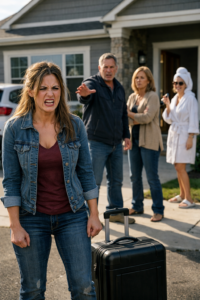
“You always make everything dramatic,” she said, and went back to her phone.
My father muted the TV with a click so sharp it felt like a slap all by itself. “Don’t come in here acting like you’re the only one with needs,” he said. “Your sister’s been under a lot of stress.”
I stared at him. The man had not held a steady job in four years. His “stress” was mostly from watching the news and deciding strangers were disappointing him personally.
“Dad,” I said. “Please. This is my career.”
He stood up slowly, as if gravity was offended by the effort. “Your career,” he echoed, like the phrase tasted sour. “You’re not a doctor. You’re not saving lives. You make slides.”
I felt heat climb my neck. “Those slides pay your mortgage,” I wanted to say. I didn’t. Not yet. I still had that old instinct to keep the peace, to be the reasonable one, to swallow my own throat if it meant everyone else could keep breathing.
“I’ll bring it back,” I said. “I’ll fill the tank. I’ll get it detailed. I’ll—”
“Your sister needs it for a spa day,” my father said, and his voice hardened on the word needs like he was laying down law.
Something inside me clicked.
Not snapped. Not shattered. Clicked—like a lock finally turning.
I took a breath and looked at my mother. “Are you seriously okay with this?”
My mother’s eyes flicked to the throw pillow beside her, and she adjusted it by half an inch, like she could tidy away the moment. “Nora,” she murmured. “Don’t start.”
“Don’t start,” I repeated, and I laughed once—short and ugly. “I’m not starting. I’m asking for help.”
My father moved faster than I expected. Four steps. His jaw clenched. His hand came up.
I didn’t even have time to flinch.
The slap landed on my cheek with a sound like a book hitting a table. My head snapped sideways. My teeth clacked together. For a second the room tilted, and the lemon-clean scent turned sharp, like chemicals.
I tasted blood.
I went down onto the rug by the entryway, my palm stinging where I caught myself. The rug was thick and soft, the kind my mother would brag about to guests. My cheek pressed into it, and all I could think was: I paid for this too.
When I looked up, my sister was already back on her phone. My mother’s hand hovered over her cardigan buttons as if she might fasten herself closed. My father stood over me breathing through his nose, not shocked, not regretful—just… satisfied, like he’d corrected something.
I stood up slowly. My face throbbed. My ears rang.
I didn’t scream. I didn’t cry. I didn’t say a single word.
I walked out into the rain.
In my car—well, not my car, because I didn’t have one—I sat in the driver’s seat of my own useless life and pressed my fingers to my cheek, feeling the heat bloom under my skin. My phone buzzed again with Marcy’s messages, Wayne’s calls, the world demanding I show up.
I opened the rental app and found the last available car in the entire city: a dented compact with “NO SMOKING” on the dashboard like a joke. The pickup location was on the edge of town, by a strip mall that always smelled like fried grease.
As I drove there, rain hammering the windshield, something colder than anger slid into place inside me.
At the rental counter, I paid an obscene amount without blinking. In the parking lot, the car smelled like old cologne and stale fries. I sat there with my cheek aching, my hands steady now, and opened my banking app.
Not to check my balance.
To start cutting strings.
I scrolled through the automatic payments I’d set up over the years—without fanfare, without thanks. Utilities. Insurance. A “family phone plan.” A monthly “household support” transfer I’d labeled groceries so I wouldn’t feel like a sucker.
Then I saw one I didn’t recognize.
Scheduled for tomorrow morning: $12,000.
Recipient: Serenity Cove Retreats LLC.
And in the memo line—typed in a familiar, bubbly style that wasn’t mine—two words made my stomach drop.
Poppy’s deposit.
My throat went tight as I stared at the screen, one thought pounding louder than the rain.
How the hell did my sister get access to my money?
Part 2
I drove through the night like the road was a tunnel I could crawl through to become someone else.
The rental’s headlights were weak and yellow, and every time I hit a bump the dashboard rattled like it was laughing at me. My cheek kept pulsing, heat and bruise building under the skin. I kept tasting copper every time I swallowed.
Somewhere around Colorado Springs, I stopped at a gas station that smelled like hot dogs and diesel. In the bathroom mirror, I tilted my face under the fluorescent light.
A perfect red handprint was rising across my cheekbone.
I held cold paper towels to it until my fingers went numb. Then I got back in the car and kept going.
My goal was simple: get to Nashville before morning. Be in that boardroom at 9:30. Deliver the pitch like nothing in the world could knock me off balance.
The conflict was also simple: my body was exhausted, my mind was a storm, and every time I looked at my phone I saw that $12,000 scheduled transfer sitting there like a loaded gun.
I could cancel it with one tap.
So why hadn’t I already?
Because canceling felt like declaring war.
Because some old part of me still wanted to believe there was an explanation. A misunderstanding. A mistake.
Because the slap hadn’t just hit my face. It had hit my childhood, my loyalty, my whole definition of “family.”
Dawn crept in gray and thin over the highway. By the time I reached Nashville, the sky looked bruised too.
The hotel Wayne had booked for me was one of those glass towers downtown where everything smells like citrus and money. I checked in with damp hair, a carry-on, and a cheek I had painted over with concealer so thick it felt like armor.
In the elevator mirror, I looked almost normal.
Almost.
At 9:12 I walked into Ellis Health Systems’ boardroom with my laptop under my arm, my blazer crisp, my mouth set in a polite smile.
The room smelled like black coffee and printer toner. The long table had that glossy wood surface that reflects your face back at you, warped and a little cruel. The board members were already seated, suits and neutral expressions, eyes like measuring tape.
Wayne stood at the front, hands clasped, relief flickering across his face when he saw me.
“Thought you weren’t gonna make it,” he murmured as I slid into place.
“I always make it,” I said.
And then I did.
For two hours, I became the version of myself I liked best—the one who could read a room like weather, who could anticipate objections before they formed, who could turn numbers into a story that made powerful people nod.
They pushed. I pushed back. They asked about risk. I showed them mitigation. They worried about cost. I showed them return.
At one point, the chairwoman—a sharp-eyed woman named Dr. Lanning—leaned forward and said, “Why you? Why should we trust your firm to run this transformation?”
I didn’t even look at my notes. I heard my own voice, steady and low.
“Because you don’t need a vendor,” I said. “You need a partner who will tell you the truth even when it’s uncomfortable. My job isn’t to flatter you. It’s to get you results you can measure.”
Something changed in the room. A small shift, like a door unlocking.
When the meeting ended, Wayne clapped my shoulder. “That was… damn,” he said, and for Wayne, “damn” was basically poetry.
At 11:47, while I stood by the window of the boardroom watching sunlight hit the river, my phone buzzed with an email.
Subject: NOTICE OF INTENT TO AWARD.
My chest loosened in a way I hadn’t felt in weeks. I exhaled, slow, like I’d been holding my breath since the gate agent said operational constraints.
We got it.
I should’ve felt triumphant.
Instead, the first thing I felt was dread, because I knew exactly what would happen the moment my family realized I wasn’t going to keep floating them.
Two days passed in a blur of follow-up calls, contracts, congratulations. Wayne hinted at a promotion. Marcy texted celebratory emojis. People in the office kitchen told me I “crushed it” while I pretended my cheek didn’t still ache when I smiled.
On the second evening, I was in my hotel room with the curtains half-drawn, staring at the city lights, when my phone rang.
Mom.
I stared at her name until it stopped, then rang again, then again.
I answered on the fourth ring, because ignoring her felt like giving her power, and I was done donating power.
“What?” I said.
Her voice burst through the speaker, sharp and panicked. “Why aren’t the bills being paid?”
No hello. No how are you. No… Nora, are you okay after what happened?
Just the bills.
I looked at my suitcase on the floor, half-unpacked. My blazer hung over the chair like a tired soldier. I could still smell the hotel soap on my hands.
“I’m not sure what you mean,” I said, keeping my voice flat.
“The internet is off,” she said. “The power company left a notice. And—” her breath hitched, like she was trying to swallow a scream, “—and they repossessed Poppy’s car.”
I closed my eyes.
The new information came with a jolt: it wasn’t just that they expected my money. It was that they were so deeply dependent they didn’t even know how their own life functioned without it.
“Mom,” I said. “Are you calling because you’re worried about me?”
Silence.
Then, smaller, like she was offended: “Of course I’m worried. But that doesn’t fix anything. Your father is furious.”
“Your father slapped me,” I said.
Another silence, heavier this time. In the background I heard the muffled sound of my father’s voice, then Poppy crying—high and furious, like a toddler who’s been told no.
Mom lowered her voice, as if she was sharing a secret instead of admitting betrayal. “He didn’t mean it.”
I laughed, but it came out thin. “Funny. His hand seemed pretty intentional.”
“Nora, please,” she said. “Just… just put everything back. You can’t do this to us.”
Do this to us.
Like I was the storm, not the one who finally stepped out of the rain.
I walked to the window and pressed my forehead to the cool glass. My reflection stared back—tired eyes, tight mouth, cheek still faintly swollen under makeup.
“I didn’t do anything to you,” I said. “I stopped doing things for you.”
My father’s voice snapped in the background, and suddenly he was on the line, breathing hard like he’d run to the phone.
“You think you’re teaching us a lesson?” he said. “You think you can punish your family because you got your feelings hurt?”
“My feelings,” I repeated softly.
“You’re selfish,” he hissed. “You owe us. After everything we’ve done—”
I cut in, sharper than I expected. “Go check your mailbox.”
“What?” he barked.
“Just go,” I said. “Check it.”
I heard him move—footsteps, the front door creaking, the metal clank of the mailbox lid. Paper rustled.
Then his voice changed.
Not angry.
Scared.
“What is this?” he whispered.
I pictured his hands shaking, the same hands that had hit me. I pictured my mother hovering behind him. Poppy crying in the living room where she filmed herself talking about “self-care” while other people paid her bills.
“What are you looking at?” I asked.
“It says… final notice,” he said, voice cracking. “It says past due.”
I didn’t correct him. I didn’t soothe him. I didn’t rush in to catch the pieces.
I just said the truth.
“That’s what happens,” I said, “when you stop paying for your own life.”
The line went quiet except for Poppy’s sobbing. My mother started saying my name over and over, like it was a rope she could throw to pull me back.
I held the phone away from my ear and watched traffic glide like fish down the street below my hotel.
Then my banking app pinged.
A notification slid across my screen:
WIRE TRANSFER REQUEST SUBMITTED: $18,500
Recipient: DUNHAVEN INVESTMENTS
My breath stopped.
Because I hadn’t submitted any wire transfer.
And the request time stamp was two minutes ago—right in the middle of this call.
My fingers went cold as I stared at the alert, one thought slicing through everything else.
If they could schedule $12,000 for Poppy… what else could they take while I was distracted?
Part 3
I was in the bank the next morning before the doors officially opened, standing on the sidewalk with a coffee I couldn’t taste and a jaw I couldn’t unclench.
The air was damp and smelled like mulch from the landscaping beds. When the security guard finally clicked the doors open, I slipped inside like I was late to something that mattered more than money.
Because it did.
Money was just the tool. The real thing at stake was control.
At the front desk, I said, “I need to freeze my accounts. Immediately.”
The woman behind the counter glanced at my face—at the faint yellow bruise I couldn’t fully hide—and her expression softened. “Do you have an appointment?”
“I have fraud,” I said.
That word cut through the small talk like a siren. Ten minutes later, I was in a glass office with a man named Darren whose tie was too bright for his serious face. He pulled up my profile on his monitor, fingers moving fast.
“Okay,” he said. “I see the wire request. It’s pending review. We can halt it.”
My shoulders loosened a fraction. “Thank you.”
He clicked again, frowning. “This is… unusual.”
“What’s unusual,” I said, trying to keep my voice even, “is my family treating my bank account like a community pool.”
Darren gave a tight little smile that didn’t reach his eyes. “There’s a note here,” he said slowly. “An authorization on file.”
My stomach sank. “Authorization from who?”
He rotated the screen slightly toward me. “There’s a power of attorney document attached to your account. It lists your mother, Linda Caldwell, as an authorized agent.”
My hands went numb. “That’s impossible. I never—”
Darren clicked to open the file. A scanned document filled the screen. My name at the top. My address. My mother’s name in bold. A signature at the bottom that looked like mine if you squinted.
But I didn’t have to squint.
It wasn’t mine.
It was too round, too careful. Like someone trying to write my name the way they’d seen it on a birthday card.
My throat tightened. “That’s forged.”
Darren’s expression shifted into something more cautious. “This document was notarized.”
“I don’t care if it was blessed by the pope,” I snapped, then forced myself to breathe. “I did not sign that.”
He pointed to the notary stamp. “It was processed last month.”
Last month. While I was buried in the Ellis pitch. While I was traveling, working, too busy to notice the quiet rewiring of my life.
“Who notarized it?” I asked, and my voice came out thin.
Darren leaned in to read. “Name is… Caleb Rourke.”
The name hit me like a cold splash.
Caleb Rourke was Poppy’s fiancé.
The guy who always showed up to family dinners with a charming grin and a “Ma’am” for my mother, who called my father “sir” like it was a joke they both enjoyed. The guy who sold “financial coaching packages” online and talked about “legacy” while my sister posted photos of green juice and candles.
I stared at the stamp on the screen. My skin prickled.
“I want it removed,” I said.
Darren nodded, already moving. “We can revoke the POA, but because it’s notarized, we’ll need a statement from you and an internal review. I also recommend you place a fraud alert—”
“Do it,” I said. “All of it.”
He printed papers. I signed. My pen scratched across the page, and for a second my hand trembled—not from fear, but from the weight of what I was accepting.
This wasn’t an accident.
This was a plan.
While Darren stepped out to “notify the fraud department,” I sat alone in the glass office and listened to the muted sounds of the bank—the soft beep of the queue system, the low murmur of conversations, the distant clack of a coin counter. Everything normal around me while my life quietly tried to collapse.
My phone buzzed with a text from my mother:
Call me NOW.
Another from my father:
Fix what you broke.
Another from Poppy, shockingly, just a single line:
What did you do?!
I stared at Poppy’s message until the screen dimmed.
What did I do.
Like I was the one who forged documents. Like I was the one who set up access to my account. Like I was the one who slapped my daughter and still expected her to pay my bills.
Darren came back in with a woman in a navy blazer. “This is Ms. Patel,” he said. “She’s with our fraud team.”
Ms. Patel shook my hand firmly. “I’m sorry you’re dealing with this,” she said. Her voice had that calm, clipped confidence of someone who’s seen a lot and doesn’t scare easily. “We’ll stop the wire and lock down your access. But we need to ask: do you recognize the email attached to your account?”
She turned her tablet toward me.
The login email listed wasn’t mine.
It was a Gmail address I’d never seen before, something like lindacaldwell.home.
My stomach rolled. “No,” I said. “That’s not mine.”
Ms. Patel nodded once, as if she’d expected it. “We’ll update it. But I want to be transparent—someone has been managing parts of your account for weeks. Possibly longer.”
The new information landed like a slow punch. Weeks. While I was working. While I was paying. While I thought I was the one holding the steering wheel.
I swallowed hard. “How did this happen without notifying me?”
Ms. Patel’s eyes didn’t flicker. “There are ways,” she said carefully. “If someone has access to your mail. Or your phone. Or if they set up forwarding.”
My mind flashed to my parents’ house, to the tidy entryway, to my mother’s obsession with “organizing” my childhood paperwork. To the way she always insisted on “keeping important things safe” at her place because I was “so busy.”
To the way I’d let her.
I signed more forms. Ms. Patel promised an investigation. Darren apologized three times. None of it made my chest feel any less tight.
Outside the bank, the sun was bright and cheerful in that rude way it gets after you’ve had a terrible night. I sat in my rental car and stared at the steering wheel until my hands stopped shaking.
My goal now was simple: confront them. Find out how deep it went. Shut it down.
The conflict: my entire nervous system wanted to run, to hide, to pretend I hadn’t seen the stamp with Caleb’s name on it.
But the emotional twist was stronger than fear.
It was disgust.
Because this wasn’t my family being messy or needy.
This was theft dressed up as love.
I drove straight to Serenity Cove, the “wellness spa” Poppy loved—an overpriced place tucked into the foothills, all cedar siding and soft music like you were supposed to forget reality existed.
I walked in and the air hit me—eucalyptus, warm towels, a faint hint of chlorine. People whispered like loud voices were against the rules.
At the front desk, a woman smiled with perfect teeth. “Welcome. How can we help you today?”
I leaned in so my voice stayed low but sharp. “I’m looking for Poppy Caldwell. And Caleb Rourke.”
The woman hesitated, scanning a screen. “They’re… in a couples massage.”
Of course they were.
My hands curled into fists at my sides. I could practically see my money burning into scented oil.
“Tell them,” I said, each word clean and cold, “that Nora is here. And that I just met the fraud department at my bank.”
The receptionist’s smile faltered.
I didn’t sit in the waiting area with the cucumber water and the soft instrumental music. I stood by the hallway entrance, watching therapists in black scrubs glide past like ghosts. Every second stretched.
Then I heard footsteps—quick, irritated.
Caleb appeared first, hair slightly mussed, face already wearing that charming confusion like a mask. Poppy was behind him, cheeks flushed, robe belted tight, eyes wide like she’d been yanked out of a dream.
“Nora?” Caleb said, too smooth. “What’s going on?”
I held up my phone with the screenshot of the forged POA and the notary stamp.
“Tell me,” I said, voice shaking now with something hotter than rage, “why your name is on a power of attorney for my bank account.”
Poppy’s mouth fell open.
Caleb’s smile didn’t move, but his eyes did—just a flicker to the side, calculating.
And in that tiny flicker, I realized he wasn’t surprised.
He’d been waiting for this moment.
My pulse roared in my ears as one question took over everything else.
If Caleb helped forge my signature… what else have they already signed in my name?
Part 4
Caleb didn’t answer right away. He did that thing people do when they think silence makes them look innocent.
Poppy, on the other hand, looked like she might float away.
“What are you talking about?” she said, voice thin and breathy. “I don’t—Nora, why would Caleb—”
I cut her off. “Don’t,” I said. “Please don’t do the wide-eyed thing. Not today.”
Caleb lifted his hands slightly, palms out, like he was calming a skittish animal. “Okay,” he said softly. “Let’s take a breath. You’re upset. I get it. But you’re accusing me of a serious crime in the middle of a business.”
“Oh, I’m sorry,” I said, and my laugh came out like a bark. “Is this bad for the vibe?”
Poppy flinched.
The hallway around us smelled like warm stone and essential oils. Somewhere, water trickled in a fountain meant to make rich people feel spiritual. A therapist walked by and pretended not to hear.
My goal was to get the truth. My conflict was that Caleb had the kind of practiced calm that made you question your own reality.
New information arrived in the shape of his eyes—steady, unbothered, like he’d rehearsed this.
“You notarized it,” I said, holding my phone closer so he could see his own name. “Explain.”
Caleb leaned in, squinting, then straightened with a sigh. “That stamp,” he said, “doesn’t mean I forged anything. It means I verified an identity.”
“Mine,” I said.
He nodded. “You were there.”
My breath caught. “No, I wasn’t.”
Poppy’s voice went small. “Nora… maybe you forgot? You’ve been so busy. There was that night at Mom and Dad’s—”
I whipped my head toward her. “What night?”
Poppy blinked rapidly, like she was trying to pull a memory out of fog. “A few weeks ago. You came by late. You were stressed. Mom made you tea. You signed some stuff—just for the phone plan, I think?”
The words hit me, cold and slippery.
Tea. Papers. Late. Stressed.
I could picture it—my mother’s kitchen, the warm light over the sink, the way she always slid documents toward me like it was nothing. “Just sign here, honey.” The way I’d scribbled my name without reading because I trusted her and I was tired and I had a flight in the morning.
I turned back to Caleb. “So you’re telling me,” I said slowly, “that you watched me sign a power of attorney and didn’t think it was worth mentioning that it gave my mother control over my bank account.”
Caleb’s mouth tilted. “I don’t manage what you and your mother agree on,” he said. “I just notarize.”
“And you’re a notary because…?” I asked.
He smiled, almost proud. “It’s part of my business services. Helps clients. Builds trust.”
His business services. Of course.
Poppy stepped forward, eyes glossy. “Nora, I didn’t know,” she said. “I swear. I thought it was for… I don’t know. For something normal.”
Something normal. Like my family had any idea what normal was without my money propping it up.
I looked at my sister, really looked.
Her robe was plush, the belt knotted perfectly. Her hair smelled like expensive shampoo. Her nails were done in that pale pink shade that always looked like wealth.
She didn’t look guilty.
She looked terrified.
Which was a red herring I might’ve believed, if not for the $12,000 scheduled transfer with her name in the memo line.
“You scheduled a deposit from my account,” I said, voice low. “For Serenity Cove.”
Poppy’s eyes widened. “I—no. I wouldn’t—”
Caleb’s hand found the small of her back, steadying her. Possessive.
And that was the moment the emotional twist landed.
It wasn’t just that my sister was spoiled.
It was that someone had positioned himself between us, hands on the levers, shaping the story.
Caleb spoke gently, like he was doing me a favor. “Nora, you’re spiraling,” he said. “Maybe you should talk to your parents. Clear it up.”
Clear it up.
Like this was a misunderstanding that could be sorted with a family group chat.
I nodded once. “You’re right,” I said.
Caleb’s shoulders relaxed, just slightly.
“I will talk to them,” I said. “And after that, I’ll talk to the police.”
Poppy gasped. Caleb’s smile vanished for the first time.
“You don’t want to do that,” he said, voice hardening.
I held his gaze. “Watch me.”
I walked out of Serenity Cove with eucalyptus still in my nose and fury buzzing under my skin, like electricity finding exposed wire.
I drove straight to my parents’ house.
Their porch light was on, warm and inviting, the same lie it had always been. The rain had stopped, leaving the street shining like it had been varnished.
I didn’t knock.
I used the spare key they’d insisted I keep “for emergencies,” and stepped inside.
The house was quiet except for the refrigerator hum and the faint tick of the wall clock. The lemon-clean scent hit me again—my mother’s idea of control.
In the living room, I saw the mail pile on the side table. A stack of envelopes, some unopened, some torn. My name on one of them, in print.
My stomach dropped.
I crossed the room and picked it up. It was from the bank—my bank—addressed to me, at their house.
I flipped it over. The seal was broken.
New information. Right there in my hands.
They weren’t just accessing my account.
They’d redirected my mail.
I set the envelope down carefully, like it might explode, and walked toward my father’s home office.
The door was ajar. Inside, the desk was immaculate. Pens aligned. Papers stacked. A framed photo of our family on a beach, all smiles, sun in our eyes like we were normal.
I opened the top drawer.
Files. Neat. Labeled.
“Insurance.”
“Taxes.”
“Poppy wedding.”
And then—my name.
A folder with my name written in my mother’s tidy handwriting.
My fingers trembled as I pulled it out and opened it.
Inside: copies of my social security card, my passport, old pay stubs, and a document I hadn’t seen since I was a kid.
My birth certificate.
But the name printed at the top wasn’t Nora Caldwell.
It was Nora… something else. A last name I didn’t recognize.
My vision tunneled. The room felt suddenly too small, too quiet.
I stared at the unfamiliar name, my heart pounding so hard I could hear it.
If my own birth certificate had been hidden in a drawer like contraband… what else about my life had they rewritten without telling me?
Part 5
I drove to the county records office like I was chasing my own shadow.
The building sat downtown in a block of concrete and glass that always made me think of dentists and jury duty. Inside, the air was stale and over-conditioned. The waiting room chairs were molded plastic, the kind that squeaks when you shift.
I took a number and sat beneath a sign that said PLEASE HAVE YOUR DOCUMENTS READY, like anyone ever came here prepared to have their reality rearranged.
In my lap, I held the birth certificate copy I’d taken from my parents’ drawer. My hands kept wanting to crumple it. I forced them to stay flat.
When my number was called, I approached the window where a tired clerk with gray-streaked hair slid a form toward me.
“Requesting what?” she asked without looking up.
“Birth record,” I said. My voice sounded wrong in my own ears. “For me.”
She finally looked up, eyes flicking to the paper in my hand. “You can’t request someone else’s birth record without—”
“It’s mine,” I said. “But the name on here isn’t what I’ve used my whole life.”
That got her attention. Her expression sharpened, not unkindly—more like someone who’d seen enough family secrets to recognize the smell of one.
She took the paper, scanned it, then typed something into her computer. Her fingers moved fast. The keyboard clicks sounded too loud.
After a minute, she leaned closer to the screen. “Okay,” she murmured. “So… yes. There’s an original record. And there’s an amended record.”
“Amended,” I repeated.
She nodded, eyes still on the screen. “When an adoption is finalized, the original record is sealed and an amended certificate is issued with the adoptive parents’ names.”
My throat went tight. “Adoption?”
She glanced at me again, softer now. “Honey, you didn’t know?”
I stared at her through the glass. I could smell the cheap hand sanitizer on the counter. Somewhere behind me, a baby fussed in a stroller. Life kept happening while mine cracked open.
“No,” I said. “I didn’t know.”
She slid the form back. “I can’t give you the sealed record without a court order,” she said, lowering her voice like she was offering a kindness. “But I can tell you the adoption was finalized when you were four.”
Four.
Old enough to have memories—vague ones, like flashes of a different house, a different smell, a woman’s laugh that didn’t belong to my mother.
My stomach rolled.
I walked out of the records office into bright noon sun that felt too cheerful. The city sounded loud—traffic, laughter, a dog barking. I stood on the sidewalk and tried to breathe.
Goal: understand who I was.
Conflict: every answer required more questions.
New information: I was adopted, and my parents had never told me.
Emotional twist: it wasn’t just that they’d hidden the truth. It was that they’d kept my documents like tools, filed and ready.
I called my mother.
She didn’t answer.
I called again.
Voicemail.
I called my father.
Straight to voicemail.
Of course. They were busy being furious about the bills. Busy calling me selfish. Busy pretending they hadn’t been stealing from me.
I went home—my apartment, not theirs—and sat at my kitchen table with the birth certificate copy spread out like evidence. The table still had a coffee ring stain from last week. The mundane detail made me want to scream.
I tried to remember being four.
I remembered a hallway with pale yellow paint. I remembered a woman brushing my hair and humming, off-key. I remembered a man lifting me onto his shoulders at a fair, the smell of popcorn and sunblock.
None of those people were Linda and Mark Caldwell.
My phone buzzed. A text from an unknown number:
Stop digging. You’ll regret it.
My skin prickled. I stared at the message until the words blurred.
Red herring: Caleb. It had to be Caleb, right? He was the one with the notary stamp. The one with the smooth threats.
But something about the message felt older. Colder.
I did the only thing I could think to do: I called the one person my mother had never been able to fully control.
Aunt Jeannie—my father’s older sister.
Jeannie answered on the second ring, voice brisk. “If you’re calling to apologize to your father, don’t,” she said.
I swallowed. “Did you know I was adopted?”
Silence.
Then, very quietly, “Oh, Nora.”
The way she said my name made my eyes sting.
“You didn’t know,” she said, not a question.
“No.”
Jeannie exhaled, long and shaky. “Your mother swore she’d tell you,” she said. “She swore. She said she was waiting for the right time.”
“There’s never a right time to lie for twenty-six years,” I said, and my voice cracked.
Jeannie’s voice hardened. “Your father didn’t want you to know because he didn’t want you ‘asking questions,’” she said, and I heard the old anger in her, the kind that had been parked for years. “He said you were ‘better off grateful.’”
Grateful.
Like my existence was a favor.
“What questions?” I asked, my pulse quickening. “Questions about what?”
Jeannie hesitated, and I felt it—the edge of something bigger.
“There was… money,” she said finally. “From your biological family. A trust, I think. Your parents became the trustees after the adoption.”
The room seemed to tilt.
A trust.
I thought about the bills my parents claimed they couldn’t pay. The new cars. The spa days. The way my mother always insisted she was “broke” while wearing designer bags. The way my father talked about “sacrifices” like he was a hero.
My mouth went dry. “How much?”
“I don’t know,” Jeannie admitted. “They kept it quiet. But I remember your father bragging once, after a few drinks, that he’d ‘secured the future.’”
Secured the future.
I gripped the edge of the table until my knuckles ached. “Jeannie,” I said, “how do I find out?”
“You need a lawyer,” she said, immediate and firm. “And you need to be ready for them to turn ugly.”
They’d already turned ugly. I had a handprint bruise to prove it.
After I hung up, I sat in silence, listening to the hum of my fridge and the distant siren of an ambulance outside. The world smelled like stale coffee and paper.
Then my email pinged.
A new message, no subject line, from a sender I didn’t recognize.
Attached: a PDF.
Title on the first page: CALDWELL FAMILY TRUST — QUARTERLY STATEMENT
My breath hitched as I scrolled.
And there, near the bottom, a line item made my vision go sharp and white.
Distribution to Trustee: $180,000.
Balance Remaining: $14.62.
My hands shook so hard I nearly dropped the phone.
If they’d drained the trust that was meant for me… what exactly were they willing to do to keep me from finding out?
Part 6
The law office smelled like leather and copier toner, and the waiting room chairs were too comfortable in a way that made me suspicious.
My lawyer’s name was Alana Fitch. She was in her forties, wore her hair in a sleek twist, and had the kind of steady gaze that made people stop lying mid-sentence.
She read the trust statement without blinking. Then she looked up at me and said, “How committed are you to pursuing this?”
I thought about the slap. The forged POA. The stolen mail. The balance of fourteen dollars and sixty-two cents.
“I’m committed,” I said.
Alana nodded once. “Okay,” she said. “Then we do this correctly. We request the full trust accounting. We file for access to sealed adoption records. We report the identity fraud.”
My stomach tightened. “If I report it…”
“Your parents could face charges,” Alana finished calmly. “And anyone else involved. Including the notary.”
Caleb.
I pictured his polite smile turning sharp.
Conflict: the part of me that still wanted a family versus the part of me that wanted justice.
New information: it wasn’t just emotional betrayal. It was legal betrayal.
Emotional twist: the relief I felt at the thought of someone finally taking me seriously.
Alana slid a paper toward me. “Sign here,” she said. “This authorizes me to request records.”
I signed. My pen felt heavier than it should’ve.
The moment I walked out of her office, my phone buzzed.
Poppy.
I almost didn’t answer. But something in me wanted to hear her voice—wanted to know if my sister was complicit or collateral.
“Hello,” I said.
Her voice was ragged. “Nora,” she whispered. “Caleb is losing it. He says you’re trying to destroy our lives.”
I stared at the street outside the office—people walking dogs, someone laughing into their phone. Normal life, like a cruel joke.
“Poppy,” I said, “did you know about the trust?”
Silence.
Then, too fast, “What trust?”
I closed my eyes. “Stop,” I said. “Please. I’m tired. Just tell me the truth.”
Her breath hitched. “Mom said it was… family money,” she said. “She said you didn’t need it because you have a career and I’m still ‘building mine.’”
My throat tightened. “And you believed that.”
“I didn’t think—” she started, then her voice turned defensive. “You always act like I’m some monster, but you never helped me—”
I cut in, cold. “I paid your car note.”
She went quiet.
I heard Caleb in the background, his voice sharp: “Who are you talking to?”
Poppy lowered her voice. “He says if you don’t stop, he’ll… he’ll send something to your company.”
My skin prickled. “What something?”
Poppy hesitated. “He has videos,” she said. “From when you were younger. Dad gave him a hard drive. He said it’s insurance.”
For a second, I couldn’t breathe.
A hard drive.
My father had handed my privacy to my sister’s fiancé like a weapon.
I felt nausea crawl up my throat, hot and bitter. “Poppy,” I said softly, “why would Dad have videos of me?”
She whispered, “I don’t know. He said he kept everything. ‘For safety.’”
For safety.
My hands shook as I gripped the phone. The emotional twist hit hard—this wasn’t just money. This was control that had been built for years, brick by brick, with my trust as mortar.
“Listen to me,” I said, voice steady now in a way that scared me. “Caleb can send whatever he wants. If he threatens me, that’s evidence. Do you understand?”
Poppy sobbed. “I don’t want to lose everything,” she said.
“You already did,” I said, and it came out gentler than I expected. “You just haven’t felt it yet.”
I hung up and sat in my car for a long time, staring at the steering wheel.
Then I drove to the police station.
The lobby smelled like old coffee and disinfectant. The fluorescent lights made everyone look tired and gray. I approached the front desk and said, “I need to report identity fraud and theft. And I think my mail’s been intercepted.”
The officer looked up slowly. “By who?”
I swallowed. “My parents.”
That got me into a small interview room with a detective named Ruiz who had kind eyes and a voice like gravel.
He listened while I laid out the timeline: the wire request, the forged POA, the redirected mail, the trust statement, Caleb’s notary stamp.
He didn’t interrupt. He just took notes.
When I finished, he leaned back and said, “Do you have access to their house?”
I hesitated. “I have a spare key,” I admitted.
Ruiz’s eyes sharpened. “Did you take anything?” he asked.
“No,” I said. Then, honest: “I took a copy of my birth certificate.”
He nodded, like that made sense. “If we open an investigation,” he said, “we may need to search their property. That requires a warrant. But your statement helps.”
He slid a form toward me. “Sign here to begin the report.”
My pen hovered.
This was the line.
Cross it, and there was no going back to pretending.
I signed.
Ruiz stood. “All right,” he said. “We’ll start. And Ms. Caldwell—” he paused, eyes on me, “if you get any threats, save everything.”
I walked out into the late afternoon light feeling like my skin didn’t fit right.
My phone buzzed again.
A new text, from the same unknown number:
Last warning.
Then, a second message popped up almost immediately.
A photo.
It was my apartment door, taken from the hallway—close enough that I could see the scratch on the paint near the peephole.
My blood went ice-cold.
Because whoever sent it wasn’t at my parents’ house.
They were right outside mine.
And as my phone rang with an incoming call from Detective Ruiz, I realized with a sick twist of fear—
If my family had been stealing from me for years… how far were they willing to go now that I’d stopped being useful?
Part 7
Detective Ruiz didn’t bother with small talk.
“Where are you right now?” he asked.
“In my car,” I said, voice tight. “About ten minutes from home.”
“Don’t go home,” he said immediately. “Drive somewhere public. Coffee shop. Grocery store. Anywhere with people.”
I gripped the steering wheel. The photo of my door burned in my mind like an afterimage. “Do you think it’s them?” I asked.
“I think someone wants you scared,” Ruiz said. “And I think you need to treat that seriously.”
I drove to a crowded supermarket parking lot and sat under the buzzing lights, watching shoppers push carts like nothing in the world was dangerous.
Ruiz called again an hour later.
“We got a warrant,” he said.
My mouth went dry. “Already?”
“The trust angle changes things,” he said. “And the forged POA. We also pulled your bank’s internal notes. That document was submitted from an IP address linked to your parents’ home internet.”
I felt a bitter laugh scrape up my throat. “So it was them.”
“It was someone using their network,” he corrected, cautious. “But yes, that’s significant.”
My hands shook. “What about the photo of my door?”
“We’re tracing it,” he said. “But listen to me: we executed the search today. Your parents weren’t home.”
Of course they weren’t. My mother loved appointments. My father loved avoiding consequences.
Ruiz’s voice lowered. “We found a safe,” he said. “And inside it—documents. A lot of documents. Some with your name. Some with forged signatures. Also… a hard drive.”
My skin went cold. “The videos,” I whispered.
Ruiz didn’t confirm, but he didn’t deny either. “You need to come down,” he said. “There’s more. And I’d rather tell you in person.”
I drove to the station with my stomach twisted into a knot.
In the interview room, Ruiz slid a manila folder across the table. The edges were worn, like it had been handled a lot.
Inside were copies of loan applications—credit cards, a personal loan, even a line of credit with my name as guarantor.
My signature, forged, over and over.
Then Ruiz set a photograph on the table.
It was a letter, handwritten, my father’s writing—blocky, aggressive.
The first line made my vision blur.
If she ever tries to pull away, remind her what she owes.
My breath left my body in a rush.
Ruiz watched my face carefully. “We also found correspondence with Caleb Rourke,” he said. “He notarized multiple documents. Not just the POA.”
The red herring dissolved. Caleb wasn’t a parasite attached to my family.
He was a partner.
Ruiz continued, “We brought your parents in for questioning.”
My throat tightened. “And?”
“They blamed you,” he said bluntly. “Said you agreed to everything. Said you’re ‘unstable’ and ‘vindictive.’”
I stared at the table, the fluorescent light humming overhead. For a moment, all I could see was my mother adjusting a throw pillow while my father hit me.
“They’re charging them?” I asked, voice hollow.
Ruiz nodded. “It’s in motion. But you should prepare for backlash.”
Backlash.
As if they hadn’t already spent years turning my life into their bank account.
When I left the station, my phone was full of missed calls. My mother. My father. Poppy.
I didn’t answer.
Instead, I sat in my car and listened to the silence.
Then I called Poppy.
She picked up immediately, sobbing so hard I could barely understand her.
“Nora,” she choked. “They took Dad.”
I closed my eyes. I didn’t feel joy. I didn’t feel victory. I felt a deep, aching sadness—like a tooth that had been rotting for years and finally cracked.
“Poppy,” I said, “did you know he kept a hard drive of me?”
She gasped. “They showed me,” she whispered. “Caleb has been using it. He said it was leverage. I didn’t know it was… I didn’t know it was like that.”
Her voice turned small, almost childlike. “What are we going to do?”
The question was loaded, familiar—the family’s favorite question, always implying I would solve it.
I inhaled slowly. “You,” I said, “are going to figure out your own life.”
She sobbed harder. “But I’m scared.”
“I’m scared too,” I said, and my voice surprised me with its steadiness. “The difference is, I’m not going to pay for your fear anymore.”
She went quiet. In that quiet, I heard a new sound—something like the first crack of adulthood in her.
Then she whispered, “Mom says you’re dead to us.”
I stared at the dark windshield, at my own reflection faintly visible. “Okay,” I said softly. “Then let me be dead.”
I hung up before she could respond.
Two days later, Alana Fitch called me with an update on the trust.
Her voice was sharp, satisfied, but careful. “We got a partial accounting,” she said. “And Nora… there’s something you need to know.”
My stomach tightened. “What?”
“There was another beneficiary listed,” she said. “A name that isn’t yours. The executor wants to speak with you.”
Another beneficiary.
Another person connected to the life I didn’t know I had.
I felt my pulse spike, a mix of fear and strange curiosity.
If I wasn’t the only one tied to that trust… who else had my parents been hiding from me all these years?
Part 8
The executor’s office smelled like old books and peppermint tea, like someone was trying to make legal paperwork feel comforting.
His name was Harold Mays. He was in his seventies, wore glasses that slid down his nose, and spoke with the careful patience of a man who’d spent decades delivering news people didn’t want.
| Continue reading…. | ||
| Next » | ||