“YOUR HUSBAND’S KID HAS NO RIGHT CALLING US GRANDMA,” My Mom Said To My 14-Year-Old Stepdaughter On Christmas
“YOUR HUSBAND’S KID HAS NO RIGHT CALLING US GRANDMA,” My Mom Said To My 14-Year-Old Stepdaughter On Christmas -In Front Of Everyone. Then My 8-Year-Old Son Stood Up And Said Something That Changed Everything.
Part 1
My name is Blair Mitchell, and for most of my adult life I believed in a simple equation: work hard, keep your head down, pay your bills, and love will somehow sort itself out around the edges.
I’m thirty-eight. I’m an industrial electrical engineer who does maintenance across the manufacturing district south of Columbus, Ohio. The plants blur together after a while—steel doors that groan on their hinges, concrete floors stained by decades of oil, fluorescent lights that turn every face the color of tired. I start early. I keep a spare set of gloves in my truck. My boots never stop smelling like hot metal and coolant, no matter how many times I scrub them.
It’s a job where you learn respect fast. A conveyor belt doesn’t care if you’re having a bad day. A panel doesn’t care if your kid was up sick all night. One mistake can take your hand, your hearing, your life.
Eleven years ago, I learned that the sharp way.
It was a Tuesday, the kind of gray day Ohio does well, when everything looks like it’s been dusted with ash. A line at a plant kept tripping, and a contractor had “fixed” it twice. The manager was hovering behind me like an anxious bird, checking his watch, as if my presence alone should make the machines behave.
I opened the panel and knew immediately something was wrong. The wiring was a mess—neutral crossed with hot, grounding done like an afterthought. It was a death trap hiding behind a clean metal door.
I didn’t even have time to think the word danger.
The surge hit me like a punch from the air itself. I flew backward, my shoulder slamming into something hard. There was a flash, a sound like a giant snapping a towel, and then my hand was on fire. Not metaphorically. I remember staring at my fingers like they belonged to someone else, shaking so badly I couldn’t curl them, and still trying to tell my supervisor I was fine.
I wasn’t.
An ambulance showed up. The EMTs didn’t negotiate with my pride. They loaded me in and drove me to the ER, and I spent the ride thinking about how stupid it would be if I lost my hand because I didn’t want to look dramatic.
The hospital smelled like antiseptic and old coffee. Fluorescent lights hummed overhead. Everything was white and sharp and too bright.
That’s where I met Ben Webb.
He was working the night shift. Calm voice. Steady hands. The kind of tired kindness that doesn’t feel like customer service. He wore scrubs, had soft brown eyes, and moved with the practiced efficiency of someone who’d seen every version of panic and pain and knew exactly how to lower the volume.
He cleaned and bandaged my burn while I tried to pretend I was in control.
“I could’ve wrapped it myself,” I told him, because I’m me, and stubborn is my default setting.
He lifted one eyebrow, the smallest expression, like he’d heard that line a thousand times. “Sure,” he said, pressing gauze gently around my palm. “And you also probably didn’t feel that shock, right?”
I tried to laugh. It came out more like a wheeze.
While we waited for the doctor to sign discharge papers, we talked. Not polite small talk, either—real talk, the kind that sneaks up on you when you’re both exhausted and there’s nothing to perform for. He asked what I did. I told him. He asked if I liked it. I shrugged and said it paid the bills.
“Bills are loud,” he said.
Something about the way he said it made me smile, even with my hand throbbing.
At some point he mentioned he had a little girl.
“Her name’s Sophie,” he said, like saying her name was the most natural thing in the world. “She’s four.”
The way his voice softened on that last word did something to me. My chest tightened in a way I didn’t understand yet.
He told me Sophie’s mom left when Sophie wasn’t even a year old. No explanation. No calls. No child support. Just gone. He said it without bitterness, but there was a weight in it that sat between us like a third person.
“I work nights for the differential,” he said, rubbing the bridge of his nose like he could press the fatigue out. “Daycare eats half my paycheck. I sleep in pieces. Some days I feel like I’m running on fumes and love.”
He didn’t say any of it like he wanted pity. He said it like a confession, like admitting the heaviness might make it a little lighter.
When the doctor finally signed my discharge around two in the morning, I stood at the sliding doors with my bandaged hand and my pride humbled.
I hesitated like a teenager, which would’ve embarrassed me if I wasn’t too tired to care.
“Can I take you to breakfast sometime?” I asked.
Ben’s mouth curved like he was trying not to smile. “When you’re not saving stubborn people from themselves.”
He pulled a little notepad from his pocket and wrote his number. “Thursday,” he said. “If you’re still interested and not just high on adrenaline.”
Thursday breakfast turned into dinner. Dinner turned into weekends.
The first thing I noticed about Ben when we started seeing each other was how careful he was.
Not careful with his feelings—he was honest about those in a way that made me feel like I’d been living in a room with the lights half off. Careful with Sophie.
He didn’t introduce me right away. He didn’t want her attached to someone who might disappear. He said it plainly, without accusation, like it was a rule the universe had written for him.
Three months in, he invited me to lunch at a diner near his apartment. I walked in and saw this little girl sitting in a booth, holding a plastic fork like it was too big for her hands. She watched me with cautious, intelligent eyes. Same dark hair as Ben. Same serious mouth.
I froze at the entrance because I suddenly realized I wasn’t just meeting my boyfriend’s kid.
I was meeting a tiny person who had already learned people can leave.
So I did the only thing that felt safe. I slid into the booth across from her and asked, “What do you like to eat?”
Sophie stared for a long moment, like she was deciding whether I was temporary.
Then she said, very seriously, “Pancakes with smiley faces.”
She held up one finger. “But the syrup has to be warm, not cold.”
Ben tried to hide his laugh. I couldn’t. And something in me cracked open.
From then on, things flowed in a way that scared me because it felt too right. Sophie warmed up slowly. First she called me Ms. Blair. Then Blair. Then one day after I helped her with a shoelace that kept coming undone, she looked up at me and asked, “Can I call you Aunt Blair?”
My chest did this strange tight thing, like my heart was trying to become bigger than my ribs.
“Only if you want,” I told her.
She nodded once, like that settled the matter.
I showed up after that. On weekends. After my shifts. I learned how to braid hair from YouTube because Sophie wanted fancy hair for picture day and Ben was panicking. I fixed toys instead of replacing them. I helped with kindergarten projects. I read bedtime stories on nights Ben worked.
Sophie had this habit of watching people closely, as if she could spot the moment they might leave. Every time I came back, every time I kept my promise, her shoulders loosened a fraction.
I didn’t know it then, but that was love taking root.
And it was the beginning of everything that came after—good and bad.
Because when you choose a family, truly choose it, you also choose the battles that come with it.
Part 2
A year after the ER, Ben proposed in our kitchen while I was wearing an old hoodie and scraping burnt cheese off a casserole dish.
There was no dramatic music. No restaurant. Just him, nervous, holding a ring like it was a promise he didn’t want to break.
“Sophie’s asleep,” he whispered, like that mattered for the moment, like he didn’t want to wake the world.
My hands were still damp from dishwater. My hair was twisted up in a messy knot. I looked down at him and thought, This is it. This is what real looks like.
“Yes,” I said before he could even finish.
He exhaled like he’d been holding his breath for a year.
Sophie was our flower girl. She picked her own dress—pink, of course—and took her job so seriously she practiced walking down the aisle for a week. She carried a basket of petals like it contained state secrets. The day of the wedding, she stood at the edge of the aisle and looked up at me with her solemn little face.
“You’re not going anywhere,” she told me. Not a question. A statement.
I crouched down and met her eyes. “Nope,” I said. “I’m staying.”
Her chin trembled for half a second, then she nodded like she was sealing a deal with the universe.
Two years later, our son Carter was born. He came out angry and red and loud, as if he’d been annoyed by the inconvenience of being inside a womb. Ben cried. I laughed. Sophie stood beside the hospital bed and stared at him like he was a miracle she could barely believe.
She was seven then, old enough to understand what it meant to be someone’s big sister, and she took to it with a fierceness that made me think we were unstoppable.
She sang him to sleep with songs she made up on the spot. She tried to help with diapers like she was a junior nurse, handing me wipes with the seriousness of a surgical assistant. She’d place her small hand on Carter’s baby head and whisper, “It’s okay. I’m here.”
Watching them together felt like the universe finally giving us something gentle.
But there was always one dark corner I kept avoiding.
My parents.
Richard and Linda Mitchell lived in Westerville in the same neat house I grew up in—trimmed hedges, clean siding, the kind of place that always smelled faintly like furniture polish. They were comfortable, retired, middle class, stable. They were also the kind of people who cared deeply about appearances.
The kind of people who smiled at church and judged you in the car on the way home.
When Ben first entered my life, my parents did what I expected: polite questions, polite smiles, polite distance. Ben was a nurse, which my mother referred to as “nice” in the tone someone uses to describe a neighbor’s ugly curtains.
Sophie was the bigger test.
They weren’t openly cruel. Not the kind of cruelty you can point to and say, There. That’s the moment it broke. Their cruelty was colder. More respectable. The kind that wears manners like armor.
Sophie’s first Christmas with us, she was five. Ben and I were engaged. We were still figuring out how to blend our lives without breaking her routine. My parents handed her a thin coloring book they’d clearly grabbed last minute. The dollar store sticker was still on the back.
Meanwhile, my nephew—my brother Kyle’s kid—got a remote-control car that zipped across the living room. Everyone laughed as it slammed into furniture.
Sophie sat quietly on the floor, coloring with careful attention, like she didn’t want to take up space.
“They just don’t know her yet,” I told myself.
When Sophie turned six, they forgot her birthday. No call. No card. Nothing.
When I mentioned it, my mom waved a hand like she was shooing away a fly. “Oh, I assumed Ben would handle that,” she said. “She’s his daughter.”
She said it casually, like that explained everything.
The years stacked up like that. Little slights. Little omissions. Gifts that felt like afterthoughts. Hugs that lingered for Carter but stopped short for Sophie. Conversations that flowed around Sophie like she was a chair, not a person.
Every time I noticed, I made an excuse because the alternative felt too heavy.
Please don’t make me choose.
Kyle made it worse, because Kyle was always there sucking up oxygen.
Kyle was thirty-three when Carter was born, and he still bounced between “big ideas” the way some people bounce between TV channels. He talked endlessly about ventures that would “change the market,” while never holding a job longer than eight months. My parents treated him like a misunderstood genius. When he failed, they bailed him out. When he borrowed money, they didn’t ask for repayment. When he disappointed them, they blamed the world.
Kyle had a son, Mason, and my parents clung to Mason like proof their lineage was continuing on schedule.
Carter, of course, was treated like treasure. My mother took pictures of him constantly, posted them online with captions about “my sweet grandson.” My father ruffled Carter’s hair, made him hot chocolate, told stories about when I was his age.
Sophie got nods. Polite hellos. A gift card with no thought behind it.
The gifts made it impossible to ignore.
For Sophie’s tenth birthday, my parents gave her a used book. Not vintage. Not sentimental. Used. Someone else’s name was still written inside the cover.
That same year, Carter got a brand-new bike.
When Sophie needed supplies for a school project, my parents said money was tight. The following week, they bought Carter a new football helmet and cleats without blinking.
Ben noticed before I admitted it to myself.
One night after a family dinner, Sophie asleep in the back seat, Ben kept his eyes on the road and said quietly, “Blair, do you see what they’re doing?”
I wanted to say no. I wanted to say I was imagining it.
Instead I stared out the window and whispered, “I know.”
He didn’t push. That’s one of the reasons I love him. He knew I’d have to get there on my own. But the silence between us that night was heavier than the night air.
Sophie learned, slowly, what children learn fast when adults pretend they’re being kind.
Keep your expectations low. It hurts less.
By the time she was fourteen, she stopped asking if “Grandma” would come to her events. She stopped using the word grandma at all.
At first I told myself she was just getting older. Teenagers shift. They pull away. It’s normal.
But then I noticed she started calling my parents Mr. and Mrs. Mitchell.
She did it softly, politely, like she was taking her own heart out of her hands and putting it on a shelf where it couldn’t get bruised.
I noticed.
I didn’t stop it.
And that’s the part that still makes my stomach twist when I think about it.
Because I had years to say something. Years to stand up and draw a line. Years to protect her.
Instead, I kept trying to keep everyone comfortable.
And comfort, I learned, is not the same thing as love.
Part 3
The older Sophie got, the more she became herself in ways that made me proud and, sometimes, quietly worried.
Proud because she was kind without being weak. Smart without needing to announce it. The kind of kid teachers remember. She loved science and books and had a dry sense of humor that would catch you off guard. Worried because her kindness sometimes looked like shrinking. Like making herself smaller so the room would feel bigger for everyone else.
She joined a robotics club in middle school. Built a tiny car that could follow a line taped on the gym floor, and when it worked she lit up like someone had plugged her into a power source.
I texted my mom a photo of Sophie holding her ribbon at the school competition.
My mom replied, That’s nice.
Then she asked when Carter’s next football practice was.
I remember staring at the screen and feeling something sour in my throat. I typed a response, deleted it, typed again, deleted again.
In the end, I answered about football.
That was my pattern. My cowardice dressed up as keeping the peace.
Ben tried to challenge it gently. He’d say things like, “We don’t have to go over there every time.” Or, “We can leave if it gets weird.” Or, “Sophie sees what’s happening, Blair.”
I always had an answer.
“They’re old-fashioned.”
“They don’t mean anything by it.”
“They’ll come around.”
But kids don’t need intention to feel impact.
Sophie’s seventh-grade honor roll ceremony was the first time I saw her stop expecting anything from them in real time.
We’d invited my parents. Not because Sophie asked—she didn’t—but because I thought maybe this would be the thing that softened them. A ceremony. A stage. A proud moment. The kind of event grandparents show up for.
My mom said they had a prior commitment. A luncheon.
My dad didn’t even get on the phone.
Sophie didn’t react. Not outwardly. She smoothed her skirt, adjusted her hair, and said, “It’s fine.”
That word—fine—came out too clean, like she’d practiced it.
After the ceremony, Carter ran around the auditorium with other little siblings, playing tag between rows of chairs. Ben and I took pictures of Sophie holding her certificate.
At home that night, Sophie taped the honor roll certificate to her wall.
But she taped it lower than her other accomplishments, like she didn’t want it to look like she was bragging.
I stood in her doorway and felt guilt crawl up my spine.
“Hey,” I said. “I’m proud of you.”
She glanced up, then smiled. “Thanks, Aunt Blair.”
She still called me that, even though I’d told her a hundred times she could call me Mom if she wanted. She never did. Not because she didn’t love me. Because that word felt like a risk, and Sophie didn’t gamble with her heart unless she was sure.
Sometimes I wanted to shake my parents. Sometimes I wanted to shake myself.
Then there was the money.
Eight years earlier, when my parents first mentioned they were “a little tight,” I offered to help. It started as a one-time thing. A repair. A bill. A “temporary” loan.
Then it became automatic.
Twelve hundred dollars a month, sent like clockwork. Mortgage help. Utilities. Insurance. “Emergencies” that never ended.
I told myself it was duty. Gratitude. Family.
Ben didn’t love it, but he also didn’t tell me what to do. He’d ask, “Are you sure?” and I’d say yes even when my stomach said no.
Kyle, meanwhile, floated through life like a balloon my parents refused to let go of. He’d show up at holidays with a new story—new business partners, new plans, new opportunities—then vanish when someone asked for details.
And my parents ate it up. They’d pat his arm, tell him he was destined for big things, talk about how the world didn’t appreciate visionaries.
Sophie, quiet and consistent, was invisible in their eyes because she didn’t demand attention.
By fourteen, she’d learned how to be polite in a way that protected her.
At family dinners she’d sit straight, hands folded, speak only when spoken to. If my mom asked the table if anyone wanted more rolls, Sophie would say, “No thank you, Mrs. Mitchell,” and my mom would nod like she’d just heard the weather report.
Carter, on the other hand, loved Sophie with the simple devotion kids have when they haven’t been taught to measure love.
He followed her around the house like a shadow when they were younger. When she read, he’d shove himself under her arm and demand she read out loud. When she built Lego sets, he’d sit beside her and hand her pieces, feeling important.
As they grew, Carter’s affection shifted into loyalty. If someone at school teased Sophie for being quiet, Carter would stomp right up and say, “That’s my sister. Stop it.”
Sophie would roll her eyes like he was annoying, but her mouth would twitch at the corner, like she was holding in a smile.
Carter saw everything.
He saw the way my mom’s face brightened for him and stayed flat for Sophie. He saw the gift piles under the tree. He saw how Sophie tried anyway.
I don’t know why that didn’t scare me sooner.
Maybe because I assumed children were oblivious to adult ugliness. Maybe because I wanted to believe my parents’ politeness counted as decency.
Last Christmas proved how wrong I was.
We pulled up to my parents’ house like we had for nearly a decade.
Same old plastic tree visible through the front window. Same cheap cinnamon candles. Same porch light buzzing.
Ben parked the car. Sophie sat in the back seat with a paper bag on her lap, wrapped carefully in newspaper and tied with a red ribbon she’d cut from her art supplies. She’d been working on the gift inside for two months. I’d watched her fingers fumble with knitting needles night after night, undoing stitches when they didn’t look right.
She wanted it to be perfect.
Carter bounced in his seat, excited, thinking about candy canes and presents and being the center of attention the way he always was there.
Ben squeezed my hand. Not hard. Just enough to ask the question neither of us wanted to say out loud.
Do we stay?
I squeezed back.
“Just a little longer,” I whispered, more to myself than to him.
We walked in.
The living room looked like it always did, decorated in the exact same way as my childhood. But the moment I saw the gifts under the tree, my stomach dropped.
Two piles.
One was tall and overflowing, wrapped in bright paper. The other was small—embarrassingly small.
I didn’t need to ask which pile was for whom.
Ben’s jaw tightened. Sophie’s eyes flicked to the piles, then away so fast it almost looked like she hadn’t looked at all.
Carter didn’t notice. Not yet.
And as we sat down, watching my parents lean toward Carter and lean away from Sophie, I had the first clear thought I should have had years earlier.
This is the night something breaks.
I just didn’t know yet who would be the one to finally break it.
Part 4
Dinner at my parents’ house was a ritual of familiarity that always tasted like obligation.
Dry ham. Mashed potatoes with lumps. Green bean casserole scooped from the same chipped dish it had been served in for as long as I could remember. My dad parked himself in his recliner, the football game murmuring in the background like a heartbeat.
Small talk filled the air like static—gas prices, weather patterns, my mom complaining about how “kids these days” didn’t know the value of work. Kyle arrived late, as usual, breezing in like he was doing everyone a favor by showing up.
My mom’s body angled toward Carter the entire time.
“How’s school going, sweetheart?” she asked him, voice warm. “Still liking football? You making lots of friends?”
Carter answered between bites, animated, excited, completely unaware that the attention he was receiving came at someone else’s expense.
Sophie sat between Ben and me, back straight, hands folded neatly in her lap. She waited her turn the way she’d learned to.
When she spoke, it was careful, like she didn’t want to interrupt the current that flowed toward Carter.
“I made honor roll again this semester,” she said softly.
My mom smiled without looking at her. “That’s good, dear.”
Then, immediately, she turned back to Carter. “So when’s your next game?”
I saw Sophie’s shoulders tighten. Just a fraction. Like someone pulling a drawstring.
Ben’s fork paused halfway to his mouth. His jaw set.
And I did what I’d done for years.
Nothing.
After dinner, my mom clapped her hands like a hostess finishing a performance. “All right,” she said. “Let’s do gifts!”
Gift time should have been joyful. In my parents’ house, it always felt like an unspoken ranking.
Carter was called up first.
He tore into the red wrapping paper like it was a race, paper flying, laughter bubbling out of him. His face lit up in a way that hurt to look at.
A brand-new gaming console. Two controllers. Three games stacked neatly like a trophy.
My dad stood up, pride radiating from him. “Knew you’d love it,” he said. “You’ve been such a good boy.”
Carter shouted and hugged them both. My mom’s eyes shone. My dad looked like he’d just been knighted.
Sophie clapped for her brother. Genuine. Warm. Like she was happy for him, even though a quiet part of her must have known what was coming next.
Then my mom nodded toward the smaller pile. “Sophie,” she said, like she was remembering an errand.
Sophie stood. She walked to the tree and picked up the only gift with her name on it. She unwrapped it slowly, carefully, like she didn’t want to offend the paper.
Inside was a sweater.
Cheap fabric. Clearance rack. A bright orange sticker still stuck to the tag.
Twelve dollars.
Sophie’s mouth lifted into a practiced smile. “Thank you,” she said, voice steady.
My mom glanced at it for half a second. “That’s nice, dear.”
Ben’s hand tightened around mine so hard his knuckles went white.
Carter noticed something then. Bless his heart, he walked over and said, “Hey, Sofh, you can play with me. We can share.”
He held up one of the controllers like it was a peace offering.
Sophie’s smile softened into something real. “Thanks, buddy.”
My mom’s lips pressed together, not pleased, like Carter was wasting attention.
After the gifts, Sophie reached for the paper bag she’d brought, the one she’d been clutching since we arrived.
She stepped forward.
“Grandma,” she said quietly.
The word hung in the air, fragile.
She offered the package, wrapped in newspaper and tied with the red ribbon. “I made this for you.”
I knew what it was. I’d seen it grow stitch by stitch in Sophie’s hands. She’d worked on it in the evenings, in the car, during commercials, undoing and redoing sections until her fingers cramped.
She wanted it to be perfect.
My mom took it like someone accepting a pamphlet from a stranger. She opened it slowly.
Inside was a blue scarf.
The stitches weren’t perfect. Some were tighter than others. But it was beautiful because it was hers. It was time and effort and hope.
My mom looked at it for maybe five seconds.
Then she set it down on the coffee table like it might stain something.
“That’s sweet,” she said flatly, and without another glance, she turned toward the doorway as Kyle wandered in with a loud, late “Merry Christmas!”
“Kyle,” my mom called, voice brightening. “Come sit. Tell us about your new business idea.”
Sophie stood there frozen.
I saw her throat bob as she swallowed. Her fingers clenched once, then relaxed.
She was trying to be brave.
Then she asked, barely above a whisper, “Are you going to try it on? I just wanted to see if it fits.”
My mom turned toward her, and for the first time in ten years, the mask slipped.
There was no politeness in her face. No distance. Just irritation, like Sophie had asked for something unreasonable.
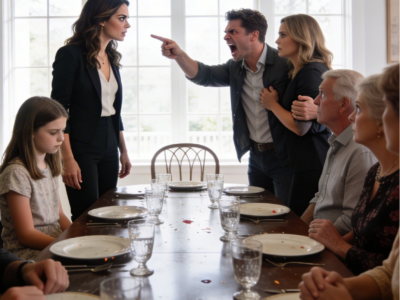
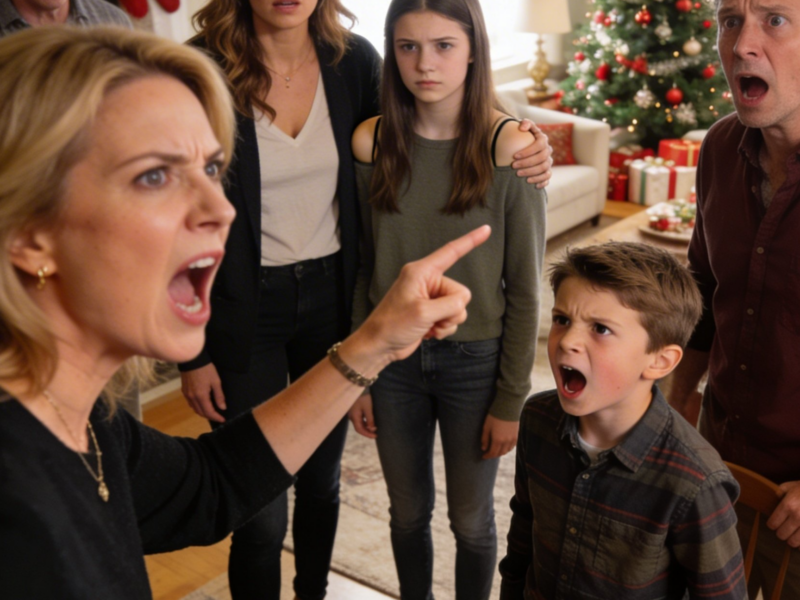
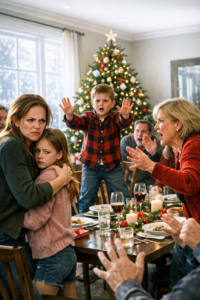
“Your husband’s kid doesn’t have the right to call us grandma and grandpa,” she said, loud enough for everyone to hear.
She gestured vaguely, as if Sophie was an object. “I only have one grandchild.”
The room went dead silent.
The football game kept playing. A player ran across the screen. The crowd cheered. The cinnamon candle flickered.
Sophie’s face drained of color like someone pulled the plug.
Ben’s hand flew to his mouth. His eyes went wet, anger and helplessness mixing in a way that made me want to throw something.
My dad didn’t even look up from his recliner. Like this was normal. Like this was a fact, not cruelty.
Kyle shifted uncomfortably, but he didn’t say a word.
And I—finally—I pushed my chair back, the scrape loud against the floor.
Anger rose in my chest like a flood.
But before I could speak, Carter stood up.
He set the controller down carefully, like he didn’t want to break it.
He walked across the room, straight to Sophie.
He took her hand.
His small fingers wrapped around hers, and Sophie’s hand trembled in his.
Carter turned to my mother, looking straight at her with a steadiness that didn’t match his age.
“If Sophie isn’t your granddaughter,” he said, voice clear, “then I’m not your grandson.”
You could have heard a pin drop.
My mom scoffed, as if he’d said something silly. “Don’t be dramatic.”
Carter didn’t move. He didn’t blink.
He looked up at Sophie and squeezed her hand. “Come on,” he said gently. “We’re going home.”
Sophie’s eyes filled. Tears slid down her cheeks, silent, like she didn’t want to make noise in a room that had just made it clear she didn’t belong.
She nodded.
I found my voice at last. “We’re leaving,” I said.
My mom’s face sharpened. “Blair—this is ridiculous. You’re blowing this out of proportion.”
I turned once, just once. “She’s a child,” I said. “And you humiliated her.”
My dad finally looked up, eyes cold. “She’s not blood,” he said, like that was the end of the discussion.
Something in me went quiet. Like a door closing.
We didn’t yell. We didn’t slam doors. We just left.
Carter kept hold of Sophie’s hand the entire walk to the car, like he was afraid if he let go, someone might pull her back into that house and erase what he’d just said.
As Ben drove, Christmas lights blurred past the windows. Inflatable Santas waved from lawns. Families laughed on sidewalks. The world looked cheerful and fake.
In the back seat, Sophie cried into her sleeve. Carter leaned toward her, whispering something I couldn’t hear, his voice soft like he was trying to build a shield with words.
I stared out the window and realized, with a sick clarity, that the moment I’d spent years avoiding had arrived.
And my eight-year-old son had been braver than me.
Part 5
When we got home, Sophie went straight to her room and closed the door.
I heard her crying through the wall—soft, controlled, like she didn’t want to bother anyone with her pain. That sound did something to me. It carved a new shape inside my chest.
Ben stood in the hallway, his eyes red. “Let me give her a minute,” he said gently. “I’ll go up in a bit.”
Carter changed out of his dress clothes and came downstairs in pajama pants with little footballs printed on them. He crawled onto the couch beside me and leaned his head against my shoulder like he’d been doing since he was a toddler.
I stared at the blank TV screen like it might explain how we’d gotten here.
“Mom,” Carter asked.
“Yeah, buddy.”
“Are Grandma and Grandpa bad people?”
My throat tightened. How do you answer that without breaking something in your child?
I swallowed. “They made a bad choice tonight.”
Carter nodded, thinking hard. He was quiet for a moment, then he said, very calmly, “But they’ve been making that bad choice for a long time, haven’t they?”
I closed my eyes. The honesty of it felt like a slap and a hug at the same time.
“Yes,” I whispered.
Carter’s voice stayed steady. “Then they’re bad people. Good people stop when they know they’re hurting someone.”
Eight years old.
And he understood what I hadn’t had the courage to act on for a decade.
That night I didn’t sleep. I replayed everything—not just Christmas, but all of it. The cheap gifts. The forgotten milestones. The way Sophie’s smile had slowly turned into a mask. Every time I told her to be patient. Every excuse I made because standing up felt uncomfortable.
I failed her.
The next morning, I stopped pretending otherwise.
For eight years, I’d been sending my parents twelve hundred dollars every month. I’d set up the automatic transfer back when my mom’s voice on the phone had trembled just enough to trigger my guilt. It was supposed to be temporary.
Temporary turned into routine. Routine turned into expectation.
I opened my banking app with hands that felt strangely calm.
I canceled the automatic transfer.
Then I blocked their numbers.
My chest felt hollow and light at the same time, like I’d set down something heavy I’d been carrying so long I forgot it was crushing me.
By that afternoon, my phone buzzed anyway. Unknown number.
Voicemail.
It was Kyle.
“You’re tearing the family apart,” he said, his voice dripping with outrage he didn’t earn. “Mom’s devastated. You need to apologize. You hear me? You need to apologize.”
Apologize.
Three days later, my dad showed up at my house.
I was in the garage, hands greasy, working on my truck because I didn’t know what else to do with the anger in my body. My dad’s car pulled into the driveway, and he stepped out looking older than I remembered. Smaller, too, like the world had started pushing back.
“We need to talk,” he said.
I wiped my hands on a rag and leaned against the workbench. “About what?”
“Your mother didn’t mean it like that,” he started.
“She said exactly what she meant.”
My dad’s jaw tightened. “Sophie isn’t your daughter,” he said. “Not legally.”
Something snapped. Not loud. Not explosive. Just clean.
“I changed her diapers,” I said, my voice low and steady. “I stayed up with her when she was sick. I taught her how to ride a bike. I helped her with homework. I held her hand when she got her first shot and pretended not to be scared.”
He frowned like he didn’t recognize me. “You’re being unreasonable.”
“No,” I said. “I’ve been reasonable for ten years.”
I pointed toward the driveway. “You can leave now.”
My dad stared at me like I’d spoken a language he didn’t understand. “After everything we did for you—”
“You raised me,” I replied. “That job ended when I became an adult. Everything since then was a gift I chose to give. And I’m done.”
He stood there a moment longer, then turned and walked back to his car without another word.
When he left, I expected to feel grief.
Instead, I felt relief.
The silence didn’t last.
It never does when people lose access to money.
A week after Christmas, my phone lit up like it was on fire. Cousins I hadn’t spoken to in years. Relatives whose birthdays I couldn’t remember. Even a few of my mom’s church friends, people I’d met once or twice at holiday dinners.
Every message sounded the same.
They’re still your parents.
Family is family.
Blood should come first.
Ben showed me what my mom had posted online.
A long, emotional rant about her ungrateful daughter. About being abandoned in old age. About how I’d changed since meeting my husband and how he was isolating me from my blood family.
She never mentioned Sophie by name.
She didn’t have to.
The comments flooded in—sympathy for her, anger at me, people praising her for “speaking her truth” without knowing what that truth had done to a fourteen-year-old girl.
Kyle shared the post with his own commentary about loyalty and values while still living off money he hadn’t earned.
Ben held his phone out to me, his jaw tight, his eyes wet with anger he was trying not to show.
“Do you want to respond?” he asked carefully.
I thought about it. I could’ve written everything. Every cheap gift, every ignored milestone. Every dollar. I could’ve posted receipts.
But I didn’t want to argue with people who didn’t care about the truth. I wanted to protect my kids. I wanted the truth to stand on its own without me begging anyone to see it.
So I posted one thing.
One photo.
Sophie’s blue scarf folded neatly on our coffee table. Uneven stitches. A little imperfect. Full of effort.
The caption said: My 14-year-old daughter taught herself to knit for two months to make a gift for the person she called grandma. That woman refused it and told her she had no right to call her grandma. I have nothing more to explain.
That was it.
Within hours, the tone shifted.
She said that to a child?
The scarf is beautiful.
That poor girl.
Questions started showing up under my mom’s post: Did you really say that? She’s been in the family ten years. Why wouldn’t she be your granddaughter?
My mom deleted her post within twenty-four hours.
But screenshots don’t disappear.
And neither does truth.
The next week, Sophie came down from her room with red-rimmed eyes and sat at the kitchen table like she was bracing for bad news.
I sat across from her and said the words I should’ve said years ago.
“I’m sorry.”
She blinked at me, confused.
“I’m sorry I didn’t protect you sooner,” I said. “I saw it. I made excuses. I tried to keep peace instead of keeping you safe.”
Sophie’s hands twisted together in her lap. Her voice came out small. “I didn’t want you to have to choose.”
That sentence broke something in me, because no child should ever feel responsible for an adult’s cowardice.
“I choose you,” I said. “I should’ve chosen you out loud a long time ago. But I’m choosing you now. Every day.”
Sophie’s mouth trembled. She stared at the table for a long time, then she nodded once, like she was deciding to believe me.
Carter slipped into the room and wrapped his arms around her from behind. “Told you,” he mumbled into her shoulder. “You’re stuck with us.”
Sophie let out a shaky laugh that turned into a sniffle.
Ben stood in the doorway, watching us like he was seeing something heal in real time.
That’s when I knew this wasn’t just about cutting my parents off.
It was about building something better in the space they left behind.
Part 6
Two weeks after Christmas, Ben handed me a package when I got home from work.
No return name. Just a law office address from the wealthiest part of Columbus.
Inside was a thick envelope and a handwritten letter.
The handwriting stopped my breath.
Aunt Margaret.
My dad’s older sister. Seventy-two. Widowed. Wealthy. Blunt. Feared.
Growing up, Margaret was the person my parents spoke about in whispers—too independent, too sharp, too unwilling to “help family” the way they thought she should. She’d never bailed them out. Never fed Kyle’s fantasies. She’d offered advice, sure, but advice came with expectations, and my parents hated expectations.
I opened the letter with shaking hands.
I’ve seen everything, it began.
I didn’t call because I wanted you to read this first.
My stomach flipped as I scanned the lines.
Margaret wrote about the social media posts—my mother’s rant, my photo of the scarf, the comments, the deletion. She wrote like someone observing a storm from a safe hill, unimpressed by the thunder.
Then I pulled the notarized documents from the envelope.
A trust.
For both children.
Sophie and Carter.
My vision blurred. I blinked hard, thinking I’d misread it.
But there it was, Sophie’s full name printed on legal paperwork, as solid as Carter’s.
Margaret had redirected the portion of her estate that would’ve gone to my parents and Kyle straight to my kids. A clean, decisive move that felt like a hand slammed down on a table.
I read the letter again more slowly.
This is my gift to Sophie, it continued. My granddaughter.
Family isn’t blood. It’s choice. You chose her, so do I.
The last line made my chest ache:
Tell Sophie I’d be honored to receive that scarf if she still wants to give it.
I sat down hard on the couch and cried, not from sadness—relief. From the feeling of someone finally seeing what I’d been trying not to see.
That night, after Carter fell asleep, I asked Sophie to come sit with me in the living room.
She hovered in the doorway like she was bracing herself for more disappointment. That alone nearly broke me.
I patted the couch. “Come here.”
She sat at the far end at first, hands tucked into her sleeves.
I told her about Margaret. About who she was. About the letter. About the trust that now carried Sophie’s name alongside Carter’s.
Sophie listened, eyes fixed on the carpet, her fingers twisting together. When I finished reading, she didn’t cry right away. She just sat very still, like her body didn’t know what to do with the idea of being claimed.
“You mean…” she started, then stopped.
“She called you her granddaughter,” I said softly. “In writing. Legally. On purpose.”
Sophie’s breath shuddered. Tears finally slipped out, not loud, just steady, like rain that’s been waiting behind clouds too long.
“I don’t even know her,” she whispered.
“You will,” Ben said from behind us. He’d been standing in the doorway, quiet. “If you want to.”
Sophie wiped her cheeks with the heel of her hand. “She wants the scarf?”
I nodded. “If you still want to give it.”
Sophie looked toward the hallway, toward the room where the scarf had been tucked away like a shame. Then she looked back at us, and something in her face shifted.
“Yes,” she said. “I want to.”
The next weekend, we drove to Margaret’s house.
It sat on the edge of a quiet neighborhood with tall trees and wide lawns. Not flashy. Just solid. The kind of house that had been cared for, not shown off.
Margaret answered the door herself.
She was smaller than I expected, with silver hair cut neatly at her chin and eyes that missed nothing. She wore a cardigan and loafers, like she’d stepped out of a different era, but her posture was straight, her gaze sharp.
“Blair,” she said, like she’d been waiting. Then she looked at Ben and nodded once. “Benjamin.”
Ben blinked. “Ben is fine.”
She gave the smallest smile. “Benjamin suits you.”
Then her eyes landed on Sophie.
Sophie stood behind me at first, clutching the scarf in both hands, her knuckles pale.
Margaret’s gaze softened in a way that startled me. “You must be Sophie.”
Sophie swallowed. “Yes, ma’am.”
Margaret’s eyebrows lifted. “Try again.”
Sophie looked confused.
“If you’re going to be in my family,” Margaret said, “you don’t call me ma’am like I’m a judge.”
Sophie hesitated. “Okay… Ms. Margaret?”
Margaret made a thoughtful face, like she was tasting the words. “Margaret is fine.”
Sophie nodded, then held out the scarf like an offering.
“I made it,” she said quietly. “It’s not perfect.”
Margaret took it with both hands, slowly, as if receiving something fragile and valuable.
She ran her fingers along the uneven stitches. Then, right there in the doorway, she lifted it and wrapped it around her neck.
“It’s perfect,” she said.
Sophie’s eyes widened. Her mouth opened like she had something to say, then she shut it again, overwhelmed.
Margaret adjusted the scarf and looked at Sophie. “I’m told you’re clever,” she said. “Honor roll.”
Sophie blinked. “Yes.”
Margaret nodded. “Good. Clever girls need to be careful who tries to make them small.”
Sophie’s throat moved as she swallowed. “Okay.”
Margaret stepped aside. “Come in. I made soup.”
Ben mouthed, soup? at me behind Margaret’s back, and I almost laughed.
We spent the afternoon in Margaret’s warm kitchen. Carter played with a puzzle on the floor. Ben talked with Margaret about nursing and shifts and the reality of raising children. I watched Sophie sit at the table, slowly relaxing as Margaret asked her about school—real questions, the kind that showed she actually wanted to know the answers.
“What do you want to be?” Margaret asked.
Sophie shrugged. “I don’t know.”
Margaret leaned back. “That’s fine. Most people who claim they know are lying. But you’ll figure it out. And when you do, you’ll do it well.”
Sophie’s mouth twitched. “You’re kind of intense.”
Margaret laughed once, surprised, then nodded approvingly. “Good. You’re paying attention.”
On the drive home, Sophie stared out the window with the kind of quiet you get after something big happens inside you.
Finally she said, “She wore it.”
Carter piped up from the back seat. “Told you. You’re stuck with us.”
Sophie didn’t roll her eyes this time.
She smiled.
And it felt like a door unlocking.
Part 7
The months after Christmas felt like living in the aftershock of an earthquake—everything still standing, but different. The ground under us had shifted, and we had to learn where to place our feet.
My parents, without my twelve hundred dollars, hit reality like a wall.
At first it was dramatic voicemails from unknown numbers, furious messages from relatives, Kyle’s texts that swung between guilt and threats.
Then it turned into quieter desperation.
A cousin called and said, “Your mom’s asking if you could just send something for the mortgage this month.”
A church friend stopped me in a grocery store and said, “Your parents are so proud. They don’t deserve this.”
I stared at her and felt my body go cold. “They told my child she wasn’t family,” I said. “In front of everyone.”
The woman blinked, startled. “Well… you know how older people can be.”
“No,” I said. “I know how cruel people can be.”
Ben and I set a boundary like a fence: no contact unless it was about genuine accountability. Not money. Not appearances. Not guilt.
Sophie started therapy in January.
I worried she’d resist, but she surprised me. She went into the first session with her shoulders stiff, then came out looking like she’d set down a backpack she didn’t realize she was carrying.
“It was weird,” she said that night, picking at her dinner. “But… good weird.”
Ben and I went too, separately and together.
I needed someone to say out loud what I’d avoided naming: I’d let my parents hurt Sophie because I was scared of what it meant to confront them. I’d been trained, my whole life, to keep them comfortable.
In therapy, I learned that being the “good daughter” wasn’t the same thing as being a good mother.
Carter, meanwhile, became Sophie’s fiercest defender in small, everyday ways.
If Sophie looked down at her plate too long, Carter would say, “Hey, tell us something you learned today.”
If Sophie got quiet when my mom’s name came up, Carter would scoot closer and start talking about something ridiculous, like how squirrels probably had secret meetings.
Once, when Sophie snapped at him—teenage irritation, not cruelty—Carter shrugged and said, “I get it. Bad day. I still love you.”
Sophie stared at him like he’d spoken a foreign language.
Because unconditional love is shocking when you haven’t gotten used to it.
Margaret became part of our rhythm, too.
Every Sunday afternoon, Sophie video-called her. At first Sophie sat stiffly, answering questions politely. Margaret, unmoved by stiffness, kept showing up.
Week by week, Sophie started talking more. About school. About robotics. About a teacher who annoyed her. About a friend who made her laugh.
Margaret listened with the kind of attention Sophie had always wanted from my parents.
Sometimes Margaret gave advice. Sometimes she just said, “Mm,” in a way that told Sophie she was taking her seriously.
In March, my parents sold their house.
I found out through my aunt on my mom’s side, who called with a voice that sounded almost smug. “They had to downsize,” she said. “It’s a shame.”
“It’s a consequence,” I replied.
They moved into a small two-bedroom apartment across town. My dad’s car got repossessed. Bills went to collections.
Kyle vanished the moment he realized there would be no inheritance waiting for him. The last I heard, he was chasing a cryptocurrency scheme and sleeping in someone’s basement.
My parents tried to reach out again when they realized Margaret’s money wasn’t coming their way anymore. They showed up at my workplace one afternoon, my mom in a wool coat like she thought she was starring in a dramatic reconciliation.
I walked out to the parking lot and saw them standing near my truck like they owned the space.
My mom’s eyes were glossy. “Blair,” she said, voice trembling. “We need to talk.”
I crossed my arms. “About what?”
My dad cleared his throat. “We didn’t know it would go this far.”
Translation: we didn’t think you’d stop paying.
My mom looked at me like I was a stranger. “You’re punishing us.”
“No,” I said. “I’m protecting my kids.”
My mom’s lips tightened. “She’s not your real daughter.”
I felt my face go still. “Say her name,” I said quietly.
My mom blinked. “What?”
“Say her name,” I repeated. “You’ve talked about her like she’s an object for ten years. Say her name.”
My mom’s jaw worked. “Sophie.”
I nodded. “Sophie is my daughter. She has been in my home for ten years. She has been Carter’s sister his entire life. And you decided, on Christmas, to humiliate her.”
My mom’s eyes flashed. “I was just being honest.”
“Honesty without compassion is cruelty,” Ben said beside me. He’d come out silently and stood at my shoulder like a wall.
My dad looked away. “What do you want us to do?” he asked, irritated. “Grovel?”
I held his gaze. “I want you to understand that you can’t buy your way back into our lives. You can’t guilt your way back. If you want a relationship, you start with accountability.”
My mom laughed sharply. “Accountability. That’s what they teach you in therapy now?”
“Yes,” I said. “And it’s what you should’ve learned a long time ago.”
My mom’s eyes darted toward the building. “Where is Carter?”
“At home,” I said.
“And Sophie?”
“At home,” I repeated.
My mom’s voice softened, switching tactics. “We miss them.”
“You miss the idea of them,” I said. “You miss the image of being grandparents. But you didn’t treat Sophie like family. And Carter saw that. He made his choice.”
My mom’s face pinched. “He’s a child.”
“Children recognize love,” I said. “And they recognize when it’s missing.”
My dad stepped closer, his voice low. “You’re choosing her over your own parents.”
I felt the old guilt try to rise, the old training.
Then I thought of Sophie crying behind her bedroom door. I thought of Carter’s small hand holding Sophie’s like he could keep her from disappearing.
“I’m choosing my family,” I said. “The one I built. The one that actually acts like family.”
My mom’s eyes filled with tears. “So that’s it?”
“That’s it,” I said.
They left, and I watched their car disappear down the street with a feeling that was almost grief, but cleaner. Like mourning something that had been rotten for a long time.
At home that night, Sophie was doing homework at the kitchen table. Carter was building something out of cardboard with tape everywhere. Ben was stirring pasta on the stove.
It was ordinary.
And it was peaceful.
Sophie glanced up as I walked in, like she could read the tension on my face. “They came, didn’t they?”
I nodded.
Sophie went back to her homework, quiet for a moment. Then she said, “I’m sorry.”
I crossed the room and crouched beside her chair. “No,” I said firmly. “You don’t apologize for existing. Not ever.”
Sophie’s eyes shimmered, then she nodded.
Carter looked up from his cardboard creation and said, “If they don’t like Sophie, they don’t get us.”
Ben turned off the stove and came to stand behind us.
And in that moment, with pasta boiling and cardboard scraps on the floor and Sophie’s pencil tapping softly, I realized something big.
My parents didn’t break our family.
They revealed who was willing to protect it.
Part 8
Spring turned into summer, and our life grew into the new shape it needed.
Sophie started high school with a different kind of posture. Not louder, not suddenly fearless, but steadier. Like she’d finally accepted that she didn’t have to earn her place in her own home.
She tried out for the robotics team again and made it, and this time, when she brought home a medal from a regional competition, she didn’t hide it low on her wall. She hung it right beside her other achievements, at eye level.
Carter started third grade and told his teacher on the first day, “My sister is basically a genius.”
Sophie groaned and said, “Please stop,” but she smiled when she thought no one was looking.
Margaret kept showing up, too. She sent Sophie books about engineering and coding. She sent Carter a weird history book about knights, which Carter loved because it had pictures of swords.
In July, Margaret invited us to a small cabin she owned near a lake, a place she said she went when she needed quiet.
We expected something fancy. It wasn’t. It was simple—wooden floors, a porch with rocking chairs, a dock that creaked when you walked on it. The lake smelled like sun-warmed water and pine trees. The air felt like relief.
The first night there, Sophie sat beside Margaret on the porch, both of them wrapped in blankets because the night air got cool.
I watched them from inside, through the screen door, careful not to interrupt.
Margaret said something I couldn’t hear, and Sophie laughed—actually laughed, head tilting back, shoulders loosening.
I pressed my hand against the doorframe and felt my eyes sting.
Ben came up behind me and slipped his arm around my waist. “You okay?”
I nodded. “I just… I wish she didn’t need this.”
Ben kissed my temple. “She deserved it all along,” he said. “Now she has it.”
Later that week, Sophie asked me a question while we were washing dishes.
“Why didn’t you like Aunt Margaret when you were younger?” she asked.
I paused. “I did like her,” I said slowly. “But she scared me.”
Sophie raised an eyebrow. “Because she’s intense?”
“Because she didn’t play the game,” I said. “My parents wanted everyone to agree with them. Margaret didn’t. She told the truth even when it made people uncomfortable.”
Sophie leaned against the counter, thoughtful. “So she’s the opposite of Grandma Linda.”
I winced at the name out of habit, then realized Sophie had said it without pain, just as a label, like a chapter heading.
“Yeah,” I admitted. “Pretty much.”
Sophie nodded like she was filing that away.
That fall, my parents tried again.
It started with a letter in the mail. Handwritten. My mom’s cursive, precise as always.
I stared at the envelope for a long time before opening it. My hands wanted to tremble, but they didn’t. I’d spent enough months building new boundaries that my body had learned we were safe.
The letter was long. It talked about how hard the year had been. How they’d been “forced” to make changes. How they missed Carter.
There was a paragraph that said, We never meant to hurt anyone.
Not a single sentence that said, We hurt Sophie.
Not once did she use Sophie’s name.
Ben read it over my shoulder and exhaled. “Same old,” he murmured.
I folded the letter and put it back in the envelope.
Sophie came into the kitchen and saw it in my hand. She didn’t flinch. She just asked, “Was it them?”
“Yes,” I said.
Sophie nodded slowly. “What are you going to do?”
I looked at her. Really looked. At the girl who had spent years making herself small so other people wouldn’t have to confront their own cruelty.
“I’m going to do what protects you,” I said. “What do you want?”
Sophie’s eyes searched mine like she was checking for traps. Then she said, “I don’t want to see them.”
Carter, overhearing, popped his head around the corner. “Me neither.”
Ben stepped closer, hand on my shoulder. “Then that’s the answer,” he said.
So I didn’t respond.
No argument. No explanation. Silence, used as a boundary, not a punishment.
In November, Sophie had a school showcase for robotics. Parents packed into the gym. Posters and projects lined the walls. Sophie stood beside her team’s display and explained their design to anyone who stopped to listen.
I watched her speak with confidence, her hands moving as she talked, her eyes bright.
Carter stood next to me, proud as if he’d built the robot himself.
“See?” he whispered. “She’s awesome.”
I glanced toward the entrance, the old reflex, the old hope that my parents would walk in and prove me wrong.
They didn’t.
And for the first time, the absence didn’t feel like a wound.
It felt like space.
After the showcase, Margaret called Sophie on video. Sophie held up the camera and gave Margaret a tour of the project. Margaret asked sharp questions. Sophie answered them, smiling.
When Sophie hung up, she looked at me and said, “It’s weird.”
“What’s weird?”
“That I used to think I needed Grandma Linda to like me,” she said. “And now I don’t.”
I reached out and tucked a loose strand of hair behind her ear. “That’s not weird,” I said. “That’s healing.”
Sophie blinked hard and nodded.
That Christmas—one year after the blow-up—we stayed home.
We put up our own tree. We made cookies. Carter insisted on decorating the living room with paper snowflakes he cut himself, most of them lopsided.
Sophie baked with me, flour on her cheek, laughing when Ben pretended not to know how to crack an egg.
On Christmas morning, the gift piles under our tree weren’t split into worthiness and leftovers. They were just gifts. Thoughtful. Equal.
Sophie opened a box and gasped.
Inside was a new set of knitting needles, high-quality yarn, and a book of patterns.
Ben watched her face, smiling. “Figured you might make more scarves,” he said.
Sophie swallowed. “Thank you.”
Carter tore into his presents, then ran to Sophie with a small box. “Open mine,” he demanded.
Sophie opened it and laughed through a sudden shine in her eyes.
It was a keychain Carter had made at school—two little figures holding hands, labeled Sister and Brother.
Sophie stared at it for a long time.
Then she stood up and hugged him so tight he squeaked. “You’re ridiculous,” she whispered.
“I know,” Carter said smugly. “It’s my best quality.”
Ben and I watched them, and I felt something settle in my chest.
The pain of last year hadn’t disappeared.
But it had been transformed.
Into clarity.
Into protection.
Into a family that didn’t require anyone to bleed quietly to keep the peace.
Part 9
Two more years passed faster than I expected, the way time does once you stop measuring your life by other people’s approval.
Sophie turned seventeen. Then eighteen.
Somewhere in those years, she started calling me Mom—not all the time at first, and not in a dramatic, movie-moment way. It slipped out one evening when she was rushing out the door and realized she’d forgotten her calculator.
“Mom, have you seen my—” she started, then froze like she’d stepped off a curb unexpectedly.
I looked up from the kitchen counter, my heart stopping for half a beat.
Sophie’s cheeks flushed. “I mean… if that’s okay.”
I set down what I was holding and walked over to her. I didn’t make a big speech. I didn’t want to make the word heavy.
I just touched her cheek gently and said, “It’s more than okay.”
Sophie’s eyes shimmered, and she nodded once, like she was letting herself believe something she’d wanted for a long time.
Carter, who had been listening from the hallway like the nosy little brother he was, yelled, “Finally!” and ran away laughing before Sophie could throw a pillow at him.
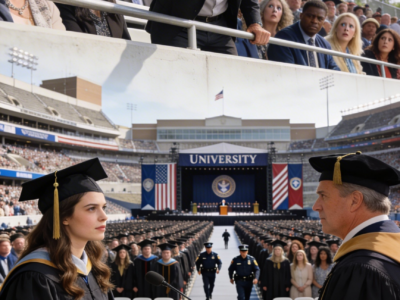
Sophie graduated high school on a warm May evening, wearing a blue cap and gown that made her look older than I was ready for.
We sat in the bleachers with Ben on one side of me and Carter on the other. Carter fidgeted through most of the ceremony, but when Sophie’s name was called he stood up so fast his knee hit the bench.
“That’s my sister!” he shouted, and several parents turned and smiled.
Sophie walked across the stage with her shoulders back, her face calm. She accepted her diploma and looked out into the crowd.
Her eyes found us.
She smiled—not the polite mask smile she’d worn for years, but a real one that reached her eyes and made her look like she’d been lit from inside.
Margaret sat a few rows down from us, the blue scarf wrapped around her neck even though the evening was warm. When Sophie looked her way, Margaret lifted her chin in a small nod that somehow carried the weight of a whole family saying, You belong.
After the ceremony, Sophie fought her way through the crowd and ran straight into our arms.
Ben hugged her first, long and tight, his eyes wet. Carter launched himself at her like a missile.
Then Sophie turned to me.
For a moment, it was just us, and I could see the years between us—the day in the diner with pancakes, the nights braiding hair, the school projects, the awkward holidays, the Christmas that broke everything open.
Sophie’s voice came out quiet. “You really chose me,” she said.
I swallowed hard. “Always,” I whispered. “I’m sorry it took me too long to say it loud.”
Sophie shook her head. “You said it with actions,” she said. “You just… finally matched it with words.”
I laughed through tears. “That’s fair.”
We took pictures. We ate too much celebratory food. Carter made Sophie wear his ridiculous handmade paper crown that said Best Sister Ever.
Later that night, after Sophie’s friends had gone home and the house got quiet, Sophie sat at the kitchen table with her acceptance letter open in front of her.
Ohio State.
Engineering.
Scholarships, plus Margaret’s trust set up to cover whatever scholarships didn’t.
Sophie traced her finger along the printed words like she was making sure they were real.
“You ready?” Ben asked her.
Sophie took a deep breath. “Yeah,” she said. “I think so.”
Carter, now ten, frowned. “I’m not,” he said. “Who’s going to tell me if my math homework is wrong?”
Sophie reached over and flicked his forehead lightly. “You’ll survive.”
Carter huffed. “Barely.”
Sophie smiled and looked at me. “I’m scared,” she admitted.
I nodded. “Me too.”
She tilted her head. “You’re scared?”
“Of course,” I said. “You’re my kid. I’m going to miss you. I’m going to worry. That’s part of it.”
Sophie’s eyes softened. “But you’re still going to let me go.”
“Yes,” I said. “Because love isn’t holding someone tight so they can’t move. Love is giving them a home they can launch from.”
Sophie stared at me for a long moment, then she stood up and hugged me.
“I love you,” she whispered.
I closed my eyes and held her. “I love you too.”
That summer, Margaret took a trip to Switzerland and sent us a photo from the mountains. Snow peaked behind her like a postcard.
She was smiling wide.
Wrapped around her neck was that blue scarf with uneven stitches.
Sophie stared at the photo for a long time, then she laughed softly and said, “I can’t believe she wears it everywhere.”
Ben smiled. “She’s making a point.”
Sophie nodded, eyes shining. “Yeah,” she said. “So am I.”
In late August, we helped Sophie move into her dorm. We carried boxes up narrow stairs. Carter complained dramatically about the effort until Sophie handed him a snack, and then he became helpful again.
When it was time to leave, Sophie hugged Carter so hard he squeaked. Then she hugged Ben. Then she hugged me.
She stepped back, wiping her eyes. “Okay,” she said, voice thick. “Go before I change my mind.”
Carter pointed at her. “You’re still stuck with us,” he declared, like a promise.
Sophie laughed through tears. “Good,” she said. “Because I like being stuck with you.”
As we walked back to the car, I felt the ache of letting go and the pride of having raised someone who could stand on her own.
In the passenger seat, Ben reached over and took my hand, the way he’d done years earlier in my parents’ driveway, when we were asking ourselves if we should stay.
We didn’t need to ask anymore.
We’d learned what staying cost.
And we’d learned what leaving made possible.
On the drive home, Carter looked out the window and said quietly, “You think Grandma Linda misses us?”
I kept my eyes on the road. “Probably,” I said.
Carter nodded, thoughtful. “But missing isn’t the same as loving right.”
“No,” I said. “It isn’t.”
Carter leaned back in his seat. “Good,” he said. “Because we’re loved right.”
I glanced in the rearview mirror at my son’s face—so sure, so clear—and I felt the final piece click into place.
That Christmas, my mom had tried to define who counted.
My eight-year-old had rewritten the rules with one sentence.
And the years that followed proved he was right.
Family isn’t who shares your blood.
Family is who holds your hand when the room goes cold, and doesn’t let go.
THE END!
Disclaimer: Our stories are inspired by real-life events but are carefully rewritten for entertainment. Any resemblance to actual people or situations is purely coincidental.