qa-I PULLED AN APACHE WOMAN OUT OF A KILLING FIELD — AND FROM THAT MOMENT ON, SHE REFUSED TO LET ME WALK AWAY…
Part 1
You ever make a choice that changed everything?
Not the kind you weigh for days, turning it over like a coin in your pocket. I mean the kind that hits you in three seconds flat—hard and hot—and you either pull the trigger or you don’t.
I made mine on a Tuesday afternoon in 1881, somewhere between hell and nowhere, when I heard a woman scream.
I was forty-five years old then. Six years into burying my wife. Twenty years into not believing in much of anything. I had eight hundred dollars in my saddlebag—money from selling a ranch I never should’ve bought—and I was headed to Prescott to disappear. Find some land. Build a fence. Die quiet.
The Arizona desert had other plans.
Three shots cracked the air like God breaking bones.
Then her voice—high, desperate—cutting through the heat like a blade through butter.
I could’ve kept riding. Should’ve, probably. I’d been a Texas Ranger once, sure. But I’d hung up that star because I was tired of choosing who lived and who died. Tired of being right. Tired of being wrong.
But some habits don’t die.
They just sleep.
I slid my Winchester ’73 out of the scabbard and urged my horse toward the sound.
The desert wasn’t empty out there. It just looked empty until trouble crawled out of the rocks. Heat shimmered off the ground. Sage and dust and sun-baked stone. The kind of country that swallows blood fast and forgets names even faster.
When I crested the rise, I saw them.
Three men.
Comancheros by the look of them—hard faces, cheap gear, the kind of eyes that didn’t see people so much as profit. Men who made their living stealing Apache women and selling them south, men who’d learned a long time ago that cruelty was easier than work.
They were circling a woman like wolves around a doe.
She had a knife.
One of the men was already bleeding.
She wasn’t begging. She wasn’t crying. She was backing up slow, shoulders squared, knife held steady in front of her like she’d rather die than be taken.
I didn’t ask questions. Didn’t announce myself. Didn’t ride in screaming warnings like I was some dime novel hero.
I just picked a target and ended it.
Sixty yards.
One squeeze.
The first man took the round through the chest and dropped like a puppet with its strings cut.
The other two spun around.
One of them was smart. He threw his hands up for half a heartbeat, then decided he liked living and scrambled for his horse. He mounted and rode hard, kicking up dust, not looking back.
The other was stupid.
He went for his pistol.
I shot him too.
And then there was silence.
Just me, the dead, and her.
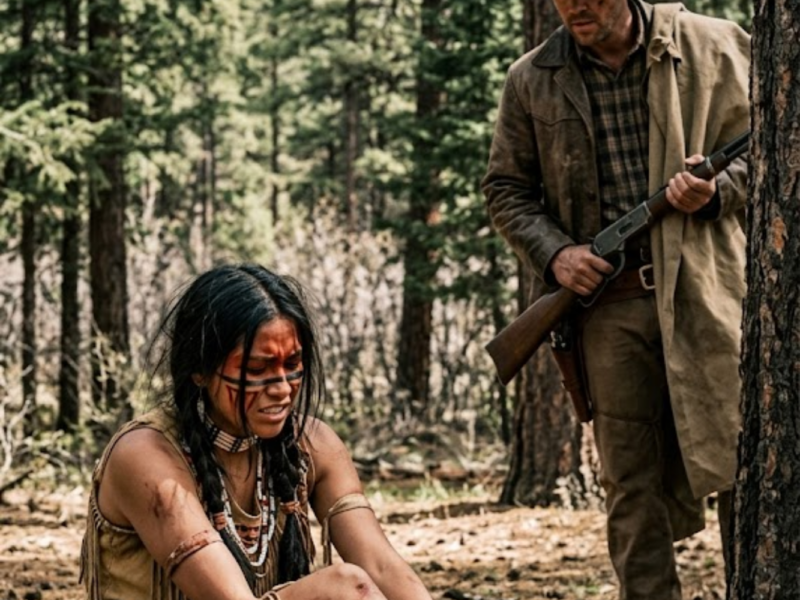
She stood there in a deerskin dress, blood on her hands—some of it hers, most of it not—staring at me like I was either her salvation or her next problem.
She was maybe thirty. Apache, no question. And she didn’t look grateful.
She looked careful.
I guess we both were.
She didn’t run. Didn’t rush me. Didn’t soften. She just held her knife for a moment longer, eyes locked on mine, measuring.
Then she turned toward the dead man I’d dropped first and walked right up to him like she owned the ground under his body. No hesitation. No ceremony. She crouched, flipped him with her boot, and started checking his pockets.
That’s when I knew exactly what kind of trouble I’d stepped into.
I slid off my horse slow, keeping my hands open where she could see them.
“You speak English?” I asked.
She didn’t look up.
“Better than you speak Apache,” she said.
Her accent was light but her tone was sharp—like she didn’t waste words trying to sound polite.
I almost smiled. Almost.
“Fair enough,” I muttered.

When I shifted, pain flared along my ribs. One of those men had gotten off a shot before I finished him. Just a graze, nothing that would kill me, but it bled like hell. The heat made it worse. Blood stuck to my shirt and pulled when I breathed.
She noticed.
Not with sympathy. With a quick, practical glance like she was clocking damage on a horse.
She pointed to a rock in the shade.
“Sit.”
That wasn’t a request.
So I sat.
She walked over, knife still in her hand, tore a strip off the edge of her dress without even asking permission from the sky, and pressed the cloth against my ribs.
Her hands were steady.
Steady as mine had been on the trigger.
She didn’t ask what I’d done. Didn’t thank me. Didn’t even look like she thought it was remarkable that I’d shot two men in the Arizona Territory like it was nothing.
Maybe because to her it wasn’t remarkable.
Maybe because in her world, survival wasn’t a story. It was Tuesday.
We didn’t talk while she worked. What was there to say? I’d killed two men. She’d already cut one of them. The desert didn’t care about explanations.
When she finished binding the cloth tight, she finally asked the question that mattered.
“Why’d you help me?”
I thought about my wife—six years cold. Thought about the Ranger star I’d turned in. Thought about the eight hundred dollars in my saddlebag and the quiet life I’d been chasing like a man chasing a ghost.
I shrugged, then regretted it when my ribs protested.
“Don’t know,” I said. “Maybe I’m old and stupid.”
Her eyes met mine.
Dark. Unreadable. Sharp as flint.
“You’re not that old,” she said. “Old enough to know better.”
She almost smiled.
Almost.
Then she stood, wiped her hands on what was left of her dress, and nodded toward the bodies like she’d already moved on.
“The Comancheros would’ve sold me in Sonora,” she said. “You saved my life. I owe you.”
“You don’t owe me anything,” I said.
“Yes, I do.” No emotion. Just fact. “I need to get to Fort Apache reservation. Two days north.”
I waited, not sure where she was going.
“You take me close,” she continued, “not inside. I know you can’t go inside. But close.” She nodded once, sealing her own deal. “Then we’re even.”
I should’ve said no.
Should’ve given her my canteen, pointed north, and ridden west to Prescott like I planned.
But you know what?
I didn’t.
Maybe because she didn’t ask like she needed me. She asked like she was offering me a bargain. And I respected that.
“All right,” I said. “But we leave now. Those men might have friends.”
She nodded. Didn’t thank me.
Didn’t need to.
We rode north that first night.
The sun dropped behind the rocks and the world cooled fast, the desert trading heat for teeth. We found a canyon that smelled like creosote and old violence and made camp where the walls cut the wind.
I built a fire. She sat across from me—close enough to share warmth, far enough to keep her options open.
Smart woman.
“You got a name?” she asked after a while.
“People call me different things,” I said. “Depends on who’s asking.”
She studied me like I was something she didn’t trust but couldn’t ignore.
“What did your wife call you?”
That one landed heavy.
I took a long pull from my canteen. Wished it was whiskey, but water would have to do.
“She called me by my given name,” I said. “But she’s gone. So that name’s gone too.”
Dahana didn’t push. Just nodded, like she understood that some things you bury so deep even you can’t dig them back up.
“Why were you out there alone?” she asked.
I looked into the fire and watched it chew through wood.
“Headed to Prescott,” I said. “To disappear.”
She didn’t laugh. Didn’t judge. Just listened.
When I didn’t add more, she spoke again, voice low.
“My brother,” she said. “He’s sixteen. He’s got the coughing sickness. What you call tuberculosis.”
I looked up.
“The reservation doctor says he’ll die if he doesn’t get medicine,” she continued. “Real medicine from Tucson.”
“Medicine costs,” I said.
She nodded once, the movement sharp.
“I make things,” she said. “Baskets. Jewelry. I thought I could sell them. I was trying.” Her eyes flicked away like the next words tasted bitter. “The Comancheros found me first.”
I didn’t think too hard.
Maybe I should’ve. Maybe I would’ve if I wasn’t already cracked open by the day.
I reached into my coat, pulled out a hundred-dollar bill, and held it out.
“Take it.”
She didn’t move.
“I don’t take charity.”
“It’s not charity,” I said. “It’s payment.”
“For what?”
“For teaching me how to survive out here,” I said, voice dry. “For not letting me bleed to death like an idiot.”
I kept my hand steady.
“Call it whatever you want,” I said. “Just take it.”
She stared at the money a long moment. Then looked at me. Then, finally, she took it—folded it careful, tucked it into her dress like it mattered.
“I’ll pay you back,” she said.
“Don’t worry about it,” I told her.
We sat in silence after that.
Not the awkward kind.
The kind you can’t force. The kind that happens when two people have seen the same edge of the world and don’t feel the need to dress it up.
And I’ll be honest with you.
I looked at her—really looked.
Not like a Ranger assessing a witness.
Like a man who’d forgotten what it felt like to sit across a fire from a woman who wasn’t a memory.
She was beautiful.
Not in the way some newspaper illustration would paint Apache women. Not exotic. Not savage. None of that garbage.
She was beautiful the way a knife is beautiful.
Sharp. Necessary. Unforgiving.
When she leaned forward to adjust the fire, the light caught the curve of her throat, the line of her collarbone where her dress had torn, and I felt something I hadn’t felt in six years.
Something I thought died with my wife.
I looked away.
“You ever been married?” I asked, trying to steer my mind somewhere safer.
“Yes,” she said.
I waited.
“He died two years ago,” she added, flat as a ledger. “Cavalry patrol shot him. Dispute over water rights.”
No tremble. No drama.
Just fact.
“I’m sorry,” I said.
“Are you?” She tilted her head. “You were a Ranger. Maybe you shot someone’s husband too.”
That was fair.
Didn’t make it easier.
“Yeah,” I said quietly. “I probably did.”
We didn’t talk after that.
Just listened to the fire crackle and coyotes howl somewhere far off.
Before we slept, she said something I didn’t expect.
“You’re not like the other white men I’ve met.”
“How so?”
“You don’t lie about what you are,” she said.
I didn’t know if that was a compliment or an insult.
Didn’t matter.
It was the truth.
Second day, we crossed into territory where the cavalry patrolled heavy.
San Carlos Reservation lay east of us—another hellhole where the government packed Apache families like cattle and called it “peace.” The army didn’t like Indians moving around without papers, and they liked it even less when a white man was involved.
Around noon, Dahana’s head lifted.
“Horses,” she said.
“Get down,” I told her.
She slid off my horse and crouched low behind brush without argument. I kept riding, slow and casual, like I had nothing to hide.
Eight troopers came over the ridge.
They were led by a lieutenant who couldn’t have been more than twenty-five. Shiny buttons. Clean uniform. The kind of officer who read dime novels and thought that meant he understood the West.
“Afternoon,” I called.
He pulled up, eyes narrowing, scanning me, scanning my horse, scanning the empty space beside me like he already knew something was missing.
“You’re a long way from anywhere, mister,” he said.
“That’s the idea,” I answered.
His gaze shifted past me, landed where Dahana hid.
His mouth curled like he’d found something he could feel superior to.
“That your Indian?” he asked, the word sharp with contempt.
My jaw tightened, but I kept my voice level.
“That’s my guide,” I said. “I’m paying her to show me the trail to Prescott.”
“You got papers for her?” he demanded.
“Didn’t know I needed any,” I said.
The lieutenant walked his horse closer.
Too close.
Dahana stayed still, head down, playing the part.
But I saw her hand near her knife.
Saw the tension in her shoulders.
“Lot of renegades moving through here,” the lieutenant said. “We’re under orders to check every Indian we see.”
I reached into my pocket slow, pulled out a twenty-dollar bill, and held it up where he could see it.
“Look,” I said, voice calm. “I’m just a man trying to get from one place to another. I hired her because I don’t know this country. She does. If that’s a problem, I’ll pay the fine and we’ll be on our way.”
I watched greed and authority wrestle on his face.
Greed won.
It usually does.
He snatched the bill like it offended him to accept it.
“Make sure I don’t see you again,” he snapped.
“You won’t,” I said.
They rode off, dust trailing behind them like a warning.
I waited until they were a smear on the horizon before I let out the breath I’d been holding.
Dahana climbed back onto the horse behind me.
I felt her body tense against my back.
“I hate them,” she whispered.
“I know.”
“Do you?” Her voice sharpened. “Do you really?”
I didn’t answer.
Because the truth was, I didn’t. Not fully. Not the way she did.
I’d never had to lower my eyes to stay alive. Never had to pretend I was less than I was just to avoid a bullet.
I swallowed hard.
“I’m sorry,” I said. “It was the only way.”
She was quiet a long time. Then she said, not soft, not forgiving, but honest:
“You understand more than most white men don’t.”
It wasn’t forgiveness.
But it was something.
We rode on late afternoon. The sky turned the color of a bad bruise.
Desert storms don’t warn you. They just hit.
Wind came first—hot and violent—tearing at our clothes and throwing sand into our faces. Thunder followed, low and mean, like the sky was angry about something old.
“There,” Dahana said, pointing.
An outcrop of rock. A shallow cave carved by wind and time.
We made it inside just as the rain started—not gentle, not kind. The kind of rain that floods arroyos and drowns horses.
We were soaked in seconds.
Pressed together in a space barely big enough for two people.
Her body was against mine, not by choice—by necessity.
I could feel her breathing. Feel the heat of her even through wet clothes. Smell her sweat and sage and something else—something I’d forgotten the name of.
“You ever afraid you’re going to die out here?” she asked.
“Every day when I was a Ranger,” I said.
“And now?”
I thought about Prescott. About my eight hundred dollars. About the quiet life I’d been chasing like a ghost.
“Now,” I said slowly, “I don’t know what I’m afraid of anymore.”
She turned her head toward me in the dim light. Our faces were inches apart.
I could’ve kissed her.
Part of me wanted to—the part that remembered being alive.
But I didn’t.
“Your brother,” I said instead. “Tell me about him.”
She blinked, surprised by the question.
Then her mouth twitched—not a smile exactly, but a crack in the armor.
“Naiche,” she said. “He’s stubborn like me. He wants to be a warrior, but…” Her voice trailed off, and the truth sat heavy in the cave. “There’s no room for warriors on the reservation. Just men waiting to die.”
“I’ll get the medicine,” I said.
The words came out before I could stop them.
A promise—dangerous, reckless, real.
“I promise.”
She studied me like she was weighing whether promises were worth anything coming from a man like me.
“Why would you do that?” she asked.
“Because I can,” I said. “Because someone should.”
The storm raged outside.
Inside, we sat in silence, listening to rain hammer the earth, and I realized something that should’ve scared me.
I wasn’t thinking about Prescott anymore.
Wasn’t thinking about fences or quiet or dying alone.
I was thinking about her. About her brother. About a people I’d been taught to fear—and a woman who didn’t need me but let me help anyway.
When the storm passed, we didn’t talk about what almost happened in that cave.
We just rode on into fading light, wet clothes drying on our backs, the desert smelling clean for the first time in months.
And somewhere ahead, two days north, Fort Apache waited.
Part 2
By the third morning, the world looked washed raw.
The storm had wrung the desert out hard—left the air sharp and clean, left the rocks dark like bruises, left the sand packed down in places where it usually floated. My clothes were still damp at the seams. My ribs still barked every time I breathed too deep.
And my mind—my mind wouldn’t go back to Prescott.
Not even when I tried.
We crested a rise as the sun climbed, and there it was in the distance: Fort Apache.
Not beautiful. Not proud.
Just there.
A hard shape on the land—timber and canvas and smoke—surrounded by open country that didn’t care who drew lines on maps. I’d been near posts like that before. Places where the government pretended it could tame a people by fencing them in and calling it peace.
Dahana pulled up so sudden my horse tossed his head.
Her hand came out and rested on my forearm—light, but firm.
“You can’t go further,” she said.
“I know,” I answered.
I’d known since the moment she asked for “close, not inside.” A white man riding into a reservation wasn’t just an insult. It was a spark in dry grass.
But she didn’t take her hand away.
She hesitated, like the next words had weight.
“Do you want to meet my brother?” she asked.
That was a question.
And it wasn’t casual.
It wasn’t polite.
It was careful. Hopeful in a way she was trying to hide.
Going into an Apache reservation as a white man felt like walking into a den of rattlesnakes wearing bacon for boots. I knew what I’d done as a Ranger. I knew what men like me had done in places like this. I knew what I represented without meaning to.
But the way she asked—like she was offering me something instead of begging—made it hard to turn away.
“Yeah,” I said, surprising myself with how fast it came out. “I’d like that.”
Dahana nodded once, and that was all the permission I got.
We rode in slow.
Not proud. Not sneaking. Just slow—like I was trying to show the land I understood I didn’t own it.
Eyes watched us from the edges.
Men stood in shadow, lean and hard, faces set. Their gaze moved over me the way a rifle sight moves—steady, measuring, not impressed.
I’d been stared at before.
This was different.
This was the stare of people who had outlived the lies I’d been raised on.
A man stepped forward.
Younger than the rest. Scar across his cheek that made him look meaner than he probably was. But the eyes—those eyes weren’t wild. They were focused.
He said something in Apache, sharp and quick.
Dahana answered. Her voice stayed controlled, but I heard the tension in it. They went back and forth, the words rising, then tightening, like they were pulling on a rope neither wanted to snap.
The young man’s gaze kept sliding to me.
Like I was a mistake he didn’t intend to allow.
Finally, Dahana turned half toward me.
“This is Ko,” she said.
Ko didn’t nod. Didn’t offer his hand. Just stared, jaw tight.
Dahana’s voice dropped.
“We were supposed to marry,” she said, and her tone made it clear it wasn’t a romantic confession. Just a fact. A plan that belonged to a life before cavalry bullets and stolen land.
Well.
That explained the look he was giving me.
Ko spoke again, shorter this time. Dahana answered, firmer.
He stared at her. Then at me.
I cleared my throat, because silence felt like surrender and I wasn’t sure surrender was wise.
“Tell him I’m just helping you get home,” I said. “That’s it.”
Dahana translated.
Ko’s expression didn’t soften. But after a long beat, he stepped aside, moving just enough to let us pass like it was his decision and not hers.
He didn’t look convinced.
He looked like he was filing my face away for later.
We rode into the village.
Wickiups and canvas tents. Cook fires. Smoke curling into a sky too big for one nation to claim. Children played in the dust—quietly, watchfully, the way kids do when they grow up in places that teach you to listen before you laugh.
It looked like every reservation I’d ever seen.
Which is to say, it looked like defeat dressed up as policy.
Dahana led me toward a small shelter near the edge, away from the busiest part, away from the men watching.
“This way,” she said, and for the first time since I’d met her, I heard something in her voice that wasn’t blade-sharp.
Nerves.
We dismounted.
My horse snorted and shifted. Somewhere nearby, a dog barked once and went quiet.
Dahana pushed aside a flap and stepped in.
I followed, careful.
Inside, the air was warmer and smelled like smoke and sickness. A blanket lay on the ground, and on it was a boy.
Thin as a ghost.
His chest rattled with every breath like there was gravel in his lungs. His skin looked stretched over bone. His eyes—God—his eyes were too old for his face.
This was Naiche.
He looked at me without fear.
“You’re the white man,” he said in English.
His voice was weak but clear, like he’d used it enough to make it a weapon.
“I am,” I said.
He coughed—a wet, ugly sound that made my stomach tighten.
When he caught his breath, he spoke again.
“You saved my sister.”
“She saved herself,” I said. “I just happened to be there.”
Naiche watched me a long moment, then let out another cough that shook his whole body.
When it passed, he fixed me with those hard, old eyes again.
“If you hurt her,” he said, voice low, “I’ll find you.”
I blinked.
He wasn’t joking.
He wasn’t being dramatic.
He was making a promise from a body that was already halfway gone.
“Even if I have to crawl out of my grave to do it,” he added.
I liked him immediately.
“That’s fair,” I said quietly. “I’m not here to hurt anyone.”
Naiche kept staring like he didn’t believe in words, only in what followed them.
Dahana stood at his side, hands clenched at her skirt, trying not to show how terrified she was. She’d been iron out on the trail. In here, beside her brother, I could see the cracks.
I reached into my coat slowly—slow enough that no one in that shelter thought I was going for a gun—and pulled out what I had left.
Seven hundred dollars.
The rest of my money. The quiet life. The fence. Prescott.
I held it out to Dahana.
“This is for the medicine,” I said. “And whatever else you need.”
Her eyes went wide like I’d handed her dynamite.
“This is too much,” she whispered.
“It’s what I got,” I said. “Take it.”
She didn’t move.
Pride, fear, disbelief—everything fighting in her face.
Naiche’s voice cut through, weak but steady.
“Sister,” he said. “Take it.”
Dahana swallowed hard. Her hands trembled as she reached out and took the money. She folded it carefully, like it was fragile, like it could disappear if she breathed wrong.
And for the first time since I’d met her, I saw tears in her eyes.
Not falling yet.
Just there. Waiting.
She blinked them back fast—like she hated the weakness of it.
But I saw.
I saw what that money meant.
Not comfort.
Not luxury.
Time.
A chance.
Outside, I heard movement.
Ko’s voice, sharp, arguing with someone else. Dahana tensed.
“We should go,” she said softly.
I nodded once.
I backed out of the shelter, giving Naiche a small nod of respect.
He watched me like a judge.
I stepped into the sunlight again and felt eyes on my back.
Ko stood nearby with his arms crossed, face hard.
He didn’t say anything to me.
But he didn’t have to.
His stare said plenty.
I made camp on the edge of the village that night, where I wouldn’t offend anyone by taking up space in the center. Where I could leave fast if I had to.
The stars came out bright and cold. The air smelled like juniper smoke and dust that still held a faint memory of rain.
I sat by a small fire and tried to pretend I was still headed to Prescott.
Tried to pretend I still had a plan.
But the truth was, that seven hundred dollars had taken my plan out back and shot it.
And I wasn’t even mad about it.
Footsteps approached through the dark.
Soft. Careful.
I looked up, hand drifting toward my rifle out of habit, then stopping when I saw her.
Dahana.
She stepped into the firelight like she belonged there, her face calm but her eyes full of something restless.
“Walk with me,” she said.
Not a request.
Not a command.
Just… a decision.
I stood. Dusted my hands off on my pants.
“All right,” I said.
We walked in silence at first, the kind of silence that isn’t empty. The kind that holds too many words and doesn’t know which one to let out first.
The creek behind the village ran thin but steady, water whispering over rocks like it was telling secrets to itself. We sat on the bank and listened for a while, letting the sound do the talking neither of us wanted to do.
Finally, Dahana spoke.
“Tomorrow you’ll leave,” she said. “That was the deal.”
“That was the plan,” I answered.
She picked up a stone and tossed it into the water. It made a small plunk, then vanished like it never existed.
“And you’ll go to Prescott,” she continued. “Buy your land. Build your fence.”
“That’s the plan,” I repeated, but my voice didn’t have conviction in it anymore.
Dahana’s eyes shifted to me, sharp.
“You don’t want to,” she said.
I let out a slow breath.
“What makes you say that?”
She didn’t smile.
“Because if you did,” she said, “you wouldn’t have given me all your money.”
Damn.
She had me there.
I leaned back on my hands and stared up at the stars like they might help me lie better.
“Maybe I’m just stupid,” I said.
“You’re not stupid,” she replied, quiet and certain.
Then she turned toward me fully, and the firelight caught her face in a way that made her look like something out of a dream I’d forgotten I had.
“You’re running,” she said.
The word hit hard.
“Same as me.”
I swallowed.
“Running from what?” she asked, though her eyes already held part of the answer.
I thought of my wife, six years in the ground. Thought of the Ranger star I’d turned in. Thought of nights when my hands shook and the only way to stop them was whiskey or work.
“I’m running from…” I started, then stopped, because saying it out loud made it too real.
Dahana didn’t push.
She just kept talking, voice cracking for the first time since I’d met her.
“I’m running too,” she said. “From my husband being dead. From my people dying. From the fact that everything I was taught to believe in is gone.”
Her voice broke on the last word.
“And I don’t know how to stop running.”
The confession sat between us like a live coal.
Without thinking too hard—because thinking too hard was how I talked myself out of anything good—I reached out and took her hand.
It was the first time I’d touched her without a reason.
Not bandaging a wound.
Not helping her onto a horse.
Just because I wanted to.
She looked down at our hands like she didn’t trust what she was seeing.
Then she looked back at me.
“Maybe we don’t stop,” I said.
My voice came out low, steady, honest.
“Maybe we just… run together for a while.”
Dahana’s breath caught.
Her eyes searched mine like she was looking for the trick.
I didn’t have one.
And then she leaned in and kissed me.
It wasn’t soft.
It wasn’t careful.
It was desperate and hungry and full of everything neither of us knew how to say.
I kissed her back, pulling her close, feeling the warmth of her—real and alive—against a body that had felt like a coffin for six years.
We ended up on the ground by the creek, the stars bright overhead, the water whispering beside us like it was keeping watch.
I won’t dress it up for you.
It wasn’t some pretty storybook romance.
It was two broken souls colliding in the dark, both of us trying to remember what it felt like to be human.
For the first time in six years, I didn’t feel like a dead man pretending to breathe.
When it was over, we lay there, her head on my chest, my hand tracing slow patterns on her back like I needed to keep touch real so the world didn’t vanish again.
After a long silence, she spoke.
“I don’t love you,” she said quietly.
I didn’t flinch.
“I know,” I said.
She lifted her head slightly, studying my face.
“But I respect you,” she said. “And I need you.”
I swallowed.
“I know that too.”
She propped herself up on one elbow and looked me dead in the eye.
“My brother needs medicine,” she said. “My people need allies.”
She nodded once, like she’d made her own decision.
“You could be that,” she continued. “You could help us.”
The words hit heavier than any bullet.
“And if I stay,” she added, “then you stay.”
Not as my husband,” she said, like she was cutting off the fantasy before it could grow teeth. “Not as a hero. Just as a man who chooses to do the right thing.”
I stared at her.
This woman who’d been through hell and come out the other side with a knife in her hand and fire in her eyes.
This woman who didn’t need me to save her, but was giving me a chance to save myself.
“What if I’m not a good man?” I asked.
Dahana didn’t hesitate.
“You’re good enough,” she said.
And maybe that was all any of us could hope for.
Morning came too fast.
I woke up to the sound of boots in dirt and the feeling of being watched.
I opened my eyes and found Ko standing over me, arms crossed, face set like stone.
He looked like he’d been thinking about killing me all night and was still weighing whether it was worth the trouble.
“We’re going to Tucson,” he said.
His voice didn’t invite argument.
“For the medicine,” he added. “You’re coming.”
I sat up slow, rubbing sleep from my eyes, feeling the ache in my ribs and the heavier ache in my chest.
Ko’s eyes narrowed.
“You know how to deal with white men,” he said, like the words tasted bitter. “I don’t.”
I looked past him and saw Dahana watching from a distance.
She didn’t smile.
Didn’t wave.
She just nodded once, small and sure.
Like this was the moment.
Like this was the turn in the road.
I nodded back.
“All right,” I said to Ko, voice rough. “We’ll go.”
Ko didn’t thank me.
He just turned and started walking like he expected me to follow.
I stood, gathered my gear, and took one last glance toward the creek.
Toward the place where I’d stopped running for a few hours and remembered what warmth felt like.
Prescott was west.
Quiet life.
Fence.
Die alone.
And for the first time, it didn’t feel like a plan.
It felt like a lie I’d been telling myself so I didn’t have to risk anything.
I swung into the saddle and followed Ko out into the morning.
Toward Tucson.
Toward medicine.
Toward the kind of choice that didn’t end in quiet.
Part 3
Ko didn’t ride beside me like a man on a shared errand.
He rode like a man escorting a prisoner.
His horse stayed half a length ahead, always angled just enough that if I tried something stupid, he’d be on me before I finished thinking it. His eyes kept scanning the horizon, then cutting back to me, then back out again—like he expected white men to appear out of the dirt the way snakes do.
Maybe he wasn’t wrong.
We left Fort Apache at first light. The village still slept under a thin blanket of smoke from cook fires that had burned down to coals. Somewhere behind us, Naiche was breathing—ragged, stubborn, alive—and that was the only reason I didn’t turn my horse west and run back to my old lie of a life.
Prescott.
Fence.
Quiet.
Die alone.
Ko spat once into the dust, like he was clearing the taste of my presence out of his mouth.
“You stay close,” he said without looking at me.
“I’m not going anywhere,” I answered.
He finally glanced over. The scar on his cheek pulled when his jaw tightened.
“White men always say that,” he muttered.
I could’ve argued. Could’ve tried to convince him I was different.
But if there’s one thing I learned wearing that Ranger star, it’s this:
A man doesn’t owe you trust because you want it.
So I said nothing and rode.
The desert stretched open and cruel. Morning light made the rocks look almost gentle from a distance, like the land was pretending to be kind. By noon, that kindness burned off. Heat rolled up off the earth in waves. The air shimmered. Our horses’ breaths came heavy.
Ko didn’t stop much. He didn’t like lingering. Every pause in this country felt like an invitation for trouble.
We drank from canteens. We rode. We watched the ridges.
And somewhere in those quiet miles, Ko finally spoke again.
“You were a Ranger,” he said.
It wasn’t a question. It was accusation.
“Once,” I replied.
“Did you kill Apache?” His voice stayed flat, like he was asking how many fence posts I’d set.
I didn’t pretend.
“Yeah,” I said.
Ko’s eyes narrowed.
“How many?”
I swallowed. The honest answer was: more than I ever wanted to count. Enough to wake up sweating some nights. Enough to make the star feel heavy in my pocket even after I turned it in.
“I don’t know,” I said. “Too many.”
Ko’s mouth tightened.
“You say that like it makes it better.”
“It doesn’t,” I said. “It just makes it true.”
He rode in silence after that, and I could feel the hate in it like heat off stone.
But there was something else under it too.
Curiosity.
Because if I was what he thought I was—a liar, a thief in a different uniform—why would I give away my money? Why would I be riding to Tucson with him instead of running for comfort?
Ko wasn’t ready to ask that out loud yet.
Neither was I.
Tucson hit us like a different kind of storm.
Not rain and thunder.
Noise.
Life.
The place wasn’t the polished city people imagine when they hear the word. It was dust and adobe and crowded streets, wagons jammed tight, horses snorting, men shouting in English and Spanish and a dozen tongues that sounded like the West itself trying to speak all at once.
The smell was worse than any saloon.
Sweat. Manure. Smoke. Frying meat. Cheap perfume. Hot metal.
Ko stiffened the moment we reached the edge of town.
His hand drifted toward the knife at his belt, not drawing it, just letting me know he remembered it existed.
“You keep your head down,” I told him quietly.
Ko shot me a look like he hated being told anything by me.
“I don’t bow,” he said.
“Then don’t,” I said. “Just don’t start a war in the middle of Tucson.”
Ko snorted.
We moved through the streets slow. People stared—some curious, some hostile, some just hungry for something different to look at. Ko’s skin marked him. His clothes marked him. And no matter how much Tucson pretended to be civilized, it was still a place built on the idea that some men belonged and others didn’t.
Ko didn’t belong.
Not in their eyes.
And I… I belonged just enough to be dangerous.
We found a doctor’s office near a cluster of shops. A small sign. A narrow door. The kind of place that smelled like old paper and sharp chemicals.
Ko stopped outside, eyes scanning, jaw hard.
“You go,” he said.
I raised an eyebrow.
“You don’t trust me in there?” I asked.
Ko’s gaze burned.
“I don’t trust you anywhere,” he said. “But you talk to white men better.”
Fair.
I stepped inside.
The room was dim and hot, a fan turning lazy in the corner like it didn’t care who sweated. Shelves lined with bottles. Jars. Labels in ink that had faded.
A man in a stained shirt looked up from behind a counter. His eyes flicked over me, then toward the door, like he was already expecting trouble to walk in after me.
“What do you need?” he asked.
“Medicine,” I said. “For the coughing sickness. Tuberculosis.”
His expression changed—just a little. Not sympathy. Calculation.
“You got money?” he asked.
I set my jaw.
“I do,” I said.
“How much?”
“That depends,” I replied. “On whether you’re selling medicine or selling a story.”
The man’s eyes narrowed.
“You a lawman?” he asked.
“No,” I said. “Not anymore.”
He stared a moment, then leaned forward.
“TB ain’t something you fix with a bottle,” he said, like he enjoyed saying it.
“I didn’t ask for a miracle,” I answered. “I asked for medicine.”
He studied me, then glanced toward the door again, like he could sense Ko outside even without seeing him.
“Who’s it for?” he asked.
I didn’t lie.
“An Apache boy,” I said.
The man’s mouth tightened.
“That’ll cost you more,” he said.
There it was. The ugly truth laid out plain.
I felt heat rise in my gut—old Ranger heat, the kind that used to make my hand drift toward my gun.
I forced it down.
“Name your price,” I said, voice calm.
He did.
And it was too high. Not because the medicine was rare. Because the boy was Apache.
I stared at him a long beat, then reached into my coat and pulled the remaining bills out—most of what I had left. The money I’d been saving for a fence. The money that was supposed to buy me a quiet grave.
I set it on the counter.
“Give me what’s real,” I said. “Not what makes you feel powerful.”
The man hesitated. Greed wrestled with whatever conscience he had left. Greed usually won in the West.
It did again.
He snatched the bills, then turned and started pulling bottles from shelves, muttering to himself. He wrapped them in cloth, tied them tight.
When he shoved the bundle across the counter, I grabbed it and held his gaze.
“If that boy dies because you sold me water and lies,” I said quietly, “I’ll come back and you’ll wish I hadn’t.”
His eyes widened.
He swallowed.
“Get out,” he snapped, as if anger could cover fear.
I turned and walked out, bundle tucked close like it was fragile.
Ko was waiting outside, arms crossed, face hard.
He looked at the bundle. Then at me.
Then, for the first time, his eyes flickered with something like respect—so fast you might’ve missed it.
“How much?” he asked.
“All I had left,” I said.
Ko stared at me a long moment.
“You’re either stupid,” he said, “or serious.”
I shrugged.
“Both,” I answered.
Ko’s mouth twitched—almost a smile, but he killed it before it could live.
“Come,” he said.
And we rode.
The ride back felt longer.
Not because the distance changed.
Because the stakes did.
Every mile out of Tucson felt like it mattered. Every hour of sunlight felt like it might be the difference between Naiche breathing and Naiche being gone.
Ko pushed the horses hard. I didn’t argue. My ribs ached. My thighs burned. Dust caked my mouth until my tongue felt like sandpaper.
We rode through heat and into cold, slept little, ate less.
Ko didn’t talk much, but once—late on the second night—he finally said something I hadn’t expected.
“You did not have to do this,” he said, staring into the dark.
“No,” I admitted. “I didn’t.”
“Why?” he asked, voice tight, like the question cost him.
I thought about Dahana’s hand in mine. Thought about Naiche’s eyes. Thought about my wife in the ground, and the kind of man I’d become after.
I could’ve given him some pretty answer.
I didn’t.
“Because I’m tired,” I said. “Of being a man who only takes.”
Ko didn’t respond right away.
Then, quietly, he said, “My people are tired too.”
That was the closest thing to agreement we had.
And it was enough.
When we reached Fort Apache again, the village saw us coming.
Men moved out of the shadows. Women watched from doorways. Children stopped playing in the dust to stare at the two riders who’d left and returned carrying something precious.
Ko rode ahead, straight toward the shelter where Naiche lay.
Dahana was there before we dismounted, stepping into the open like she’d been holding herself back by sheer force.
Her eyes went straight to my hands.
To the bundle.
Her face tightened.
“Did you get it?” she asked, voice steady but thin.
I nodded once and held it out.
“Yeah,” I said. “I got it.”
Her shoulders dropped a fraction like she’d finally allowed herself to breathe.
She took the bundle carefully, like it might break if she gripped too hard.
Then she looked at me, and for a heartbeat her eyes held something raw.
Gratitude.
Fear.
Hope.
All tangled up.
“Come,” she said.
We went into the shelter.
The air was still thick with smoke and sickness. Naiche lay on the blanket, chest rising and falling in uneven, rattling pulls. His eyes opened when he heard movement.
He looked at Ko first. Then Dahana. Then me.
“You came back,” he rasped.
“I said I would,” I replied.
Naiche coughed, a sound that looked like it hurt his whole body.
When he caught his breath, his eyes narrowed.
“You didn’t have to,” he said.
“I know,” I answered.
Naiche studied me a long moment, then nodded once—slow, like a king granting permission.
“Give it,” he said.
Dahana moved fast then, opening bottles, measuring drops the way people do when they’re terrified of doing it wrong. Ko hovered near the doorway, watching everyone, but I noticed his shoulders weren’t as tight as they’d been.
Dahana coaxed medicine into Naiche’s mouth.
Naiche grimaced, then swallowed.
He coughed again, then again, body shaking, and Dahana’s face went pale with fear.
Ko stepped forward automatically, steadying Naiche’s shoulders.
Naiche’s breathing didn’t stop.
He didn’t collapse.
He kept fighting.
And that—after days of riding and spending and promising—felt like the closest thing to victory I’d tasted in years.
Dahana glanced at me then, eyes shining.
“He’s still breathing,” she whispered, like she didn’t trust the words.
“Yeah,” I said softly. “He’s still fighting.”
I should’ve left the next day.
That was what the deal said, wasn’t it?
Deliver her to the reservation. Get close, not inside. Make it even. Ride away.
But I didn’t pack my bedroll.
I didn’t saddle my horse and point it west.
I stayed.
Not forever. Nothing’s forever.
But long enough to matter.
Long enough to stop running.
At first, it was small things.
Helping Dahana carry water without making a show of it.
Fixing a broken wagon wheel when no one else had the tools.
Sitting with Naiche when his cough kept him awake, listening to him talk when he had strength and sitting in silence when he didn’t.
Ko watched me the whole time like he was waiting for the trick.
And maybe I was too.
Because I didn’t trust myself yet either.
But the days kept passing, and I kept staying.
And slowly, the village’s eyes shifted.
Not warm. Not welcoming.
But less sharp.
Less ready to cut.
A trader came through one afternoon with bright cloth and hard smiles, offering pennies for work worth dollars. I watched young men reach for what they could get because hunger doesn’t negotiate.
I stepped in—not with a gun, not with threats.
With words.
With math.
With the kind of calm I used to use in Ranger disputes before bullets started flying.
“That’s not what it’s worth,” I said to the trader, voice flat.
The man scoffed. “And who are you to say?”
“A man who knows when he’s being cheated,” I replied.
The trader’s eyes narrowed, then flicked to the men watching.
It wasn’t fear of me that made him adjust his offer.
It was fear of losing the deal.
But the young men saw something in that moment:
That the world could be pushed back, just a little, without blood.
Dahana watched from the shade, arms folded, eyes unreadable.
Later, she sat beside me by the fire and said quietly, “You teach them.”
I shook my head.
“I’m not a teacher,” I said.
“You’re a man who knows how white men steal,” she replied. “That is teaching.”
So I taught.
Not with speeches.
With small lessons.
How to read a contract mark.
How to count weight honestly.
How to look a trader in the eye and not flinch.
Ko still didn’t like me, but he stopped looking like he wanted to put an arrow through my throat every time I stood near Dahana.
That was progress in its own ugly way.
And Dahana—
We weren’t married.
We weren’t in love the way stories like to pretend—soft and clean and easy.
What we had was sharper than that.
Real.
She didn’t need me to save her. She never had. But she let me help anyway, and that did something to a man like me.
One night, sitting under stars that didn’t care about borders, she said something that stuck with me.
“You came here running,” she said. “Now you sit like you belong.”
“I don’t,” I admitted.
Dahana’s mouth twitched.
“You belong where you choose to stay,” she said.
I didn’t know if that was Apache wisdom or just the truth of surviving long enough to see it.
Maybe both.
I still thought about Prescott sometimes.
About that fence.
About the quiet life I could’ve had if I’d kept riding and let a woman scream out in the desert without turning my head.
But you know what?
Quiet’s overrated.
Quiet is just loneliness with better manners.
I’d rather have dirt under my nails.
Purpose in my chest.
A boy still breathing because we rode hard and didn’t quit.
A woman who looks at me like I’m worth something even when she doesn’t love me—yet.
And here’s the thing nobody tells you when you’re young and stupid and think “home” is a place you buy.
A man doesn’t find home.
Home finds him.
And sometimes home isn’t a cabin or a fence or a patch of land with your name on it.
Sometimes home is a reason.
A reason to keep going when everything in you says to quit.
Do I know if I did the right thing?
No.
I don’t know if any of us do.
But I’m still here.
Still breathing.
Still trying.
And maybe that’s enough.
THE END