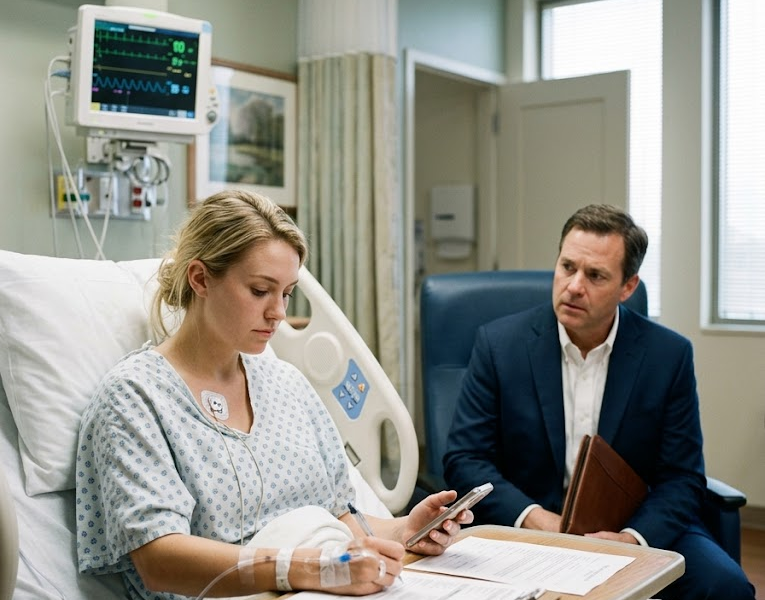
I CALLED MY MOTHER FROM THE OPERATING ROOM TEN MINUTES BEFORE SURGERY, BUT SHE HUNG UP BECAUSE MY SISTER WAS SOBBING OVER A LIVING ROOM DECOR ARGUMENT—SO WHEN I WOKE UP IN THE ICU, I DIDN’T ASK FOR HER AGAIN… I ASKED MY LAWYER TO COME INSTEAD, AND BY THE TIME SHE FINALLY SHOWED UP ACTING LIKE NOTHING HAD HAPPENED, THE PAPERS ON THE TRAY TABLE HAD ALREADY CHANGED WHO CONTROLLED MY LIFE, MY MONEY, AND EVERY DECISION SHE THOUGHT WOULD ALWAYS BE HERS
The fluorescent lights over my head buzzed with that thin, electric whine hospitals seem to collect, like they harvest anxiety and pipe it through the ceiling. A nurse adjusted the IV pole beside my bed, the plastic bag trembling slightly each time she brushed it. Somewhere down the hallway, a cart squeaked, a monitor chimed, someone coughed.
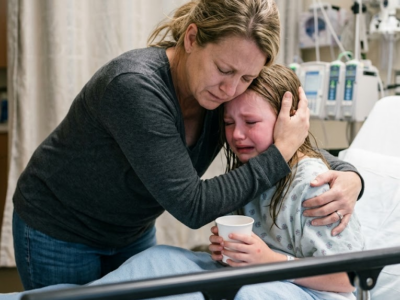
The pre-op room smelled faintly of antiseptic and something sharper I couldn’t name—metallic, clean, unforgiving. A blood pressure cuff squeezed my arm in slow, steady pulses, like a hand that didn’t know it was hurting me.
My phone was warm in my palm.
“Your sister is very upset right now,” my mother said, her voice flat and irritated through the speaker. “This is not the time to be dramatic.”
I stared up at the tiled ceiling and counted the tiny holes in the acoustic panels so I wouldn’t start screaming. It was the same tone she used when I was eight and cried because I’d sprained my ankle at recess. The same tone when I was seventeen and called to say my car had been rear-ended. The same tone when I told her, at twenty-eight, that a specialist had used the words “surgery” and “sooner rather than later.”
I’d never liked that tone. I just hadn’t realized until recently that I didn’t have to live under it.
“I’m being taken into surgery in ten minutes,” I said quietly.
There was a pause—small, dismissive, like she’d set the phone on a table to straighten something. For a heartbeat I heard muffled conversation in the background, then her voice came back sharper.
“She’s crying because you criticized her living room,” my mother replied. “Can this wait?”
Of course. Of course that was the reason.
I closed my eyes and could see the scene as clearly as if I were standing in my sister’s house: the oversized beige sectional, the eucalyptus branches in a white ceramic vase, the aggressively neutral rug that cost more than my car payments for three months. Emma’s latest project, her newest transformation, captured and filtered and posted with a caption like, “Finally feels like home  .”
.”
I had said, in a moment of fatigue and honesty last week, “The couch looks a little big for the space, don’t you think?”
Apparently that was a sin.
“Hi, everyone, my name is Marissa,” I whispered to no one in particular, the way you do when someone is filming you. The anesthesiologist stood at the foot of the bed, checking the order on the chart, his expression neutral and practiced. He didn’t look surprised that I was on the phone. People said frantic things before surgery. He’d heard worse.
“Mom,” I tried again, swallowing against the dryness in my throat. “They’re going to wheel me in soon. I just wanted to hear your voice before they start.”
She sighed. Not the worried kind. The put-upon kind.
“You’re an adult,” she said. “You’ll be fine. I have to deal with your sister right now.”
In the background, I could hear Emma saying something in a high, breathy tone that translated roughly to make her pay attention to me.
Then the line went dead.
No “I love you.” No “You’ve got this.” Just a beep and a blank, glowing screen.
The nurse at my side—her name badge read “JEN – RN”—glanced down and saw my face. Her hands slowed on the straps she’d been fastening around my arm.
“Family on the way?” she asked gently.
I stared at the phone for a long, thin second. The answer was technically “maybe.” Maybe later, if traffic was light and tears over a sofa subsided in time. Maybe if there weren’t any sales at the home decor store on the way.
“No,” I said. My own voice sounded unfamiliar in my ears—too calm, almost weightless. “No one right now.”
Jen’s eyes softened around the edges. “They may come later,” she said, her tone practiced but kind. “Sometimes people just need a little time.”
I could have told her that in my family, “time” meant something else. Time meant we’ll get there when it doesn’t inconvenience us. Time meant if it’s not about Emma, it can wait. Time meant I was old enough to manage, so why rearrange a day for me?
Instead, I just smiled tightly and let her believe whatever made her job easier. It wasn’t her burden to carry.
Because in that moment, staring at the phone in my hand, I understood something important. Something I had been circling for months but never quite put into words.
My surgery was critical.
But my sister’s home decor argument apparently ranked higher on the family priority list.
That realization didn’t make me cry. It didn’t even make me angry in the way it used to. It just…clarified.
I didn’t sob or beg her to come or try one more time to explain. I’d done that dance for years. Every time I thought about doing it again, I could feel the old steps under my feet—apologize, rephrase, minimize my needs so hers could fit in the room.
Instead, I took a slow breath, felt the scratch of the nasal cannula under my nose, and did something else.
I scrolled down my contacts list to a name I never thought I’d call from a hospital bed.
“My surgery starts in a few minutes,” I told my lawyer when he picked up. My voice was steady. “If I wake up, meet me in the ICU tomorrow.”
There was a pause. Not the hesitant, judging kind. The calculating kind. The taking this seriously kind.
“Understood,” he replied.
And that was the moment everything quietly changed.
The surgery lasted six hours.
I remember almost none of it, just flashes—cold operating room lights like distant moons, the rustle of paper gowns, the anesthesiologist’s calm voice telling me to breathe slowly while the medication slid coolly through the IV in my arm. The metallic taste at the back of my throat. Someone placing a mask gently over my face.
“Count backward from ten for me, Marissa.”
Ten.
Nine.
Eight.
Everything narrowed, then vanished, like someone had dimmed the world down to a single pinprick and then snuffed it out.
For a while, there was nothing.
No mother, no sister, no argument over couches.
Just dark, and a body I couldn’t feel, and the distant awareness that I had handed myself over to strangers with sharp tools and steady hands.
When I woke up, the world felt thick and far away, as if I were rising up through layers of water.
There was a beep. Then another. A chorus of beeps, actually—machines humming around my bed, monitors marking time in small electronic increments. The air felt cooler, the light harsher.
“Welcome back, Marissa,” a voice said. Different from Jen’s. Older, maybe. “Can you hear me?”
I blinked. The ceiling above me came into focus first—plain white, a rounded sprinkler head in the corner, a dust mote drifting lazily in a shaft of light. Then a face leaned into view, framed by a pale blue cap and a surgical mask pulled down to her chin.
“Did it work?” I whispered.
My throat hurt. Everything hurt, actually, in a distant, padded sort of way—as if my body had submitted a formal complaint, but the meds were still intercepting most of the messages.
“It went very well,” the nurse said, her eyes wrinkling with what I assumed was a smile. “You’re in the ICU. You did great.”
Relief should have been the loudest emotion in that moment. Relief that I had opened my eyes. Relief that my heart was still beating, that the thing growing inside my chest had been removed before it could do more damage.
Instead, what rose up through the fog was something quieter, sharper.
Clarity.
My phone sat on the small tray beside the bed, placed there neatly by someone who had transferred me from gurney to ICU bed. The case looked absurdly bright in the sterile room—soft teal with a peeling sticker of a tiny plant on the back.
I lifted my hand, felt the tug of the IV line, and inched my fingers toward it. It took longer than it should have to pull it closer and tilt the screen toward me.
No missed calls.
No messages.
No “How did it go?” or “We’re in the lobby.”
Nothing from my mother.
Nothing from my father.
Not even a pity text from my sister.
The nurse adjusted my IV, smiled kindly. “Family usually comes later in the day,” she said, like she was reciting a familiar script. “Sometimes they just need time to get here.”
I didn’t correct her.
I didn’t say, Sometimes they need time to finish an argument about throw pillows.
Instead, I opened my phone and typed one short message.
I’m awake.
I hit send.
The reply came almost instantly, a small bubble popping up at the bottom of my screen.
I’m on my way to the hospital.
I set the phone down and stared at the ceiling again. The beeping of the heart monitor steadied into a reassuring pattern beside me.
My mother still hadn’t called.
But something else had already begun.
Because the legal paperwork we had discussed before surgery—the forms everyone tells you are “just a precaution”—had one purpose: to make sure my life decisions were no longer controlled by people who treated them like optional background noise.
My lawyer arrived that afternoon.
Not dramatically, not like in the legal dramas Emma watched while scrolling Instagram. No booming entrance, no echoing footsteps in a marble hallway.
Just a quiet knock on the ICU door and a man in a dark jacket stepping in, holding a leather folder under his arm.
“Marissa?” he said softly.
I looked over. “Hey,” I managed. My voice was less raspy now but still tired. “You found me.”
He smiled a little. “ICU isn’t that hard to locate when the nurse at the desk is terrified of someone misplacing the woman who just had half her chest opened.” He moved closer to the bed. “How are you feeling?”
“Sore,” I admitted. “Like I got hit by a truck. Then they backed up and checked if they missed a spot.”
“That’s expected,” he said mildly, pulling a chair up beside my bed. His name was Daniel, but I still thought of him as “my lawyer” in the same way people think of “my doctor” or “my therapist.” A professional category who had become, unexpectedly, the only person I trusted not to dismiss me.
He set the folder carefully on the tray table and opened it, the papers inside crisp and perfectly aligned.
“I brought the documents you requested,” he said.
Three months earlier, when my health first started declining, we had sat in his office across from each other while rain tapped against the floor-to-ceiling windows. I’d clutched a paper cup of coffee I didn’t drink while he unfolded phrases I’d only ever heard in passing.
Power of attorney.
Medical authority.
Advance directive.
Financial control.
They sounded like things for old people, for wealthy people with vacation homes and trust funds to distribute, for sick relatives you spoke of in hushed tones.
They did not sound like things for someone my age.
But my cardiologist had looked me in the eye and said, “You’re young, yes. But we’re not playing with a sprained ankle here. This is your heart. It’s surgery. It’s serious. You should consider making sure someone you trust can make decisions for you if something goes wrong.”
Until this morning, my mother had been listed as my emergency decision maker.
Not because she’d earned it.
Because I’d assumed, the way children do, that she would show up.
Daniel slid the papers onto the tray so I could see them without moving too much. The pages were already flagged with small colored tabs.
“Are you certain about the changes?” he asked quietly.
I looked down at the lines of typed text. At my own name, printed neatly in bold. At the blank lines waiting for a signature that would redraw the map of my life.
Was I certain?
Memories rose up in a reluctant parade:
Emma screaming in the bathroom at fourteen because Mom had picked the wrong brand of mascara and Mom racing in with a whole new bag from the store twenty minutes later.
Me, at ten, standing in the nurse’s office with a fever of 103 while the school secretary dialed my mother three times in a row. The voicemail. The call to my dad. The eventual, “Your mother was in the middle of something with your sister.”
Emma sobbing on the phone at twenty-two because her boyfriend had canceled a date, my mother comforting her for hours.
Me, sending a long, careful message at twenty-six: “I think something is wrong. I get dizzy if I walk too fast. My chest hurts sometimes.”
Her reply: “You’re young. You’re probably just stressed. You always were dramatic.”
And then my call from the operating room. The one she’d just hung up on.
“Yes,” I said. My voice was steady. “I’m certain.”
He picked up a pen and handed it to me, carefully arranging it so I wouldn’t strain the IV line in my arm. My hand shook slightly as I wrapped my fingers around it. Not from fear. From the effort.
“One signature,” he said, tapping the first line, “removes your mother’s authority over your medical care. The second removes her access to your financial accounts. The third designates me as your medical and financial proxy, subject to the conditions we outlined before.”
He had explained those conditions in detail weeks ago. This was not a man who left things vague. If I lost consciousness, if I couldn’t speak for myself, if I needed someone to sign off on procedures—he would be the one to listen to the doctors, to weigh the risks, to act in my best interest without worrying about throw pillows.
I took a breath, exhaled slowly, and signed.
One line.
Then another.
Then the last.
Each signature felt less like rebellion and more like rearranging furniture in a house that had never really fit me.
Just as I finished the third, my phone buzzed on the tray.
The sound made both of us look up.
Mom, the screen read.
Of course.
I hit answer.
“Hi,” I said, and listened to my own voice echo faintly back through the speaker before her words rushed in.
“Why didn’t you tell me the surgery was today?” she demanded.
I stared at the signed paperwork for a heartbeat. At my name, at Daniel’s, at the legal language wrapped around them like armor.
“I did,” I said.
“You mentioned something earlier,” my mother said quickly. “But your sister was very upset.”
I could picture Emma’s blotchy, tear-streaked face, the dramatic collapse onto the sofa she was so worried about, the flood of words about how I “never support her” when I offer even the mildest critique. My criticism of her living room—a couch, some plants, a rug—had wounded her more than my impending surgery had moved her.
I leaned back against the hospital pillows, careful not to disturb the stitches across my chest. There was a line of pain there, but it felt more honest than half the phone calls I’d had with my family.
“I called you from the operating room,” I said calmly. “Ten minutes before they took me in.”
“Well, I thought you were exaggerating,” she replied.
Exaggerating.
The word landed between us like something rotten.
“When are you getting discharged?” she asked. “The doctor said it went well, right? How long will you be there?”
“Not for a few days,” I said.
“Oh,” she said, and I heard the subtle shift in her tone, the recalculation. “Your sister and I might come by later this week.”
Might.
I glanced at the folder still open on the tray beside me. At Daniel, watching me with quiet focus. Not intruding. Just present.
“You don’t need to,” I replied.
Silence hummed on the line, sharp as the beeping monitor beside my bed.
“What’s that supposed to mean?” she asked, her voice sharpening.
“It means,” I said, my voice still soft, “I’ve handled everything already.”
“What?” She laughed, a short, disbelieving sound. “Handled what?”
“Everything,” I said. “My medical decisions. My financial decisions. My emergency contacts.”
There was a pause. I could almost hear the gears turning.
“You’re being dramatic again,” she said.
I almost smiled. The familiarity of that line, the way she wielded it like a dull knife, would have been funny if it hadn’t cut so deeply for so many years.
“I’m being practical,” I said.
Daniel quietly gathered the signed papers while I spoke, sliding them back into the leather folder one by one, his movements precise.
“What practical decision?” she demanded.
“The one where you’re no longer responsible for my care.”
Silence filled the line. Not like before, when she’d stopped talking to make room for her annoyance. This was bigger. Thicker.
“What are you talking about?” she finally asked.
“I changed my medical authority this afternoon,” I said.
“You can’t just remove your own mother, Marissa.”
I watched Daniel slide the last document into place and close the folder with a soft click.
“Yes,” I said. “I can.”
“You did what?” my mother snapped.
Her voice was louder now, ricocheting off the plastic edges of the phone.
“I reassigned medical authority,” I repeated. “And power of attorney. And emergency contact.”
“You had no right to do that.”
I looked at Daniel. He raised an eyebrow very slightly, as if to say, Should I explain, or will you?
“I actually had every right,” I said.
“You’re punishing me,” my mom said.
“No,” I replied. “I’m protecting myself.”
“For what?” she demanded. “I wasn’t even there yet.”
Exactly, I thought. Exactly.
Out loud, I said, “I thought about the operating room doors closing behind the gurney while you were debating throw pillows with Emma.”
“That’s not fair,” she snapped. “You know how emotional she gets. She was in tears. I had to calm her down.”
“Mom,” I said slowly, “I was about to go under anesthesia.”
“You survived,” she replied quickly.
The room became very quiet.
Daniel looked up from his folder, not surprised. Just listening.
“I did,” I agreed. “And that gave me time to think.”
“Think about what?” Her impatience crackled down the line.
“About who actually shows up when it matters.”
There was another pause. I could almost see her standing in Emma’s kitchen, one hand on her hip, the other clutching her phone, the new barstools in the background, the tray of candles on the island. I wondered if Emma was listening.
“Fine,” she said sharply. “When can we visit?”
I looked at the heart monitor beside my bed. My pulse blinked across the screen in little green mountains, steady and unwavering.
“You can’t,” I said.
“What do you mean we can’t?”
“I mean you’re no longer listed as family contact,” I said. “You’ll have to check in as visitors.”
“You can’t remove your own mother,” she said again, but the certainty had faded around the edges.
“I already did.”
Daniel slid a second document across the tray, this one thinner. “This confirms the hospital records update,” he said quietly. “Once you sign, their system will be notified of the new proxy and contact information.”
I signed it slowly while my mother was still talking.
“You’re being irrational,” she said. “Hospitals always call family.”
“This one won’t,” I replied.
“Why not?”
“Because you’re not listed as family contact anymore,” I said. “My medical proxy is.”
“Who did you assign that to?” she demanded. Her voice had taken on that familiar, scornful note. “Your therapist? One of your friends?”
“I assigned medical authority to someone who answers the phone,” I said.
Daniel didn’t react, but I saw the tiniest movement at the corner of his mouth, there and gone too quickly to be a smile.
“You chose a stranger over your own mother,” she said sharply.
“He’s not a stranger,” I replied. “He’s reliable.”
That seemed to offend her more than anything else I’d said.
“This is ridiculous,” she said. “When I arrive, we’ll fix it. I’ll talk to the doctor, and we’ll get these silly papers straightened out. You’re in pain. You’re not thinking clearly.”
“You can come to the hospital,” I said calmly. “But you’ll check in like every other visitor.”
“What does that mean?”
“It means you won’t be making decisions,” I said.
The heart monitor beside my bed continued its steady rhythm.
“You’re overreacting,” she said again.
I looked down at the bandage across my chest, at the faint edge of a scar I would carry for the rest of my life.
“No,” I replied quietly. “I’m reorganizing.”
My mother arrived the next afternoon.
Not quietly.
I saw her before I heard her. The ICU had a small window inset in each door so the staff could see in without barging into vulnerable moments. From my bed, I could see through that rectangle, a slice of the waiting area beyond the nurses’ station.
She came into view like a storm front—shoulders squared, lips pressed, her purse slung over her arm like a weapon. She wore a fitted blazer, despite the heat outside, and her hair was styled into careful waves. Emma trailed behind her, mascara perfect, hair in a loose bun that probably took forty minutes.
My father was nowhere in sight. He rarely was when conflict threatened. He preferred to be a voice on speakerphone, neutral and tired.
Mom marched up to the ICU desk. I couldn’t hear her words through the door, but I watched the nurse—a different one today, with curly hair pulled into a bun—type something into the computer, glance at the screen, and then look back up.
“Are you listed as family contact for Marissa Collins?” the nurse asked. I’d heard that question enough times by now to recognize the shape of it on her lips.
“Yes,” my mother said, emphatic. “I’m her mother.”
The nurse checked the screen again. I watched her expression carefully. She didn’t look flustered. Just…prepared.
“I’m sorry, ma’am,” she said. “You’re listed as a visitor.”
My mother blinked. I saw the disbelief cross her features, then the flush rising in her cheeks.
“That’s incorrect,” she said. “There must be a mistake. I’ve always been listed—”
“It was updated yesterday,” the nurse said politely.
Emma stepped closer, peering at the monitor like she could will it to change. “There’s a note,” the nurse added, pointing to something on the screen. “It says that medical decisions and information access are restricted to the designated proxy on file.”
“I am the proxy,” my mother insisted, jabbing a manicured finger toward her own chest.
The nurse shook her head slightly. “Not according to this,” she said. “I’m sorry. You’re authorized to visit as long as Ms. Collins consents, but we can’t give you updates or allow you to make decisions unless she changes the paperwork.”
I watched the entire exchange through the small glass panel. My heart rate ticked up on the monitor; the green peaks jumped, and the machine let out a sharper, faster beep.
Daniel stood beside my bed, his arms folded loosely, watching as well.
“She’s not authorized for medical decisions,” the nurse said again.
My mother’s voice sharpened, even through the thick ICU door.
“I am her mother,” she said.
“Yes, ma’am,” the nurse replied calmly. “But not her medical proxy.”
The words landed harder than I’d expected, even for me.
Mom turned and finally saw me watching from inside the room. Our gazes collided through the glass. For a fraction of a second, her expression was naked—shock, anger, disbelief all tumbling over each other. Then the familiar mask slid back into place.
She pushed open the door without waiting for permission and stepped inside. Emma stayed in the hallway, arms wrapped around herself, eyes darting from the nurse to me like she’d stumbled into the wrong theater.
“What did you do?” Mom demanded as the door swung shut behind her.
I didn’t raise my voice. I didn’t even sit up straighter. Any sudden movement tugged at the stitches.
“I made sure the person responsible for my life answers when I call,” I said.
Her eyes flicked briefly toward Daniel, then back to me. “You replaced me with him?” she asked, incredulous.
“Yes,” I said simply.
For the first time in my life, she looked like she had no control left. Like the room was not arranged around her.
“You’re being dramatic,” she said after a long moment, reverting to her favorite accusation as if it were a lifeline.
I almost laughed. If this was drama, it was the quiet kind the world didn’t applaud. The kind where a woman sitting in a hospital bed signed her name on a line and rearranged the gravity that had held her down her entire life.
“I was about to go into surgery,” I replied quietly. “I called you from the operating room.”
“You made it sound like an emergency,” she said.
“It was,” I said.
She folded her arms, tilting her chin up slightly. “Your sister was in tears,” she said.
I looked at her carefully. She didn’t even flinch when she said it.
“About a sofa,” I said.
“That’s not the point.”
For the first time, I realized it finally was.
The nurse stepped inside briefly, checking my monitor, adjusting the IV, pretending not to listen. She gave my mother a polite nod, then left again, closing the door softly behind her. The sound was quiet but decisive.
Mom glanced around the ICU room, taking in the machines, the tubes, the bandage across my chest, the faint bruises blossoming near my IV. She looked uncomfortable, not because of my pain, but because this was a place where her usual tricks didn’t work. She couldn’t charm a monitor or guilt an IV drip.
“You should have waited for me,” she said.
I looked at her. “I did,” I said.
Silence followed. It stretched between us, filled with years of smaller silences I’d never questioned before.
“Your lawyer shouldn’t be making family decisions,” she added, jerking her chin toward Daniel as if he weren’t in the room.
“He isn’t,” I said. “I am.”
The difference seemed to register slowly, like a new language she didn’t want to learn.
“This isn’t how families work,” she said. “You don’t cut people out because they make a mistake.”
“It’s not a mistake if it’s a pattern,” I replied.
She opened her mouth, closed it again.
“You’ll regret cutting family out,” she warned.
I looked down at the faint scar beneath the bandage on my chest and imagined the years ahead of me, the life I might have, the things I could build if I stopped begging to be prioritized.
“No,” I said. “I’ll regret ignoring reality.”
My heart monitor continued its steady rhythm beside the bed. Stronger than her authority. Stronger than her absence.
She stayed for sixteen minutes.
I knew because the wall clock in the ICU ticked loudly, second by second, and there was little else to focus on after the initial confrontation settled into uneasy conversation.
She asked perfunctory questions about the surgery—What did they do exactly? How long will you be here? Are there going to be scars?—her tone clipped and businesslike.
Daniel answered when the questions become too technical, explaining the procedure in calm, nonjudgmental terms. He used words like “successful” and “promising,” and never once looked at my mother for approval.
She shifted topics quickly.
“Emma wanted to come in,” she said. “But she thought it might upset you.”
“Why would it upset me?” I asked.
“Because of the argument last week,” she said. “You know she’s sensitive.”
“I know,” I said. I also knew that my imminent surgery hadn’t made the list of things worth pushing through that sensitivity for.
“You really hurt her feelings about the living room,” Mom added.
I realized then that if I hadn’t changed my paperwork, this entire conversation would have been about Emma’s feelings and my tone and whether it was necessary to mention that a couch was too large for a room.
“She criticized my health,” I said softly. “You didn’t seem concerned about that.”
Mom frowned. “What are you talking about?”
“When I told you I was scared something was wrong,” I said. “You told me I was being dramatic.”
“You were always like that, even as a child,” she said, as if that explained everything. “Everything was an emergency with you. If I jumped every time you called, what kind of life would I have?”
“One where your daughter doesn’t sign legal papers to keep you away from her medical decisions,” Daniel said mildly.
We both turned to look at him.
“Excuse me?” my mother said.
He spoke like he was explaining a contract. Calm, even, the way you talk to someone who might sign something they don’t fully understand.
“Marissa hasn’t cut you out of her life,” he said. “She’s set boundaries around the areas where your behavior has been demonstrably unreliable.”
“You don’t know anything about our family,” she snapped.
“I know that when she called you from the operating room, you hung up,” he replied. “And I know that when we spoke, she was lucid, informed, and consistent in her reasoning.”
“I don’t need your opinion,” she said.
“I didn’t offer one,” he said. “I’m stating the facts that led to a set of legally binding decisions.”
She turned back to me. “He’s turning you against us.”
I almost laughed. “He didn’t answer the phone for you,” I said. “You did that.”
Her jaw clenched.
“We’ll talk about this when you’re out,” she said. “You’re on medication. You’re not thinking clearly.”
I thought about the months leading up to the surgery, the therapy sessions where I’d unboxed years of favoritism and dismissal and tiny cuts that had added up to something deep and bleeding.
I thought about the day I’d walked into Daniel’s office with a folder of test results and a list of questions, my hands shaking, my voice small.
“Actually,” I said, “I’ve never thought more clearly.”
We stared at each other for a long moment. Then she looked away, adjusting the strap of her purse.
“We should go,” she said. “I have things to do, and Emma gets nervous in hospitals.”
She didn’t ask if I wanted them to stay. Didn’t squeeze my hand. Didn’t say, “I love you.”
“Okay,” I said.
She hesitated at the door.
“This isn’t the end of this,” she said.
“I know,” I replied.
Then she was gone.
Through the window, I watched her and Emma walk back toward the elevators. Emma glanced over her shoulder once, her face unreadable, then turned away.
The door clicked softly as it closed.
Daniel waited a moment, then sat down again.
“You all right?” he asked.
I let out a breath I didn’t realize I’d been holding.
“Yes,” I said. “Actually, I think I am.”
Recovery was slow.
Days blurred into one another, marked by the repetitive rituals of vital checks and blood draws and pill cups. The pain shifted from sharp and electric to dull and insistent. I learned how to sit up without feeling like my chest would split open. I learned how to sleep through the beeping and the hallway voices and the distant code calls.
Flowers arrived from coworkers. A card came from my boss, a generic “Get Well Soon” with a handwritten note about not worrying about work. A bouquet of pale pink roses appeared one afternoon with no name on the card, just a short message in blocky handwriting: You scared me. Don’t do it again. It was from my friend Lena; I recognized the sarcasm.
Nothing came from my mother.
She called twice more before I was discharged.
The first time, I let it go to voicemail. The second time, curiosity nudged me to answer. The conversation lasted three minutes. She asked when I would be going back to work. She told me Emma was redecorating again. She did not ask how I was feeling.
“I’ll come by once you’re home,” she said at the end. “We can sit down and have a real talk about all this. You’ll see it differently once you’re not in that place.”
I pictured my apartment, the quiet of it, the stack of legal documents in my bag, the scar healing under my shirt.
“We’ll see,” I said.
On my last day in the hospital, Daniel stopped by one more time. I was dressed in real clothes for the first time in days—soft leggings, an oversized sweater I could pull on gently over the bandages.
“You’re being discharged,” he said, glancing at the chart hanging at the end of the bed.
“Apparently they’ve gotten all they can out of me,” I said. “Now they need the bed.”
He smiled slightly. “Hospitals are like that.”
He handed me a small envelope. “This is your copy of everything,” he said. “Medical proxy, power of attorney, financial arrangements. We’ll keep originals on file, but I want you to have this.”
I held the envelope, the weight of it strange in my hand.
“So that’s it,” I said.
“For now,” he said. “There will probably be fallout. Your mother might call. She might show up. She might threaten to get a lawyer of her own. She might try to talk to your doctor.”
“She threatened to ‘fix’ it when she got here,” I said.
“She can’t,” he replied. “Not without your consent. And based on what I’ve seen, I don’t think you’re about to give that.”
I traced the edge of the envelope with my thumb.
“Do people do this a lot?” I asked. “Change their paperwork like this?”
He considered. “People take back control in different ways,” he said. “Some change their wills. Some block phone numbers. Some move to another city. You chose the level of trust each person has with your physical body and your daily life. It’s not unusual.”
“It feels unusual,” I said.
“That’s because you’ve spent your life being told your feelings are extreme,” he said. “They’re not.”
I looked up at him. “Do you think I’m being dramatic?” I asked.
He smiled. “I think you nearly died,” he said. “And in the face of that, you made clear, measured decisions about who you want in charge if it happens again. That sounds about as undramatic as a person can be.”
I exhaled, tension I didn’t know I still had easing out of my shoulders.
“Thank you,” I said.
He stood. “Call me if you need anything,” he said. “Legal or otherwise.”
“I will.”
He paused at the door.
“And Marissa?” he added.
“Yeah?”
“You’re allowed to protect yourself,” he said. “Even from family.”
After he left, I sat on the edge of the bed, envelope in my lap, and listened one more time to the hospital’s sounds: carts, beeps, hushed voices. I touched my fingers lightly to my chest, to the line of the scar, to the place where a stranger’s hands had held my heart.
Then I picked up my phone and scrolled to my mother’s name.
For a long moment, I just stared at it.
Then I opened a new contact instead and updated the entry under “In case of emergency.”
I typed in Daniel’s name.
My lawyer.
My proxy.
The person who had shown up.
I saved it, slipped the phone into my bag alongside the envelope, and stood slowly, feeling the pull of healing muscles.
Outside, the sky was bright and ordinary. Cars honked. People carried coffee. Somewhere, in a carefully styled living room across town, my sister arranged a new throw blanket just so and took a picture of it.
My heart beat steadily in my chest, every thud a small, quiet insistence that I had another chance.
I didn’t know exactly what my life would look like now.
But I knew this.
Next time I called from an operating room—
or a doctor’s office,
or a bad day,
or any moment where my voice shook—
I would not be waiting on someone who believed their convenience weighed more than my survival.
I would call someone who answered.
And that, more than any surgery, was the beginning of healing.
THE END.