I Bought My Dream House, Set the Perfect Family Dinner, and Learned My Own Parents Were Waiting for Me to Fail and Come Crawling Back

My name is Madison Carter, and the day I bought my house began with a key so cold it almost startled me.
I stood on the sidewalk longer than I needed to, holding that new silver key in my palm and looking at the front door as if I had to prove it was real before I let myself touch it. The house was painted the exact soft robin’s egg blue I had sketched a hundred times in the margins of notebooks when I was a girl. The fence was white. The oak tree in the front yard was broad and mature enough to cast a perfect patch of shade over the grass. Even the porch swing moved in the breeze with a slow, patient rhythm that made it seem less like a recent installation and more like something that had been waiting for me.
I had imagined this moment for ten years. I did not want to rush through it and turn it into memory before I had really lived it.
Most people spend their twenties collecting stories. I spent mine collecting proof. Proof that discipline could outlast loneliness. Proof that staying late at the office for overtime would add up to something visible. Proof that skipping trips, saying no to expensive dinners, driving an aging sedan, and renting an apartment so small I could reach the stove from the couch if I leaned far enough were not signs that I was living badly. They were signs that I was building toward something. I learned the difference between wants that flicker and wants that organize your whole life.
The blue house with the white fence was the second kind.
I worked in the IT department of a midsized company in a city that never quite became home while I was saving for the real one. I solved other people’s problems for a living. Broken laptops, locked accounts, corrupted files, frantic late afternoon calls from department heads who thought urgency itself should count as planning. The work was stable. The pay got better. The overtime helped. So I took it, again and again, while other people complained about long weeks and then spent half their paychecks treating themselves for surviving them. I cooked cheap meals. I tracked every dollar. I learned to treat delayed gratification like a language I could speak more fluently than almost anyone I knew.
And on that afternoon, at thirty years old, two months after my birthday, all that quiet discipline became a deed with my name on it.
I walked up the path, put the key in the lock, and turned it.
The click was one of the most satisfying sounds I had ever heard.
Inside, afternoon light streamed through the tall windows and spread across the hardwood floors in long warm bands. The house smelled like fresh paint, cut wood, and the hollow clean stillness of a space that had not yet absorbed anybody’s habits. I moved through each room slowly, not because the house was huge but because every room felt like evidence. The kitchen had pale countertops and enough cabinet space that I laughed out loud the first time I opened them. There was a fireplace in the living room. One of the extra bedrooms would become my office. The back yard had enough room for a garden. I thought, I did this.
Then, almost immediately, I thought, I want to share this.
That impulse came from a part of me I should have known better than to trust. Still, I trusted it. Maybe because hope can survive in places where logic would have walked out years earlier. My family had spent a decade treating my obsession with buying a house as one more example of me taking life too seriously. My mother Sharon liked to say I was always preparing for a future I had not been invited to yet. My younger brother Kevin teased me for having spreadsheets about retirement while I was still in my twenties. They all preferred the version of adulthood that looked relaxed from the outside, even if it was unstable beneath the surface. I was the odd one. The practical one. The one who never just enjoyed herself.
But here, at last, was the result.
Three bedrooms. A fireplace. A yard. A porch swing. A deed in my name alone. Surely this, if nothing else, would translate the last ten years into something they could finally recognize. Surely a real house would speak a language they understood better than sacrifice ever had.
So on Thursday evening I sent a message to the family group chat.
I kept it simple. I got the house. It is everything I dreamed of. I am making dinner Saturday at seven. I would love for you all to come celebrate with me. I attached a picture of myself on the porch holding up the key, smiling so openly I almost deleted the photo before sending it. Then I hit send and waited for the small gray check marks to turn into replies.
My mother wrote, “Beautiful!”
Kevin sent a string of surprised emojis.
My father wrote, “Nice place, kiddo.”
Not warm, exactly. But responsive enough to keep hope breathing.
Saturday, I woke up earlier than I needed to because excitement has always ruined my ability to sleep late. I made coffee, stood at the kitchen window looking over the back yard, and planned the day. I wanted the first dinner in my house to feel like an occasion that honored what the place meant to me, not just what it cost. So I cooked carefully. My mother’s favorite slow roasted chicken with rosemary and garlic. Creamy mashed potatoes whipped until they were smooth enough to pass the kind of invisible test she would never admit she applied to everything. And for dessert, a lemon tart made from scratch using the same recipe Kevin and I had once used when we were children and still capable of working side by side without some hidden competition threading through everything.
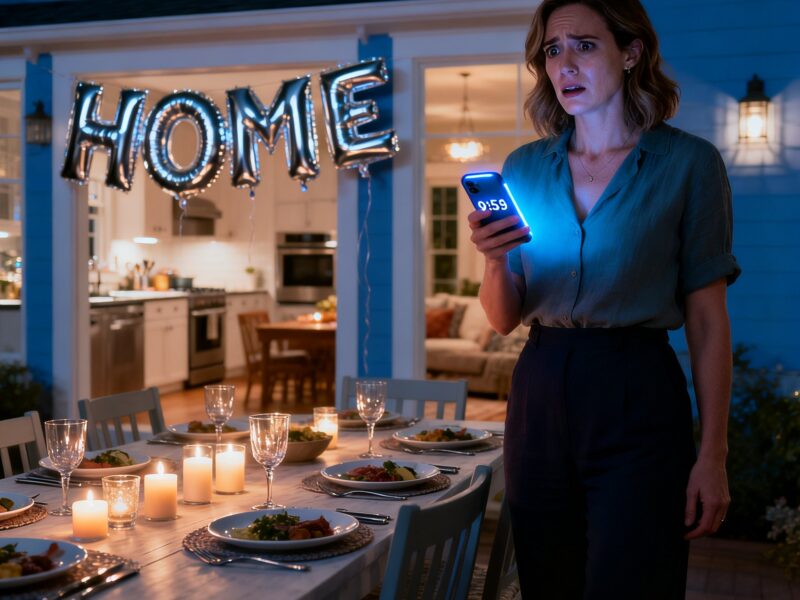
I bought a bottle of the expensive red wine my father always liked but never purchased for himself. I picked up sunflowers for the dining room table because they made the room look happy and full. I used my good plates even though nobody in my family had ever once noticed the difference between good plates and regular ones. I laid out cloth napkins. I polished the silverware. I hung silver balloons over the dining room entry that spelled HOME because that word meant more to me than house ever could. A house was a structure. Home was the promise inside it.
By six thirty, the whole place glowed.
The sunflowers stood bright in their vase. I changed into a navy dress and checked my phone.
No messages, but that did not worry me yet.
At six fifty five I sat on the living room couch and listened for cars.
At seven, I smiled to myself and thought they were probably parking.
At seven thirty, the smile had disappeared from my face.
I sent a light message to the group chat. Dinner is ready whenever you get here.
No response.
At seven forty five, I stood by the front window and watched the quiet street. No headlights slowed near my house. No doors slammed. No footsteps approached the porch. The candles on the table had burned lower. The mashed potatoes were losing heat. The chicken skin would be going soft under the foil.
At eight fifteen my phone buzzed.
I picked it up so fast I almost dropped it.
It was my mother.
Five words: Sorry, something came up. Busy tonight.
That was all. Not a call. Not even a separate message from my father or Kevin. Just one flat sentence in the group chat, as though canceling attendance at the only celebration I had asked for in years required less emotional effort than rescheduling a dentist appointment.
I stared at the words until the screen went dim in my hand.
Then I set the phone face down on the table and looked at the six place settings I had arranged. One for me. Five for the people who were not coming. The house was still beautiful. The food still smelled incredible. The music still played softly in the other room. Nothing material had changed. But the silence had changed. It was no longer peaceful. It was the specific silence of a room prepared for people who had decided it was not worth entering.
I did not cry right away. Instead I sat down at the head of the table and let memory line itself up beside the empty plates. My high school graduation, when they arrived just as we were leaving the gym. My college awards ceremony, which they missed because Kevin had a soccer tournament. Kevin’s small accomplishments treated like proof of destiny, mine treated like expected maintenance. They were not monsters. That would have been easier. They were simply consistent in all the ways that wound quietly.
Eventually I stood and began clearing the table.
My movements were calm, which felt more dangerous than anger. I put the chicken into containers. I covered the potatoes and tucked them into the refrigerator. I wrapped the tart carefully even though nobody had tasted it. I blew out the candles. I took down the serving dishes I had arranged so neatly on the counter. It felt like dismantling a version of reality I had built only that morning.
I was rinsing glasses I had never poured wine into when there was a knock at the door.
It was nearly midnight.
I looked through the peephole and saw Amber, Kevin’s girlfriend.
She stood on my porch in sweatpants with a grocery store bakery box in both hands.
I opened the door.
“Hey,” she said, giving me a thin, awkward smile. “Sorry. I know it’s late.”
The box had a clear plastic window. Inside was a sheet cake with bright blue frosting. The price sticker was still on the side. Nineteen ninety nine. The fact that nobody had even peeled off the sticker hit me almost as hard as the fact that she was the only person standing there.
She pushed the box toward me. “Your mom wanted me to drop this off.”
I took it because refusing it on the porch seemed more dramatic than I had energy for. Then I stepped aside and let her in.
Amber’s eyes traveled around the entryway, into the living room, over the staircase, across the dining room. She said, “Wow. It’s big.”
“I like it,” I said.
“Yeah. I can see that.”
I set the cake on the kitchen counter without opening it. “So what was so important that nobody could come?”
She shifted her weight. “Things came up. You know how your family is.”
I looked at her. “That is not an answer.”
She sighed as if I were making a simple errand harder than necessary. “Your mom had a book club call. Your dad was tired from work. Kevin got distracted. I mean, it’s not that deep, Madison.”
My mother’s book club met on Tuesdays. My father managed to golf all day on Sundays. Kevin getting distracted had apparently matured into a complete explanation for anything he failed to do.
I said all of that.
Amber’s expression sharpened. “You’re being dramatic.”
“No. I spent ten years building this. I invited my family to one dinner. One. And nobody even bothered to call.”
“They said they were sorry.”
“In five words.”
She folded her arms. “You always do this. You make everything symbolic.”
I laughed once, because the alternative was something much uglier. “This is symbolic. That’s the point. They keep telling me my priorities are weird, my goals are obsessive, my life is too controlled. Fine. Tonight was the moment they could have looked at what all of that built and said they were proud of me. Instead I got a grocery store cake delivered by my brother’s girlfriend six hours late.”
Amber flinched, but only slightly. “They’re busy people.”
“Busy people make time for what matters to them.”
Neither of us said anything for a moment.
Finally Amber said, “I should go.”
“Yes,” I said. “You should.”
I did not walk her to the door. I listened to it close, turned the deadbolt, then looked at the cake box for a long moment before dropping the whole thing into the trash unopened.
That night I slept badly in a beautiful house.
The next morning I woke up with the kind of clarity that only follows humiliation once the first shock burns off. The hurt was still there, but it had condensed into something cleaner than sadness. Something like decision.
I went into the garage, found a flat piece of cardboard from one of the moving boxes, and took a black permanent marker from the junk drawer. Then I sat at the kitchen island and wrote in big block letters:
NO FAMILY DISCOUNTS.
NO FAMILY VISITS.
NO EXCEPTIONS.
I taped the sign to the front gate facing the street.
Was it measured? No. Was it honest? Completely.
Family discounts referred to every unpaid favor, every last minute tech support call, every “small loan” that was never repaid, every assumption that my savings and skills existed partly for their convenience. Family visits referred to the boundary I finally understood I had the right to set. And no exceptions meant I was done negotiating against my own peace.
The phrase family discounts had not appeared there by accident. It came from years of little assumptions that were never spoken plainly because plain speech would have exposed how unfair they were. Kevin would call and ask me to fix his laptop “for ten minutes,” and the ten minutes would turn into two hours and dinner I paid for myself on the drive home. My mother would ask whether I could look over an online order, a bank password issue, a phone problem, speaking in that bright tone that always suggested the favor was tiny and my refusal would therefore be huge. My father once borrowed money “until next payday,” then acted wounded months later when I reminded him. None of it had ever been enough on its own to justify a dramatic break. That was the genius of it. Each ask was small, each disappointment deniable, each boundary negotiable if I wanted to keep the peace badly enough. The sign was me admitting that the peace they offered had always been purchased with my labor, time, and silence.
I stepped back, took a picture of myself standing beside the gate with the blue house rising behind me, and posted it online with a caption that said only: My house. My rules.
Instead the post spread.
By noon it had been shared hundreds of times. By evening, thousands. People told stories in the comments about family members who wanted free labor, free money, free emotional access, but not the responsibility of showing up. The responses came in waves, and with them came validation I had never once received from the people whose approval I had chased the longest.
My mother called that afternoon.
Her voice had the precise, brittle sharpness she used whenever she believed herself to be the injured party.
“Take that sign down,” she said without preamble.
“No.”
“You are humiliating this family.”
“Interesting choice of concern.”
“Your aunt called me in tears.”
“Was she crying because I was hurt or because she’s embarrassed for you?”
Silence. Brief, but loud.
Then: “You are being ridiculous. This whole public display makes you look unstable.”
“The sign is not why I look upset.”
“Madison, you need to apologize.”
“For what, exactly? Setting a boundary after all of you skipped the one dinner that mattered to me?”
“We said something came up.”
“No. You typed something came up.”
Her exhale crackled through the line. “You always need everything to be about you.”
I looked around my kitchen, still neat from the cleanup, sunlight crossing the floor. “I invited my immediate family to celebrate buying my first home after ten years of work. Yes. That was, in fact, about me.”
She switched tactics fast. “If you keep acting like this, you will end up alone.”
“I have myself,” I said. “Right now, that’s enough.”
Then I ended the call before she could answer.
Kevin texted an hour later: Stop embarrassing everyone. You’re being extra.
I did not reply.
Three days later my father appeared at my door carrying an expression I remembered from childhood, the one that said he had been sent to smooth over trouble he had not caused but had no intention of examining too closely. I kept the chain lock on when I opened the door.
“Can I come in?” he asked.
“No,” I said.
He adjusted his stance on the porch. “Your mother is upset.”
“I figured.”
“We were thinking maybe we should do a real celebration. Something bigger. Invite family friends. Your mom could help plan it.”
There it was. Not remorse. Not even a genuine effort to understand why I was angry. A performance. A party for the audience they wished had seen them show up properly the first time.
He nodded. “Make it nice.”
“It already was nice. On Saturday. When no one came.”
He rubbed the back of his neck. “People make mistakes.”
“Yes,” I said. “And what they do after the mistake tells you whether they understand it.”
“We want to be part of your life.”
I laughed softly. “Now?”
“Madison—”
“This house is paid for with my work. Every overtime shift. Every skipped vacation. Every cheap meal. Every year you all treated this goal like a personality flaw. You don’t get to miss the building part and then ask for a photo op in front of the finished walls.”
He looked down.
That, more than anything, told me he knew I was right.
“I’m not cutting you out,” I said. “I’m drawing a boundary. The fact that it needed to be written in capital letters on cardboard is not my failure.”
Then I closed the door.
What happened next was so predictable it almost felt boring until it got ugly. If my family could not get me to remove the boundary, they would try to discredit the thing the boundary protected.
Rumors started circulating through extended relatives and social media. The house was not really mine. My parents must have cosigned. It was probably a rental I was pretending to own. I was performing independence online for attention. I was, according to one aunt, “always very theatrical.”
I read all of it and felt something in me go still.
My family had spent years minimizing what I built. Now they were actively trying to detach me from it. That crossed a line even they had not crossed before, at least not this openly.
So I went to my home office, opened my file cabinet, and pulled out the documents.
The deed with my name as sole owner. The mortgage approval in my name alone. Pay stubs. Savings records. Ten years of methodical proof. I spread them across the kitchen table in clean afternoon light, covered the account numbers that did not need to be public, took a picture, and posted it with a single caption: Receipts are louder than gossip.
That post spread too.
The rumors collapsed almost immediately under the weight of documentation. People who had been repeating secondhand claims went quiet. A few relatives deleted comments.
Then Chloe messaged me.
Chloe was technically my cousin, though distant enough that we had never been close. Her message request contained no greeting, just three screenshots and the words: Thought you should have these.
I opened the first image and felt my stomach drop.
It was from a family group chat I had been removed from years ago.
My mother, the night after the dinner, telling the extended family I was “having one of my dramatic episodes” and that if I reached out to anyone they should ignore me because I needed to learn I could not always be the center of attention. Amber replying that I would be begging for mortgage help within a year.
The second screenshot was from the day I posted the sign. My father telling everyone not to engage because attention was what I wanted. Kevin calling me a loser. My mother saying, “Let her struggle. She’ll have to sell eventually and come back.”
The third was from after my father’s visit to the house. My mother asking what plan B was. Kevin writing, “We can’t let her win.” My mother replying, “Start asking where the money came from. If people think she’s faking it, the support dies off.” Then one more line from her that I read three times because the words were so nakedly ugly: “Don’t hype her. Let her struggle. She’ll have to sell.”
The empty dinner table had hurt. Those screenshots hurt differently. The missed dinner could still have been explained, if not forgiven. Those messages removed all ambiguity. This was not neglect. Not thoughtlessness. Not ordinary selfishness. This was strategy. My own family rooting for my collapse because my independence felt like a threat to their version of the story.
I cried then. Just a few steady tears that fell onto the heel of my hand as I sat there in the house I had built for myself and finally let go of the idea that success would ever make them see me clearly.
I posted the screenshots exactly as Chloe sent them. Names visible. Words intact. No commentary except one line above them:
Imagine rooting against your own blood.
After that I blocked my mother, father, brother, and Amber on every platform I had. Phone. Email. Social media. Everything. Then I turned my phone off and went outside.
The yard was quiet. The oak tree cast a broad shadow over the front grass. The sign still hung on the gate, blunt and honest. I sat on the porch swing until the light turned gold, then amber, then blue.
My mother deactivated her social media. My father, according to a relative who still talked to Chloe, had to answer awkward questions from coworkers who had seen the posts. Kevin tried to say the screenshots lacked context, which might have worked if the context had not been so perfectly supplied by the words themselves. For the first time in my life, I did not rush to soften the consequences for anyone.
What I felt was clean. That is the closest word for it. Clean in the way a wound feels after the debris has been washed out, even if it still hurts. The damage had not disappeared. But I was no longer cooperating with it.
The first dinner I cooked in that house for myself alone came four nights after I posted the screenshots. I made something simple, pasta with garlic and tomatoes, because after the performance of that abandoned celebration I wanted an evening with no symbolic weight attached to it. I ate at the kitchen island in sweatpants with the windows open and cool air moving through the screen. No candles. No guests either. No expectation of headlights turning into my driveway. Halfway through the meal I realized I was relaxed, in a way I had not been during any family gathering in years. I was not bracing for a joke at my expense, or a dismissive comment, or the math of whether I was asking for too much. I finished dinner, washed my plate, and stood in the dining room looking at the table where six settings had once waited. The emptiness no longer felt like accusation. It felt like available space.
Then something I never expected began to happen.
My neighborhood noticed.
Carol, who lived two houses down and wore gardening gloves like jewelry, showed up one afternoon with a homemade apple pie balanced carefully in both hands. “Just wanted to say congratulations,” she said. “And boundaries are healthy.”
Mark from across the street offered to help with the lawn and then, when I declined, nodded as if he respected me more for declining than he would have for saying yes. Mrs. Alvarez from the corner lot waved me over during an evening walk and said, “People mistake access for love all the time. Don’t confuse them.” Then she handed me cuttings from her hydrangeas.
I had spent so long imagining family as the only audience whose love counted that I had forgotten community could arrive in quieter, steadier forms.
Strangers wrote, too. A watercolor of my house from a woman in Ohio. A book about boundaries from a man in California. A handwritten card from a woman in Michigan who said the photograph of my sign had finally convinced her to stop paying her brother’s rent. None of these people owed me anything. Yet they offered kindness my own family had treated like an inconvenience.
One afternoon, about three weeks after the screenshots, I was sitting on the porch swing reading when a little girl stopped outside the gate with her mother.
Her mother looked embarrassed. “I’m sorry to bother you,” she said. “My daughter saw a photo of your house online, and she’s been talking about it ever since.”
The girl stepped forward. “Is it really yours?”
“Yes,” I said.
“You bought it by yourself?”
“I did.”
She stared up at the porch, the fence, the swing, the blue siding that glowed softly in the afternoon light. “Wow.”
Her wow held pure possibility, not envy or calculation, just awe at the idea that a woman could build her way toward a dream.
“I want a house all by myself too someday,” she said. “Purple.”
I smiled. “That sounds perfect.”
Then I remembered the spare key in the drawer by the front door. I went inside, brought it back, and crouched down so we were eye level.
“When you have a big dream,” I told her, “sometimes it helps to hold onto something solid that reminds you it can become real.”
I placed the key in her small hand.
“Not forever,” I said when her eyes widened. “Just until you don’t need the reminder anymore.”
She closed her fingers around it like I had given her treasure. They thanked me and continued down the sidewalk, the little girl looking down every few steps to admire the key again.
For years I had believed the house would prove something to my family. I thought the deed would translate me into a language they respected.
But the house had never been a translator. It was a mirror.
And what it showed me was not just who they were. It showed me who I was without them.
I stopped setting places for people who had repeatedly chosen not to sit at my table. I stopped rehearsing imaginary conversations where they suddenly understood what they had done. I stopped preparing explanations for people who preferred narratives where I was dramatic, difficult, or ungrateful. Instead I began furnishing the life I actually had.
I planted herbs in the back yard. I painted the office shelves myself. I hosted Carol and Mrs. Alvarez for coffee. I discovered there was a difference between solitude and abandonment, and the difference had everything to do with choice.
Months later, when the weather cooled and the oak tree began shedding leaves across the front walk, I found the grocery store cake receipt sticker stuck to the bottom of a pantry shelf. Nineteen ninety nine. I peeled it off and stood there for a second thinking about that whole night. Not with rage this time. Just with clarity.
My family had sent a cake because they thought gesture could replace presence. Then they had spread rumors because they thought doubt could weaken what I had built. Then they had schemed in private because they believed my independence was an insult. In the end, the sign on my gate had not been cruel. It had been accurate. It named terms they had relied on for years and announced that those terms were no longer valid here.
I do not know what story my family tells about me now. Perhaps I am still the dramatic one in their version. Every family protects itself with language when truth becomes too expensive. I no longer need to audition for a kinder role in their version of events.
What I know is simpler.
My house is blue. The fence is white. The oak tree is exactly as broad and sheltering as the one I used to draw in the margins of school notebooks while my teachers talked. The porch swing still moves in the afternoon breeze. The rooms inside this house hold my books, my dishes, my quiet, my work, my laughter, and my grief. Nothing in here asks me to shrink so someone else can remain comfortable.
I used to think home was the place where people welcomed you without question. Now I think home is the place where your existence does not require negotiation.
On good evenings I sit on the porch swing as the light fades and the street grows still. Sometimes neighbors wave. Sometimes Carol drops by with extra tomatoes from her garden. And sometimes I sit there alone with the windows glowing behind me, listening to the peaceful silence of a place I earned in full.
I did not just buy a house.
I learned what it means to hold the key and choose, finally, who gets invited inside.
THE END