My Parents Demanded the Owner Evict Me From Apartment 4B—Then My Attorney Opened the Deed Folder and My Family Finally Saw Who I Was
My name is Elena Brooks, and for nine years my family treated me like a cautionary tale with good manners.
I was the daughter who had wasted potential, the sister who had taken the wrong road, the one who smiled through holiday dinners while my father praised my older brother’s law firm and my younger sister’s surgical fellowship as if excellence only came with a framed diploma and a title someone else understood. I was the one they described with sighs and softened voices. Elena works in property management, they would say, pausing just long enough to imply disappointment before moving on.
The strange part was that none of it made me angry anymore. Not at first. Not for years. By the time I turned thirty one, their condescension had become background noise, like a bad refrigerator hum in an old apartment. You stop noticing it if you live with it long enough. You build your own rhythm around it. You smile. You pass the potatoes. You let your mother ask whether you have a retirement plan as if she has just invented the concept. You let your brother mention billable hours with the gravity of war stories. You let your sister ask whether you have considered returning to school for something more stable. Then you go home and keep building the life they never bothered to ask about.
If they had asked, I might have told them that I loved buildings more than prestige. I loved the logic of them, the way value could be hidden under neglect and unlocked through patience, timing, and a tolerance for unglamorous details. I loved balance sheets more than applause. I loved neighborhood maps, zoning proposals, transit rumors, construction permits, occupancy rates, and the quiet fact that real wealth rarely arrived in a dramatic car. It showed up in contracts, leverage, renovation schedules, and rent rolls.
When I was twenty two and told my family I was not going to follow my brother into law or my sister into medicine, my father laughed so hard he had to set down his wineglass.
“Operations for apartment buildings?” he had said. “That sounds like glorified janitorial work with spreadsheets.”
My mother did not laugh. Her disappointment was more precise than that. “We did not pay for a good education so you could collect keys and answer maintenance calls.”
My brother Ethan, already a first year associate at a polished firm in Chicago, smirked into his drink. “At least someone has to manage broken elevators, I guess.”
My sister Claire, who was still in training then and permanently exhausted, had offered the gentlest insult of them all. “I just think you’re capable of more.”
But I wasn’t interested in their definition of more. I was interested in assets. I was interested in ownership. And while they were measuring success in titles and public prestige, I had already started measuring it in equity.
I took a job as an assistant property manager at a midrange complex in Seattle for thirty nine thousand dollars a year. To my family, it looked like proof that they had been right. To me, it was paid education. I learned lease enforcement, vendor negotiation, turnover timelines, emergency maintenance, security issues, insurance headaches, tenant psychology, and every small expensive problem that could quietly kill a property if no one was paying attention. I learned which neighborhoods were sleepy because they were dying and which ones were sleepy because everyone else had not noticed them yet.
What my family never knew was that I had started investing at nineteen with money I saved from internships, scholarships, and the trust distributions I never spent showing off. While Ethan leased luxury cars and Claire took celebratory trips between rotations, I bought tiny stakes in multifamily deals through a private investor group. Three percent here. Five percent there. Ugly brick walkups near future light rail. Small complexes in districts about to be rezoned. Buildings with bad management but excellent bones.
By twenty five, I had minority positions in seven properties. By twenty eight, I had consolidated into controlling ownership of three smaller buildings through a maze of buyouts, refinances, and one partnership split so tense it taught me more about human vanity than any psychology textbook could have. By thirty, through Blue Alder Residential Holdings, LLC, I bought a one hundred twenty seven unit luxury building in Seattle’s South Lake Union district for forty three million dollars.
That building was called Harbor Crest Residences.
It was also where I lived.
In unit 4B.
My family thought I was renting a modest one bedroom that stretched my budget and proved their point. In reality, Harbor Crest was the centerpiece of a growing portfolio that had taken me a decade to build quietly, deliberately, and mostly alone. I had not hidden it because I was ashamed. I had hidden it because they had spent too many years treating my words like amateur theater. I wanted the facts to be so solid that no amount of dismissal could bruise them.
Harbor Crest had been eighty six percent occupied when I acquired it. The previous owner was burned out, cash rich, and ready to retire. I secured financing through a commercial lender that cared far more about underwriting discipline than about whether my father considered me impressive. Over the next eighteen months I renovated common areas, tightened operations, upgraded security, refinished the rooftop lounge, renegotiated service contracts, improved renewals, and pushed occupancy to ninety eight percent. The last appraisal put the property at fifty nine million. After debt, my equity in that building alone sat around twenty four million.
But my family did not see strategy. They saw my six year old Honda Accord, my simple wardrobe, my practical apartment furniture, my refusal to live like a billboard. They mistook restraint for failure. That was their favorite error.
A few people knew the truth. Naomi Whitaker, my attorney, had structured Blue Alder and every entity beneath it. Ben Park, my operations director, handled day to day management when I wanted to work quietly from the shadows. Lucia Reyes, my accountant, could find inefficiency in a spreadsheet the way some people found gossip in a church lobby. And Grant Ellis, head of building security at Harbor Crest, understood the difference between discretion and silence.
To tenants, I was just Elena from 4B who occasionally helped in the office when things got busy. To my team, I was the owner.
Everything worked perfectly until my parents decided to visit without warning.
It was a rainy Saturday in October when my mother called.
“We’re in Seattle for the weekend,” she announced, as if weather and geography rearranged themselves to accommodate her schedule. “Your father is attending a conference, and we’ve decided to come see your apartment this afternoon.”
I was standing in the Harbor Crest lobby reviewing a contractor estimate for hallway lighting. “This afternoon?”
“Yes, Elena. This afternoon. We haven’t seen where you’re living in two years.”
That had been intentional on my part.
“It’s just a one bedroom, Mom.”
“I’m sure it’s fine for your budget,” she said, pity coating every syllable.
They arrived at two o’clock, and I had deliberately done nothing to prepare beyond making sure the place was clean. My apartment was tasteful but modest. Neutral sofa. Functional dining table. Good coffee machine. No art that screamed wealth, no luxury clutter, no dramatic view staged to make a point. It was the kind of space a practical woman might choose if she valued efficiency over display.
My mother stepped inside and immediately began cataloging shortcomings.
“Oh, Elena. This is very compact.”
My father stood by the window with his hands behind his back. “How much are you paying for this?”
“It’s manageable.”
“That usually means too much,” he said.
Then Ethan walked in behind them.
I stared at him. “You came too?”
He lifted a shoulder. “Mom thought it might help to have all perspectives represented.”
Claire arrived a minute later carrying a pastry box like she had come to a baby shower instead of an intervention.
Within five minutes all four of them were in my apartment evaluating my life like inspectors from a judgment agency.
My mother pressed down on my sofa cushion and frowned. “This furniture is very plain.”
My father found a building notice on the counter about upcoming exterior improvements. “Construction upgrades? Your rent is going up.”
Ethan glanced around my kitchen. “Do you have enough liquidity for emergencies?”
Claire opened my pantry and then shut it again, as if my canned soup inventory had confirmed a diagnosis. “Have you ever thought about doing a graduate program in real estate finance? At least then you might move into a corporate position.”
I smiled the same small smile I had perfected in adolescence. “I’m okay, Claire.”
My father settled into one of my dining chairs and looked at me with the grim patience of a man preparing to explain gravity to a child. “You are thirty one years old. You should be established by now.”
“I am established.”
Ethan laughed under his breath. “You rent a one bedroom and work in building operations.”
“I work in property management.”
“You have a job,” Claire corrected. “Not a long term strategy.”
The irony was so sharp it almost made me dizzy.
My mother pulled out her phone. “We have been talking, and we know someone with a listing in Tacoma. Small studio, very affordable, much more realistic for your income level. If you moved somewhere cheaper, you could save money, maybe go back to school, maybe finally put yourself on a path with real upside.”
“I don’t need a studio.”
“Pride will not pay bills,” my father said.
That sentence did something strange inside me. It did not wound me. It clarified everything.
I looked at all four of them in my modest apartment, in my building, in a unit I had chosen inside an asset I owned outright through an entity they had never heard of. They had not come to understand. They had come to correct. They wanted to drag my life back into a shape they could recognize.
“Thank you for your concern,” I said calmly. “I’ll think about it.”
They left pleased with themselves. Ethan texted me that evening.
They’re trying to help. Don’t let stubbornness ruin your future.
I did not answer.
The real trouble began three days later when my father called.
“Your mother and I have made a decision,” he said without greeting.
“What decision?”
“We are going to help you whether you accept it or not. We spoke to someone at your building.”
I went still. “You did what?”
“We contacted management,” my mother added from speakerphone. “We explained that you are in over your head financially. They were very understanding.”
Ben had mentioned that a couple had come by asking questions about 4B, but at the time he had not realized they were my parents. He had told them, correctly, that resident information was private. Apparently that had only encouraged them.
“We are prepared to pay whatever penalty is required to break your lease,” my father said. “This is no longer optional.”
“I do not need you to break my lease.”
“We’re not asking. Tomorrow we are coming to that building, and we are going to speak directly to the owner.”
I leaned against my kitchen counter and closed my eyes for one second.
“The owner?”
“Yes, the owner. Someone in charge needs to understand that you cannot afford to live there. Frankly, if you are working for management while living above your means in the building, that may be a conflict issue as well.”
They were planning to get me removed from my own residence and possibly fired from my own company.
If I told them over the phone that I owned Harbor Crest, they would think I was being defensive or dramatic. If they wanted a lesson, they were going to receive it in person.
“If that is what you feel you need to do,” I said.
“It is,” my father replied.
The line went dead.
I immediately texted Naomi.
My parents are coming tomorrow to demand I be evicted from 4B. They still do not know I own Harbor Crest. I think the time for mystery has passed.
Her response came two minutes later.
I’ll bring the deed, operating statements, entity documents, and appraisal summary. This should be memorable.
The next morning I dressed exactly as I usually did when I planned to spend part of the day in operations meetings: dark jeans, a cream sweater, flats, hair pulled back, no jewelry beyond my watch. Nothing about me suggested control of an eight figure portfolio. That, too, had always been part of the problem. People see what flatters their assumptions.
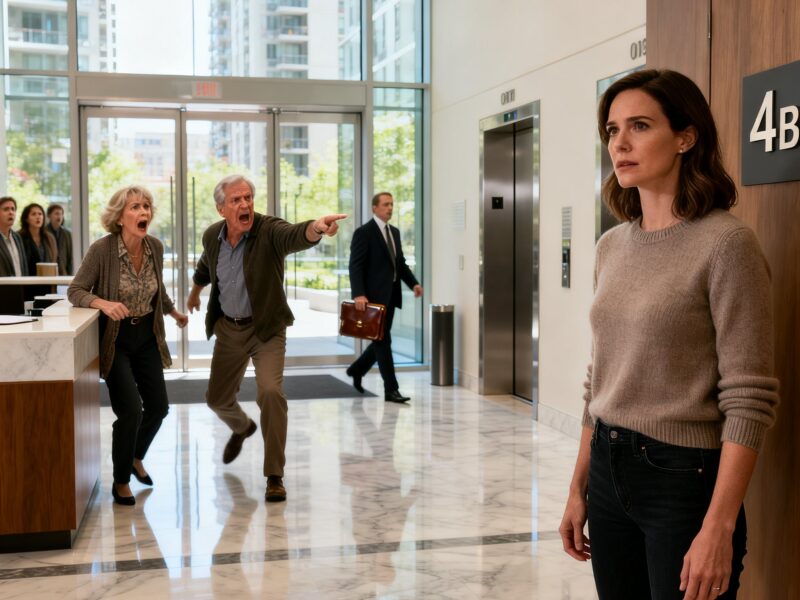
I was in the management office with Ben reviewing work orders when I heard my father’s voice in the lobby.
“We need the owner right now.”
Ben looked up sharply. “That would be them.”
I stood and moved to the office doorway.
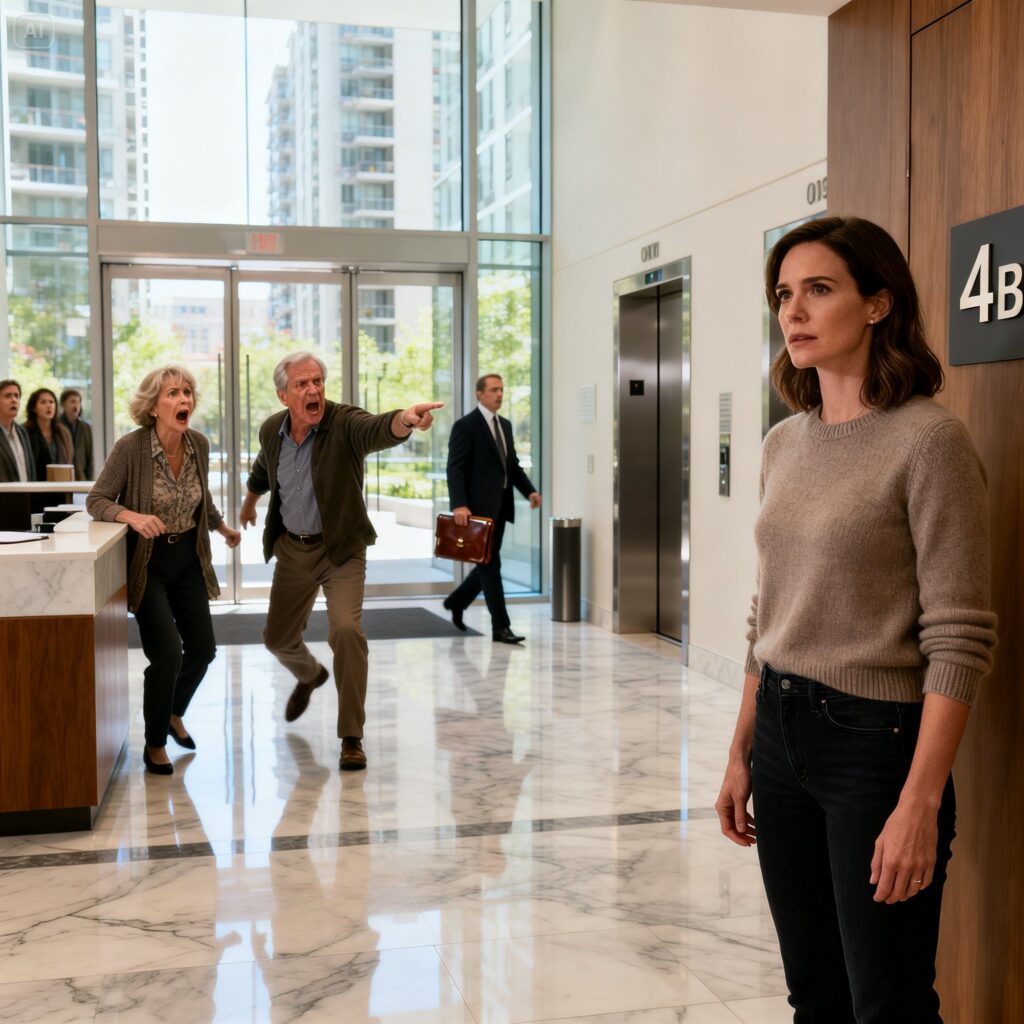
My parents had brought Ethan again. My mother wore a navy trench coat and an expression of determined righteousness. My father’s face was already red with indignation. Ethan stood slightly behind them, arms folded, ready to litigate morality if necessary.
Ben stayed perfectly composed at the front desk. “Sir, the owner is not available without an appointment. I’m the operations director. I can assist you.”
“You’ll do,” my mother said. “We need to discuss unit 4B. Elena Brooks is our daughter, and she is clearly living beyond her means.”
“Mr. and Mrs. Brooks,” I said from the hallway.
My mother turned, annoyed rather than surprised. “Elena, we told you we were handling this.”
My father stabbed a finger toward the desk. “Get us the owner immediately. My daughter is basically squatting in 4B.”
Ben’s eyebrows rose a fraction. “Ms. Brooks is a resident in good standing, sir.”
“We want her evicted today,” my mother said crisply. “She cannot afford that apartment. She is making irresponsible decisions, and your building is enabling it.”
“As the person running this property, you should know better than to lease to employees who are financially unstable,” Ethan added, slipping into his courtroom voice.
I said, “Noted.”
Then I took out my phone and texted Naomi.
They’re here. Please clarify ownership before my father bursts a blood vessel.
My father mistook my calm for submission. “Good. Maybe now you’re finally listening.”
“I’m listening,” I said.
He turned back to Ben. “Our family is prepared to cover any costs associated with terminating her lease. We simply need to speak to the owner and have this corrected.”
Ben, to his immense credit, did not glance at me. “I can assure you that won’t be necessary.”
“Then get us the owner,” my father repeated.
The lobby doors opened.
Naomi Whitaker walked in carrying a leather portfolio and enough composure to lower the temperature in the room by ten degrees. She was in a charcoal suit with silver earrings and that serene expression attorneys reserve for moments when facts are about to do all the work.
“Good morning,” she said. “I’m Naomi Whitaker, counsel for Blue Alder Residential Holdings, LLC. I understand there is a concern regarding unit 4B.”
My father exhaled in relief, as if competent adulthood had finally arrived. “Yes. Our daughter is in financial trouble. She cannot afford this apartment. We are here to arrange immediate release from her lease and discuss her employment situation.”
Naomi opened the portfolio. “I’m afraid there has been a misunderstanding. Ms. Elena Brooks does not have a lease for unit 4B.”
My mother leaned forward triumphantly. “There. You see? We knew it.”
Naomi did not even blink. “No. She does not have a lease because she is the beneficial owner of Harbor Crest Residences through Blue Alder Residential Holdings.”
The silence that followed was so complete I could hear rain tapping the lobby windows.
My father stared at her. “What?”
Naomi removed the first document and placed it on the front desk with the elegance of a magician revealing a final card. “Recorded deed. Harbor Crest Residences. One hundred twenty seven units. Acquired in March of 2022 by Blue Alder Residential Holdings, LLC. Managing member: Elena Brooks.”
Then a second document. “Commercial mortgage statement. Current principal balance: thirty four point two million dollars. Borrower: Blue Alder Residential Holdings, LLC. Managing member: Elena Brooks.”
Then a third. “Most recent appraisal summary. Market value: fifty nine million dollars.”
Then a fourth. “Current operating statement. Net operating income: two point three million annually.”
Ethan grabbed the papers first. The color drained from his face as he scanned the signature lines. My mother remained standing, rigid with humiliation. My father looked as if the world had abruptly stopped honoring grammar.
Naomi continued in the same calm tone. “Ms. Brooks resides in unit 4B by choice. She is not a tenant. She is the owner.”
My father turned to me slowly. “You own this building?”
“Yes.”
“This building.”
“Yes.”
Ethan was still reading. “These are real.”
“They are,” Naomi said.
My mother’s voice came out thin and unfamiliar. “How much of it does she own?”
“All of it through the holding entity,” Naomi replied. “Harbor Crest is her primary asset, though Ms. Brooks also holds majority or controlling positions in eleven additional residential properties across Seattle and Tacoma.”
My sister Claire chose that exact moment to walk in through the lobby doors, late and breathless. She stopped dead when she saw all of us standing around the documents.
“What is happening?”
Ethan looked up from the appraisal like a man reading his own obituary. “Elena owns the building.”
Claire laughed once because she thought he was joking. Then she saw my face. Then Naomi’s. Then the paper in Ethan’s hand. The laugh vanished.
I stepped forward, not because I wanted to enjoy their embarrassment, but because someone in the room should speak plainly.
“I bought Harbor Crest two years ago,” I said. “I’ve been building a portfolio for almost a decade.”
Claire stared at me. “You never said that.”
I met her eyes. “Would you have listened if I had?”
Nobody answered.
Naomi, perhaps sensing that her role was complete, slid the documents back into her portfolio with efficient grace. “If anyone requires copies for personal understanding, I’m happy to provide them. Otherwise I believe the matter of eviction is resolved.”
“Eviction,” my mother repeated faintly, as if the word now belonged to another language.
“Yes,” Naomi said. “It is difficult to evict the owner from her own building.”
Even Ben looked away to hide a smile.
My father found the nearest lobby chair and sat down hard. “We came here to demand the owner remove you.”
“You did.”
“And you are the owner.”
“I am.”
Ethan lowered the papers. “Why didn’t you tell us?”
The question should have angered me. Instead it just made me tired.
“For the same reason I stopped explaining my work to you years ago. You had already decided what I was. Anything that contradicted that would have sounded like exaggeration.”
“That’s not fair,” my mother said automatically, but there was no force behind it.
“No?” I asked. “Last month you offered me your old dining chairs because you assumed I couldn’t afford furniture. Six months ago Ethan sent me a budgeting app. Last Thanksgiving Claire asked whether I had enough saved for emergencies. Dad, three days ago, you told me pride would not pay my bills. You all built an entire fantasy about my failure because I did not live loudly enough for you.”
My father rubbed both hands over his face. “We thought we were helping.”
“You were trying to fix something that wasn’t broken.”
The lobby had gone unnaturally still. Residents moving through stopped pretending not to stare. Grant from security stood near the elevators, though by then the damage was entirely emotional.
Claire looked at Naomi. “Eleven properties?”
Naomi nodded. “Current portfolio value is approximately eighty eight million dollars, with estimated equity around thirty two million.”
Claire turned back to me with a bewildered expression I had never seen on her face before. “You’ve been doing this while we all thought you were just… managing buildings?”
“I was managing buildings,” I said. “Mine.”
The shame in my mother’s posture became visible then, not dramatic tears or apology yet, just a collapse in the shoulders, a woman watching her own assumptions break apart in public. “Everyone heard us.”
“Yes.”
“They heard us demand that you be thrown out.”
“Yes.”
My father looked around the lobby as though he had only just realized that walls could witness. “Elena, I don’t know what to say.”
“You don’t need to say anything in the lobby,” I replied. “You wanted to talk to the owner. You did.”
Ethan’s embarrassment began hardening into defensiveness, which was very on brand for him. “You let this happen.”
“I told you not to come.”
“You could have stopped us.”
“I tried. None of you believed me when I said I didn’t need help.”
“That’s different.”
“No. It isn’t.”
Naomi closed her portfolio. “Ms. Brooks, unless you need me further, I’ll head upstairs.”
“Thank you, Naomi.”
She inclined her head. “Always.”
Her heels clicked across the marble and disappeared into the elevator, leaving my family alone with me and the ruin of their own confidence.
Ben cleared his throat softly. “Elena, I can reschedule the contractor meeting if needed.”
“Please do. Thank you.”
He nodded and retreated into the office, tactful enough to leave us space, cruel enough not to rescue them from it.
I looked at my family in the center of the Harbor Crest lobby and felt something I had not expected: not triumph, exactly. Completion.
My father stood slowly. “We owe you an apology.”
“Yes,” I said. “You do.”
My mother’s chin trembled once. “We truly thought you were drowning.”
“I know.”
Claire took one step toward me. “Why keep it secret for so long?”
“Because I wanted to build something real before I held it up for inspection. Then I realized no achievement would matter if it came from me, because all of you had already decided I was unserious.”
“That is not true,” Ethan said, though weakly.
I gave him a long look. “Say that again when you remember sending me links to ‘entry level investment workshops’ after I closed on a downtown high rise.”
His mouth shut.
I took my keys from my pocket. “I need to get back to work. Harbor Crest is doing quite well, but buildings, unlike family egos, still require maintenance.”
My father flinched.
I softened my tone by a degree, but not the message. “If you want to talk later, we can do it somewhere private. Not here. Right now I have actual responsibilities.”
I turned toward the office, then paused and looked back one final time.
“Oh, and Dad? You asked what happens if the building decides I’m not worth keeping around. I make that decision. So far, I’m very pleased with ownership.”
Then I walked away.
The voicemails started before I made it back upstairs. My father first, then my mother, then Claire, then Ethan. I let each one roll into silence. Naomi texted me that afternoon.
Do not respond until you’re ready. Public humiliation makes people either honest or more theatrical. Give it time.
So I gave it time.
For three days I listened to none of the messages, answered none of the calls, and went on with the ordinary work of ownership. We had a roofing issue at one Tacoma property, an insurance question on another, and a contract negotiation that mattered far more to my balance sheet than whether Ethan was currently rethinking his personality. Work steadied me. Work always had.
When I finally met my family, it was at a coffee shop near Pike Place, neutral territory, public enough to discourage melodrama, quiet enough for honesty if honesty happened to arrive.
All four of them were there already. My father looked older. My mother looked careful. Claire looked bruised by self reflection. Ethan looked like a man trying to salvage dignity from a shipwreck.
My father stood when I approached. “Elena.”
I sat down. “Dad.”
He inhaled and let it out. “We owe you an apology.”
“You said that in the lobby.”
“I know. I mean a real one now.” He folded his hands as if he were preparing testimony. “We were arrogant. We judged your life without understanding it. We assumed you were failing because your choices did not resemble ours.”
My mother swallowed hard. “We mistook simplicity for struggle.”
Claire added quietly, “And we never asked what you actually wanted.”
Ethan stared into his coffee before speaking. “I was condescending. More than that. I was lazy. It was easier to assume I understood your life than to ask questions that might force me to rethink mine.”
That, from Ethan, was close to miraculous.
I wrapped both hands around my cup and let the warmth ground me. “Do you know what hurt the most?”
My mother’s eyes filled. “What?”
“Not the jokes. Not even the visit. It was the certainty. You all looked at me and felt completely sure that you understood my limitations. None of you left room for the possibility that I was operating from knowledge you didn’t have.”
My father nodded slowly. “You’re right.”
“I was never asking you to approve of my choices,” I said. “I only wanted you to stop treating me like an unfinished version of yourselves.”
Claire wiped under one eye with the side of her finger. “We thought we were trying to protect you.”
“You were trying to edit me.”
Silence settled over the table, but it was a better kind than the lobby silence. This one had room in it.
My mother took a breath. “Why did you live so modestly if you had all that?”
I almost smiled. “Because I like my life. Because wealth is easier to keep than to perform. Because I wasn’t interested in broadcasting what I was building to people who had already decided I was small. And because an asset appreciates whether or not I drive a German car.”
Claire gave a watery half laugh. Ethan rubbed a hand over his mouth.
My father looked at me with something new in his face, something I had wanted when I was twenty two and no longer particularly needed at thirty one. Respect arrived late, but it had finally found the address.
“I am proud of you,” he said.
I held his gaze. “You should have been.”
“I know.”
Ethan leaned back. “Can I ask a selfish question?”
“Probably.”
“How did you do it? Not the sentiment. The mechanics.”
That was the first real question any of them had asked me in years.
So I told them. I explained the early fractional investments, the discipline of reinvesting distributions, the timing of acquisitions, the risk of leverage, the importance of operational competence, and why owning ugly buildings with upside had given me more freedom than chasing status ever would have. As I spoke, they listened. Truly listened. No smirks. No interruptions disguised as concern. No translating my life into something more comfortable for them.
For the first time, I was simply describing them.
When we finished, my mother looked at me with a strange tenderness. “That must have been lonely.”
I shook my head. “Not really. Quiet isn’t the same thing as lonely.”
My father gave a tired smile. “What were you thinking when we stood in that lobby demanding the owner evict you?”
I thought about the answer before giving it to him.
“I was thinking that reality was finally about to speak in a language you all respected.”
Nobody argued with that.
We parted cautiously, not healed exactly, but altered. Families do not rebuild in a single apology. Over the next three months, they improved. My parents stopped dropping advice into every conversation like confetti. Claire started asking about development trends instead of my savings account. Ethan, remarkably, called once just to ask what cap rate I considered healthy in current conditions, and when I answered, he listened instead of correcting me.
They visited Harbor Crest again, this time by invitation. My mother complimented the lobby renovation without asking how much it had cost me personally. My father toured the rooftop and asked intelligent questions about occupancy strategy. Claire admitted the security upgrades were impressive. Ethan stood in the leasing office and said, almost reverently, “You really built all this,” and I understood that he finally saw not the building, but the years.
The story spread through the extended family, of course. Families are terrible vaults. Soon the extended family knew that the daughter once dismissed as unserious owned a portfolio worth nearly ninety million dollars. I found it irrelevant.
I had not built wealth to punish my family. I had built it because I trusted my own instincts before anyone else did. That remained the central fact.
My name is Elena Brooks. I am thirty one years old. I live in unit 4B of Harbor Crest Residences in Seattle, a building I own. My parents once marched into my lobby demanding that the owner evict me for living beyond my means. Then my attorney walked in with the deed, the operating statements, and enough truth to leave my father speechless.
These days I still drive my old Honda because reliability is underrated. I still dress simply because clothing does not negotiate contracts. I still work long hours because ownership is not passive, despite what finance bros online pretend. And I still believe the same thing I believed at twenty two when everyone laughed at the phrase property management.
Real success does not need to be loud. It only needs to be real.
THE END