My Mom Let My Sister Cut Up My Rented Vera Wang Wedding Dress for Prom—Then the Police Report Cost Her Jail, Her Pension, and Her Future

I found my wedding dress in pieces on my mother’s kitchen floor nine weeks after I wore it.
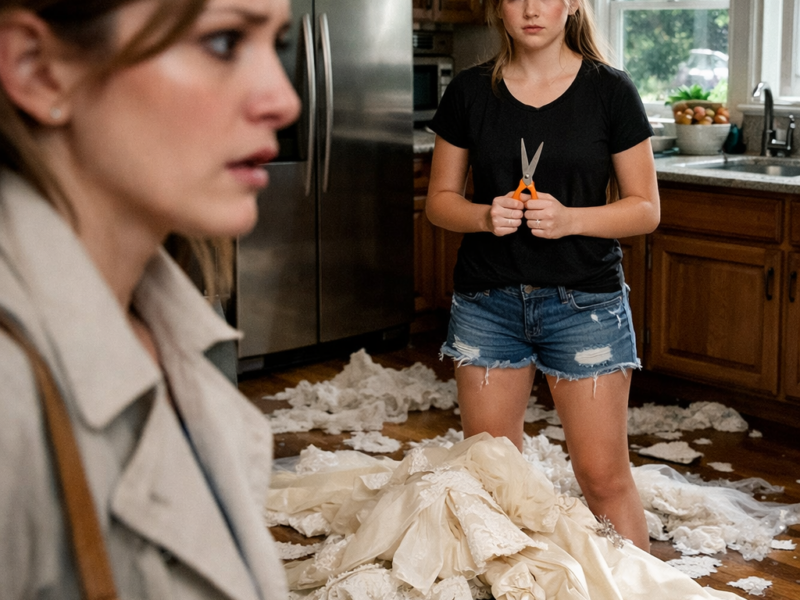
Not wrinkled. Not stained. Not tucked carelessly into the wrong garment bag. Cut apart. The ivory tulle lay in drifts across the linoleum. Hand-beaded lace from the cathedral train had been hacked into uneven strips. The structured silk bodice had been separated from the skirt and tossed onto a chair like a dish towel waiting to be folded. Near the stove, my seventeen-year-old sister Gemma stood gripping a pair of orange-handled craft scissors, staring at me with the defiant panic of someone who had expected outrage but not consequences. My mother, Roxanne, stood at the dining table with a glass of iced tea and the kind of flat expression that had defined most of my childhood.
“Your sister needed the fabric for her prom dress,” she said with a shrug. “So we used it.”
I did not scream.
That was what both of them expected. A dramatic breakdown. Crying. Maybe pleading. Maybe one of those family scenes where the person who had been wronged became the one accused of making everybody else uncomfortable. Instead I stood in the doorway, rainwater still on my coat from the storm outside, and looked at the shredded remains of the most expensive garment I would ever wear. Then I set my purse on the kitchen island, unzipped the side pocket, and pulled out the folded rental agreement.
“It’s a vintage Vera Wang on loan from a boutique,” I said. My voice sounded so calm I almost did not recognize it. “And the insurance policy requires me to file a police report for intentional destruction of property.”
The color drained from Roxanne’s face so quickly it looked unnatural.
Gemma let the scissors slip from her fingers. They hit the floor with a loud plastic clatter that sounded tiny compared to the damage already done.
I had come to my mother’s house that rainy Tuesday afternoon expecting a quick stop. Justin and I had just returned from our honeymoon in a cabin in Maine where the internet was weak, the cell service was worse, and the outside world had felt pleasantly far away. Before we left, Roxanne had insisted I leave the dress in her cedar closet because my apartment had no climate control beyond a moody air conditioner and she did not want the lace to yellow in the humidity. It was one of the few practical offers she had made during the entire wedding process, and against my better judgment I had accepted it.
I used my old spare key to let myself in, assuming I would grab the garment bag, exchange a few polite sentences, and leave. Instead I walked into a dressmaking crime scene.
My mother’s dining room had been transformed into a workshop. Measuring tape. Pins. Pattern paper. A handheld steamer. Several glossy prom magazines fanned across the table. Gemma had apparently decided that the only acceptable way to attend her senior prom was in something no one else in the county could possibly own, and Roxanne, in her endless devotion to the daughter she considered dazzling, had provided a solution. My wedding dress had become raw material.
The sight should have broken me immediately. Instead it made something inside me go cold and sharp.
Maybe that happened because this was not, in truth, a sudden betrayal. It was simply the cleanest expression of a pattern that had existed for years.
My father died when I was twelve. He left behind a modest life insurance policy, a small amount of savings, and a family imbalance that became impossible to ignore once he was gone. Roxanne poured every emotional and financial resource she had into Gemma. She called it protecting the baby of the family. What it really meant was that Gemma got private riding lessons, name-brand clothes, birthday parties with hired photographers, and endless absolution for every selfish impulse she mistook for personality. I got responsibility. I got told I was mature. I got asked to understand. I got a part-time job at sixteen and forty-hour weeks in college while Roxanne spent what should have helped both daughters on the one she believed reflected best on her.
I paid my own tuition working as a medical records clerk. I bought my first car with money saved in secret because if Roxanne knew I had extra cash, Gemma suddenly needed something. When I graduated near the top of my class, Roxanne forgot to bake the celebratory cake she had promised because Gemma had a regional cheer competition. When Justin and I announced our engagement, Roxanne said she could not contribute to the wedding because Gemma needed a car for her sixteenth birthday. I nodded, adjusted my expectations, and moved on. That had become my talent. Moving on.
But there had been one thing I refused to compromise on.
The dress.
I had wanted a particular Vera Wang gown since I first saw it in an old bridal editorial years earlier. The dress dated from 1996, from an early period when Vera Wang’s designs still carried a kind of severe romance that felt less like pageantry and more like art. Hand-stitched floral appliqués. French tulle. Chantilly lace. A structured bodice that looked sculpted rather than sewn. A cathedral train so elegant it seemed to float rather than drag. Buying it outright was impossible. The archival market price sat somewhere in the orbit of a luxury car. So I did the next best thing. I negotiated with a high-end vintage archive boutique in downtown Atlanta owned by a woman named Vivienne.
Vivienne was the type of woman who spoke about garments the way museum curators speak about paintings. She agreed to lease me the gown for the wedding at a steep rental fee and an even steeper insurance bond. Justin and I scraped together every spare dollar we had. Three thousand for the rental. Four thousand for the insurance policy. Forty thousand in coverage if the dress was destroyed beyond repair. The contract was explicit. Standard cleaning issues were one thing. Intentional destruction, theft, or vandalism triggered mandatory reporting requirements and full-value liability.
That contract was now spread on my mother’s kitchen island next to her sweating glass of tea.
Roxanne stared down at the bold header listing the owner as Vivienne’s Vintage Archive. “Why would you rent a dress?” she demanded, anger rising as panic settled in. “A normal person buys their wedding dress.”
“A normal person doesn’t cut up property that doesn’t belong to her,” I said.
Gemma’s lower lip trembled. “Mom told me it was yours.”
Roxanne shot her a warning look, then turned back to me. “You left it in my closet. That implies you abandoned it.”
I almost laughed at that. Abandoned. As if I had tossed a cardigan over a chair and forgotten it for six months.
“I left it here because you have the only cedar closet in the family,” I said. “The return deadline is Friday. If I don’t provide a police report today, the insurer can deny coverage and Vivienne can sue me personally for the full retail value.”
Gemma’s eyes widened. “Forty thousand dollars?”
“Plus any other damages the boutique pursues,” I said.
Gemma made a choking sound. “Mom, you said Audrey owned it. You said she wouldn’t need it anymore. I already told everyone I was wearing a Vera Wang to prom.”
There it was. The real tragedy, in Gemma’s mind. Not that she had destroyed something precious. Not that she had violated trust. Not that she had turned a once-in-a-lifetime garment into scraps on a kitchen floor. The tragedy was that the social fantasy she had built around the dress might collapse before her classmates could admire it.
Roxanne recovered fast enough to point a finger at me. “You are not calling the police on your own family over fabric.”
I looked at the orange-handled scissors on the floor, then at the severed lace scattered around them like bone.
“It’s not fabric,” I said. “It’s insured property. And if I lie about what happened, I commit insurance fraud.”
“Then tell them it was an accident. Say it got caught in a door. Say there was red wine on it. They have insurance for a reason.”
The ease with which she suggested a felony was almost impressive.
“There is no accident that looks like someone cut through three layers of structured silk with craft scissors,” I said. “And I’m not going to prison so Gemma can have a dramatic senior year.”
I pulled out my phone and dialed the non-emergency police line.
That was the first moment Roxanne actually moved. She lunged toward me, trying to grab the phone, but I stepped back into the hallway and blocked her with one of the kitchen chairs. The dispatcher answered. I gave the address, described the intentional destruction of high-value property, and requested an officer to take a report.
“They’re on their way,” I said when I ended the call.
Gemma burst into tears and ran upstairs, leaving the scissors where they were.
Roxanne stood amid the ruins of my gown and stared at me with the kind of hatred that should have hurt more than it did. But something in me had gone past hurt. I was simply done.
“You have always been jealous of your sister,” Roxanne hissed. “You couldn’t stand that she was going to look more beautiful at prom than you did at your wedding.”
I looked at her and felt, unexpectedly, relief.
For years I had kept some foolish hope alive that if I worked hard enough, stayed reasonable enough, demanded little enough, Roxanne would one day see me clearly. She never had. She never would. Standing there in the kitchen, with my wedding dress in pieces and her voice still reaching for some version of blame that landed on me, I understood that the relationship I wanted had never existed.
I walked outside and sat on the front porch steps to wait for the police.
Rain fell in a fine gray sheet across the yard. Water ticked from the gutter. I held the rental agreement in both hands and thought about the long history of making myself smaller so Gemma could remain centered. Every achievement of mine had been treated as a footnote beside one of her mood swings or milestones. My first scholarship. Her dance recital. My promotion. Her birthday photos. My apartment lease. Her cheer uniform fees. I had spent twenty-four years being told that maturity meant absorbing disappointment quietly.
Maybe maturity actually meant knowing when to stop absorbing it.
The patrol car arrived twenty minutes later, tires hissing over wet pavement.
Two officers stepped out. Officer Briggs was older, broad-shouldered, with graying hair and the tired patience of a man who had spent years watching people ruin themselves over things that should never have become police matters. His younger partner followed him with a small digital camera and a legal pad.
I met them at the driveway and handed Briggs the rental agreement before he asked for it.
He read enough to understand the stakes and followed me inside.
Roxanne came out onto the porch behind us in full performance mode, declaring that this was a private family misunderstanding and no officer had any business entering her home. Briggs did not raise his voice. He simply explained that the alleged victim had invited them inside to document destroyed property and that her objections did not alter that.
The younger officer went straight to the kitchen. Camera flashes lit the room in white bursts as he photographed the tulle on the floor, the severed train, the cut bodice, the scissors. Roxanne followed him, protesting loudly, telling him I was vindictive and unstable and trying to ruin Gemma’s life over “an old dress.”
Briggs asked me one direct question.
“Do you want to press charges for intentional destruction of property?”
I looked past him at my mother, who still wore an expression of righteous outrage, as if the greatest offense in the room was my refusal to protect her from what she had done.
“Yes,” I said.
The word settled with surprising ease.
Briggs turned to Roxanne. He explained that because the documented value of the damaged property exceeded the felony threshold, the charge would be criminal mischief in the first degree pending review. Roxanne’s face lost all remaining color. She began talking faster, saying she did not know the dress was a rental, that she had only been trying to help Gemma, that no reasonable person would involve the police over a family misunderstanding.
Ignorance was not the defense she thought it was.
The handcuffs came out.
I will remember the exact sound of them locking for the rest of my life.
Gemma came flying down the stairs just in time to see our mother’s hands taken behind her back. She started screaming. Real screaming, the kind that strips words into raw sound. Briggs remained calm, guiding Roxanne toward the door while the younger officer bagged the scissors as evidence.
On the front walk, rain dampened Roxanne’s hair and darkened the shoulders of her blouse. She twisted once to glare at me.
“You’re putting your own mother in jail.”
“No,” I said. “You did that when you picked up the scissors.”
It was the only dramatic line I spoke all day, and even then it did not feel theatrical. It felt factual.
The patrol car pulled away with Roxanne in the back seat. Gemma stood at the edge of the yard sobbing and calling me a monster. I walked back inside, signed the evidence forms the younger officer handed me, and then called Vivienne.
She arrived an hour later in a dark delivery van with the boutique name discreetly lettered on the side. Her face tightened the moment she stepped into the kitchen. She moved carefully through the wreckage, crouched beside the train, and lifted one severed piece of beadwork between her fingers as if touching a body at a wake.
“Oh,” she said softly. “No.”
That single syllable carried more grief than all of Gemma’s theatrics combined.
Vivienne explained, in the clipped, controlled voice of someone holding professionalism together by force, that the gown was one of only a few surviving wearable examples from that early collection. It had been booked for future archival rentals. The boutique’s insurer would require the full policy payout. Depending on the outcome, her attorneys might also pursue associated business losses. I gave her the police report number, the insurer’s contact information, and my written statement before she had to ask.
When she left with the remains of the dress packed into a plastic archive bin, I finally felt the first tremor of exhaustion.
I drove back to the apartment Justin and I shared.
The second I stepped through the door, Justin took one look at my face and pulled me into his arms without asking a single question. I stood there with the police report folded in my fist and let the day hit me all at once. Not in sobs. Not in collapse. More like the hard internal shaking that follows when adrenaline has done its job and abandons you with the quiet.
“My mother got arrested,” I said into his shirt.
Justin held me tighter. “Then she must have done something arrest-worthy.”
That simple sentence, so free of the usual family gaslighting, nearly broke me harder than anything else.
The next morning the extended family began its campaign.
Uncle Gordon called three times before noon, each voicemail louder than the last. I had disgraced the family. I had gone too far. No amount of silk or lace was worth putting a mother in jail. One aunt texted that grief made people do irrational things, as though my father’s death twelve years earlier somehow explained a woman cutting up a rented couture gown on a Tuesday. A cousin I had not spoken to in months suggested I withdraw the complaint for Gemma’s sake.
What struck me most was how quickly everyone adopted the language of minimizing the actual act. The dress became “fabric.” The destruction became “a misunderstanding.” The arrest became “your decision,” not the legal consequence of Roxanne’s choices.
I did not answer any of them.
Instead I spent that afternoon on the phone with the insurance investigator. He requested copies of the rental contract, the police report, photographs, and a notarized statement confirming that the damage had been intentional. He was efficient, unemotional, impossible to manipulate. I liked him immediately.
The company agreed to pay Vivienne’s boutique the forty thousand dollars. Then the investigator explained subrogation. Once they paid the claim, they would pursue Roxanne for reimbursement. The debt would not vanish because she cried. It would become a legal target with its own file number.
By Friday Roxanne still had not made bail.
Because she had no prior record, the amount was not especially high by felony standards, but Roxanne had no real savings. She had spent years living paycheck to paycheck while pouring money into Gemma’s wants and maintaining the illusion of generosity on a foundation of financial irresponsibility. She called me from the jail payphone that evening, and against my better judgment I answered.
The automated recording announced that the call was from a correctional facility and subject to monitoring.
“Audrey,” Roxanne said, voice thin and hoarse, “please get me out of here.”
For the first time in my life, she sounded smaller than the situation she was in.
She talked fast. The women inside were terrifying. Gemma was alone. There was no money for groceries. She would pay me back when her tax refund came. I had savings. I was married now. I could not let my own mother sit in a cage over a prom dress.
Over a prom dress.
Even then she could not say wedding gown. Could not say rental property. Could not say forty thousand dollars. To name things accurately would have required seeing them accurately.
“You did not cut up a prom dress,” I said. “You cut up a forty-thousand-dollar archival gown that did not belong to you.”
Silence.
Then her voice sharpened with the first hint of familiar blame. “So you’re really going to do this to me.”
“No,” I said. “I’m going to let it happen.”
That was the line she could not bear. Because manipulation requires participation. She needed me to step in, translate disaster into rescue, and prove that she still had access to my labor, my money, my emotional compliance. Refusing to do that felt less like cruelty than clarity.
I hung up and blocked the jail number. The practical consequences began arriving faster than the emotional ones. The district attorney’s office assigned a victim advocate to walk me through the process. She called two days after the arrest, introduced herself as Marisol, and explained in a brisk, compassionate voice what would happen next. Formal charging review. Evidence inventory. Statements from the boutique owner and insurer. Bail hearing. Possible plea negotiations. Restitution calculations. She had the calm efficiency of someone who spent her days translating chaos into checklists, and I was grateful for every sentence. Family dysfunction thrives in vagueness. Legal systems, for all their flaws, at least force events into names and dates. Marisol asked whether I wanted a protective no-contact condition included if Roxanne were released before trial. The question should not have startled me, but it did. Until that moment some part of me had still been thinking in family terms, as though this was a spectacular argument that had accidentally wandered into the courthouse. Hearing the state ask whether I needed protection from my own mother rearranged the scale of what had happened. “Yes,” I said after a pause. “I do.” That temporary order was granted at the initial hearing. Roxanne was forbidden from contacting me directly except through counsel about the case. The restriction did not stop the extended family from acting as volunteer messengers, of course. It only changed the style of the pressure. One relative said Roxanne was humiliated in front of strangers and needed compassion. Another said Gemma had not eaten properly in two days, which turned out to mean she did not like the frozen meals in the freezer. My Aunt Denise sent a six-paragraph text about Christian forgiveness that somehow never mentioned accountability once. The underlying theme stayed consistent. They all wanted me to restore the old arrangement in which other people created damage and I was expected to quietly absorb it. Justin read one of the texts over my shoulder and said, “Funny how none of them are offering to pay the boutique.” That became my private test. Anyone who called it a misunderstanding but did not volunteer forty thousand dollars was not serious. They were merely trying to preserve comfort. I met with the insurance investigator in person the following Monday. His office sat in a low beige building that smelled faintly of coffee and printer toner. He wore a navy suit and introduced himself as Alan Pierce. Alan had already reviewed the police photographs, the contract, and Vivienne’s preliminary valuation documents. He wanted my statement recorded again, in detail, with dates, timeline, and context. We spent nearly two hours going through every step. When I left, he walked me to the elevator and said, “For what it’s worth, you handled the initial reporting exactly right. Most claim problems start when people panic and start editing the truth.” Editing the truth. That phrase stayed with me. It described my whole upbringing. Roxanne never lied in grand dramatic ways if she could avoid it. She simply edited. She removed details that made her look selfish. She softened events until the person she had hurt sounded oversensitive. She added tiny moral decorations to her own motives. Gemma was not manipulative, just emotional. Roxanne was not unfair, just overwhelmed. I was not neglected, just independent. Hearing an insurance investigator describe honesty as the refusal to edit felt strangely vindicating. A week later I had to return to Atlanta to sign additional papers at Vivienne’s boutique. Justin insisted on driving me. The shop occupied the second floor of an old brick building downtown, hidden above a jewelry store and a florist. The first time I visited, it had felt magical, all soft lights and garment bags and velvet benches. This time it felt almost ecclesiastical. Quiet. Reverent. Mourning something precise. Vivienne brought out the storage bin containing the remains only because I asked. Part of me did not want to see them again, but a larger part needed the sight fixed in reality. The cut edges looked even more brutal up close. Beadwork torn loose. Lace panels severed mid-pattern. Silk backing sliced without care or comprehension. You could see where Gemma had tried to improvise shape by chopping away what she did not understand. It reminded me that ignorance can be violent even when it arrives wearing innocence. “I’m sorry,” Vivienne said. Not as a formality. As an equal speaking to another woman who had lost something irreplaceable for reasons too stupid to dignify. “So am I,” I said. She closed the lid gently. “The law cannot restore craftsmanship,” she said. “But it can establish who bore responsibility for its destruction.” That was one of the most useful things anyone said to me all month. The bail hearing came and went without my attendance, but Marisol called afterward. Roxanne had cried. Gemma had cried harder. Their attorney had emphasized family tension, misunderstanding, emotional stress, first offense. The prosecutor had emphasized value, intent, evidence, and the fact that the property did not belong to either defendant. Bail was set. The no-contact condition remained. The message, as Marisol put it, was clear: sentiment did not erase damages. I should tell you that there was one weak night in the middle of all this when I almost broke. It happened around two in the morning, because apparently the worst decisions of my life always tried to bloom at that hour. Justin was asleep. The apartment was dark except for the stove clock. I was standing at the kitchen counter drinking water and looking at my phone, where a new voicemail from Uncle Gordon sat unopened. For one stupid minute I thought maybe I should call the jail, maybe put up the bail, maybe stop the machine before it rolled any farther. Not because Roxanne deserved rescue. Because old conditioning is stubborn. Because daughters raised to maintain peace can confuse surrender with kindness long after they know better. By dawn, I knew I would not fold.
Roxanne spent thirty-two days in county custody before her public defender negotiated a plea deal. Because the evidence was so clean and the insurer wanted the criminal finding to support recovery, the prosecution would not dismiss the case into irrelevance. In the end she pleaded guilty to a reduced charge, avoided prison, and took supervised probation, community service, and full restitution. To pay it, she had to liquidate her state employee pension fund. Early withdrawal penalties gutted it. Taxes took another bite. Her job at the municipal water department vanished after the conviction. The small, shaky future she had assumed would somehow carry her into retirement collapsed under the weight of one afternoon’s entitlement.
I did not attend sentencing.
By then Justin and I had already moved to Savannah, three hundred miles away, into a bright apartment with tall windows and creaking floors and no room for old chaos. We spent weekends walking through the historic squares, trying little restaurants, learning which coffee shop had the best pastries and which street turned gold in the late afternoon. For the first time in years, distance began to feel like treatment rather than geography.
Gemma texted me for weeks.
At first she was furious. I had ruined prom. I had ruined school. Everybody knew. People whispered. Teachers looked at her differently. Then the texts changed tone. Complaints about working after school at a discount grocery store. Complaints about bills. Complaints about how unfair life had become. I never answered those either. Fairness had never interested Gemma when she was benefiting from the opposite.
Two months later, Vivienne sent me a package.
Inside was a custom-bound leather photo album containing high-resolution prints from my wedding day. She had somehow obtained the files from our photographer and chosen images that showcased the gown in exquisite detail. The train spread across the grass in pale arcs. The lace caught sunlight. The bodice looked exactly as I had dreamed it would. Tucked inside the front cover was a handwritten note.
She thanked me for my honesty. She thanked me for handling the disaster with integrity. She wrote that while the physical garment had been destroyed, preserving the truth of what happened had allowed the boutique to be made whole and had protected the value of the archive from being obscured by lies.
I sat on our sofa with the album open across my lap and understood something I had not been ready to say aloud before.
The dress was gone, yes. That loss was real. But its destruction did not reach backward and contaminate the day I wore it. It did not diminish the vows Justin and I made. It did not cut through the part of the memory that mattered most. Roxanne and Gemma had destroyed fabric, craftsmanship, history, and money. They had not destroyed my marriage. They had not even destroyed my wedding. What they had severed, finally and completely, was my obligation to keep forgiving what they never intended to stop doing.
That realization felt lighter than vengeance and steadier than grief.
People sometimes ask whether I feel guilty about the pension, the job, the probation, the public humiliation, the gossip that followed Gemma through the rest of her senior year. I do not. Consequences are not cruelty simply because they arrive after someone has grown accustomed to escaping them. Roxanne did not lose her financial future because I filed a police report. She lost it because she believed my property, my trust, and my wedding memories were raw material for Gemma’s spotlight.
There is a kind of freedom that appears only after the last illusion dies.
Mine arrived quietly. In the evenings Justin would come home, hand me a glass of water, ask what I wanted for dinner, and sit with me under the strange peace of a household where love did not need a victim to organize itself around. Out our living room window, Savannah’s moss-draped oaks moved gently above the street, and I would think about the years I had spent trying to earn fairness from people who only respected usefulness.
I do not try anymore.
Biology is not permission. Family is not a legal defense. And being the calm one does not mean you owe anyone protection from the natural outcome of deliberate harm. When Roxanne held those scissors and let Gemma carve my wedding gown into prom-dress scraps, she made a conscious choice. Filing the police report was not revenge. It was simply the moment I stopped volunteering to absorb the cost of other people’s entitlement.
I still have the album Vivienne sent. It sits on the bookshelf in our living room, not as a shrine to loss but as proof that beauty can survive being targeted, at least in memory, and that truth matters more than performance. Sometimes I open it and run my hand across the page where the train curves behind me in a white sweep of lace and light. I think about the rain that day at Roxanne’s house, the kitchen floor covered in silk, the way I stayed calm because rage would only have entertained them. Then I think about the silence of my new home, and the distance between who I had been raised to be and who I finally allowed myself to become.
True peace, I have learned, is not the absence of betrayal.
It is refusing to lie so the people who betrayed you can keep pretending they did nothing wrong.
THE END