I Built a Fence on My Family’s Texas Land, Then the HOA Sent Fake Security and Learned My Boundary Came With Voltage
I did not start that war. I built a fence.
That is the first thing folks need to understand before they start telling the story wrong. I did not go looking for a fight with an HOA. I did not march into their neat little subdivision waving my deed and daring them to test me. I stayed on my side of the line, the same side my family had held since 1931, and I built a strong fence where a strong fence belonged.
My name is Clay Banner, and the northern stretch of my Texas ranch has carried my family’s footprints longer than any of the people at Clear Hill Acres have probably been alive. My granddad laid the first line out there with a borrowed mule, rough cedar, and hands still shaking from Depression hunger. My father kept the place breathing through drought, blight, cattle sickness, and a tornado mean enough to peel half the barn roof away while somehow leaving the old windmill spinning like it was mocking the sky. By the time the land came to me, I knew every post hole, every washout, every cedar stump, every place where the topsoil turned redder than the rest. One hundred and twenty acres is enough land to hear yourself think if the world leaves you alone.
For most of my life, the world did.
My mornings ran on the same rhythm my father taught me. I stepped out before sunrise, let the cold cedar air hit my lungs, and walked the porch boards in the same old grooves my boots had worn over the years. Duke, my dog always came with me, yawning like he was doing me a favor. By six I was checking the cattle, tapping water troughs, looking at the sky, and then inspecting fence lines because trouble finds men faster when they stop paying attention. I did not do it because I expected a fight. I did it because land rewards steady habits and punishes laziness.
Then Clear Hill Acres showed up north of my boundary.
The development rose fast, faster than any place with that many rules should have risen. Streets too straight, sod too green, houses too close together, decorative trees that had no business pretending they belonged in Texas heat. They carved roads where cattle had once wandered and filled those roads with people who loved the idea of the country more than the reality of it. Lawns got clipped short. Mailboxes got standardized. Somebody probably formed a committee about bird feeders. I did not care. Their tidy little world stopped at the edge of mine.
At least that was what I thought.
The first time I felt something tighten in me was when I saw how close their northern road came to my line. It was not fear. It was not anger. It was that old ranch instinct, the one that tells you a storm is forming long before the clouds decide to admit it. So I upgraded the northern fence.
Not to provoke.
Not to posture.
Just to make a clean, visible, undeniable line between my land and theirs.
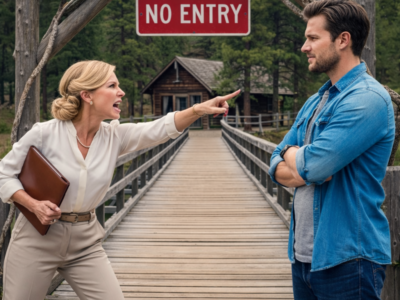
I sank every post myself. Treated cedar. Steel core where it mattered. Wire pulled tight enough to sing in the wind. Solar cameras every fifty feet. Private Property signs every ten. Video Surveillance. No Trespassing. It was the kind of fence my father would have approved of completely. Functional, honest, and impossible to misunderstand unless misunderstanding was the whole point.
There are people who think a fence is just wood, wire, and the stubborn urge to keep one thing separate from another. Those people have never inherited a place where the fences are part memory, part warning, and part promise. My father used to say you could tell what kind of man owned land by the way he treated his boundaries. A lazy man let his line sag. A foolish man built for appearance instead of weather. A crooked man counted on confusion. My father hated all three kinds. When I was twelve, he made me walk the north end with him after a hard windstorm. We carried staples in our pockets and old fencing pliers in our belts. Every few yards he would stop, touch a post, and tell me a story about why that exact place mattered. Here was where Granddad had turned a flash flood by hand with a shovel and a mule team. There was where a neighbor once offered to “straighten” the line in exchange for a little handshake adjustment, and my father sent him off so fast the dust still seemed embarrassed. By sunset my boots were raw and my shoulders hurt, but I understood something I had not understood that morning. A fence is not only about keeping things out. It is also about remembering what must not be given away in pieces. That lesson sat inside me every time I tightened a strand of wire on the Clear Hill line. Bradley Sloan thought he was arguing with a retired rancher who disliked paperwork. He was actually pushing against ninety years of family refusal.
The morning the first letter arrived, I was on my porch with coffee when I saw the envelope in the mailbox. Cream colored. Embossed seal. Addressed not to Clay Banner, but to Property Owner, Northern Boundary Zone, like whoever wrote it thought he was corresponding with a disputed military sector instead of a rancher. The signature at the bottom read Bradley Sloan, President, Clear Hill Acres Homeowners Association.
I laughed before I even opened it fully.
Inside, in polished language trying real hard to sound official, Bradley informed me that my newly installed fence violated the established aesthetic standards of the Clear Hill Acres community and that I had thirty days to remove the unauthorized visual obstruction to preserve neighborhood harmony.
Neighborhood harmony.
That line earned a snort. My land had been called dusty, sunbaked, rugged, stubborn, and once by a city cousin “aggressively honest.” Harmonious had never come up. More importantly, my ranch was not part of their neighborhood. Their HOA had the same authority over my fence that a book club had over the Rio Grande.
I folded the letter, set it on the kitchen table, and went back to work.
Two weeks later, the second envelope showed up.
This one was heavier, meaner, written by somebody who had swallowed a legal dictionary and burped threats. Formal Notice of Continued Violation. Non-compliance. Public Safety Concern. Escalation. Tucked in the back was a blurry satellite map with a thick red outline drawn around the northern edge of my property as if a man with a marker could just redraw eighty years of ownership.
That part did not make me laugh.
I sat at my table looking from the map to my own window, where the real ridge sat in the distance minding its business, and I felt that slow warmth rise up the back of my neck. Not fury. Not yet. Just confirmation that this was no clerical mistake. Somebody at Clear Hill Acres believed enough in their own paperwork to come after ground that was not theirs.
So I wrote back.
Not on elegant stationery. Not on printer paper. On a page torn out of a lined notebook. I wrote in all caps partly because my handwriting looks better that way and partly because I knew it would irritate the kind of man who embosses HOA seals. I attached copies of my deed, my parcel registration, and the historic boundary map filed so long ago the paper itself had probably outlived Bradley Sloan’s sense of importance. At the bottom I signed:
CLAY BANNER
OWNER
INDEPENDENT AS HELL
GOD BLESS TEXAS
I mailed it and got two quiet weeks.
That should have warned me more than the letters did. Trouble that goes quiet after being challenged is usually not defeated. It is regrouping.
The first motion alert hit my phone on a Thursday afternoon while I was elbow deep in mud fighting a stubborn water valve. Duke barked once and looked north. I swiped the screen and there they were on my camera feed: two men in HOA polos and khakis standing at my fence line like substitute teachers who got lost and wandered onto a ranch. One was thin as a coat rack. The other looked built from spite and red meat. Both held clipboards.
There is a certain kind of man who thinks a clipboard counts as authority. Those men are always more dangerous to property than useful.
The skinny one started snapping photos through the rails. The bigger one ran his hand along the top rail, looked at the sign directly in front of his face, and then put one boot on the lower beam and started climbing.
I did not run out there.
I did not shout.
My grandfather taught me never to confront a fool before I collect evidence of his foolishness. So I watched. Saved the footage. Tagged the file. Backed it up. Ten minutes later they climbed down, wrote something on their clipboards, and swaggered away like they had performed official business.
A few days later I found the top wire cut clean near one of my boundary markers.
Not weather damaged. Not loosened. Cut.
I checked the footage. Same man. Same HOA polo. Same entitled little crouch under the sign before the bolt cutters snapped shut. That was when it changed from ridiculous to criminal.
Officer Judson came out that evening after I filed the report. He watched the footage leaning against his cruiser, then looked at the clipped wire and said exactly what I already knew.
“Criminal trespass,” he said. “And property damage.”
He also said, with a kind of tired amusement, “These HOA folks forget where the pavement ends.”
The next alert came at 12:47 a.m.
Camera six. North fence. Infrared.
A lone figure in a hoodie moved along the line carrying bolt cutters and a backpack. Same build as one of the polo boys. Same gait. Same purpose. He reached the section I’d repaired two days earlier and squeezed the cutters onto a replacement wire I had rigged with a harmless little dye pack.
I had not built a trap to hurt anyone. I built a lesson.
When he cut the line and leaned through the gap, the pack popped and coated him in a bright orange cloud that lit up the infrared like a clown had exploded. He stumbled backward cussing, slipped in the dirt, flailed, and ran. The microphone caught enough of his panic to make the whole clip worth saving even without the glorious color.
Sheriff Hayes showed up before dawn because somebody in Clear Hill Acres had called in a suspicious figure running through the development orange as a pumpkin. I handed him the tablet. He watched the video without blinking and then, when the dye popped, let out one long breath through his nose.
“Well,” he said, “that’s trespass.”
Then he walked the fence, flashlight sweeping over every warning sign I’d installed, and asked if I planned to electrify it.
“Legally,” I said.
He smiled the way a man smiles when he knows the law is about to teach somebody manners. “Make sure it’s coded agricultural. Signs visible. Voltage legal. If they come back, call me.”
Then he added the part that mattered most.
“They don’t want your fence, Clay. They want your land.”
The next morning Bradley Sloan finally put a face to the name.
He rolled up in a black SUV polished enough to blind cattle. Pressed slacks. Leather folio. Sunglasses. The sort of posture only men who have never dug a post hole think looks impressive. He introduced himself as if I should be honored.
I did not shake his hand.
He said he was there because “last night caused concern.”
“You mean the trespass?” I asked.
He waved that away. “A misunderstanding.”
Right then I clicked on the recorder in my shirt pocket. Old habit from military days. A good habit.
Bradley launched into what he called a mutually beneficial solution. He claimed the homeowners were distressed by the fence and proposed buying thirty or forty feet of my northern strip for a fair cash price so the development could improve its neighborhood buffer. Fifty thousand dollars. Quick. Clean. Tax beneficial.
I asked what happened if I said no.
That was when the mask slipped just enough.
“Then the association might have to continue filing safety claims, environmental concerns, fence violations,” he said. “These things can drag out.”
There it was. Quiet extortion dressed like civility.
“You threatening me, Bradley?” I asked.
He laughed too fast. “Just offering options.”
I stepped closer and let him see that some men do not read pressure as pressure. They read it as invitation. “Get off my land,” I told him.
He left stiff-backed and angry, and I stood there afterward with the recorder in my pocket knowing this had nothing to do with aesthetics or safety or neighborhood harmony. That man wanted ground. The fence was just an obstacle.
The next morning I went to the county office.
Roberta was behind the counter, same as always, glasses low on her nose, the kind of woman who knows county records the way pastors know scripture. She pulled up the parcel map, tapped the screen, and there it was plain as daylight: my ranch line, the HOA line, and forty three feet of earth between their authority and my fence.
“You’re outside their jurisdiction by a country mile in HOA terms,” she said.
I asked for two copies.
She laminated them.
One I kept. One I mailed to Bradley Sloan with an orange sticky note that read: STOP TRESPASSING. YOU ARE OUT OF YOUR JURISDICTION.
Then I went into town and bought every grounded, state certified part I needed for a legal Texas agricultural electric fence.
Old Walt at the supply counter just looked at my cart full of insulators, grounding rods, solar energizer, and warning signs and said, “Going electric now, Clay?”
“Seems I got neighbors who don’t understand polite signage.”
Back home, I walked the whole northern line in the afternoon heat and upgraded it piece by piece. Reinforced posts. Ground rods deep. High-tensile wire stretched until it hummed. Solar unit mounted. Reflective Electric Fence signs every ten feet. I tested the voltage at sundown. Enough to deliver a loud, unforgettable correction to anybody stupid enough to touch a clearly marked boundary. Not enough to harm anybody obeying the law.
The next morning camera two caught my first satisfied replay.
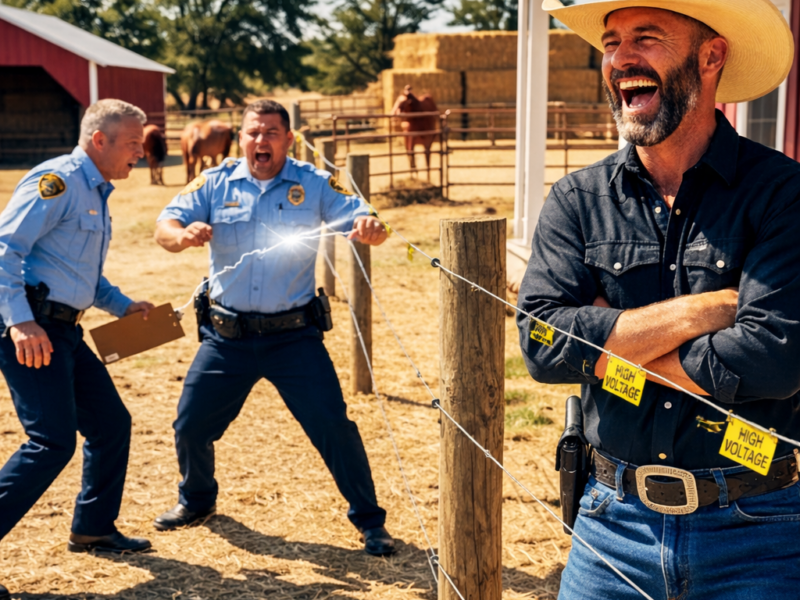
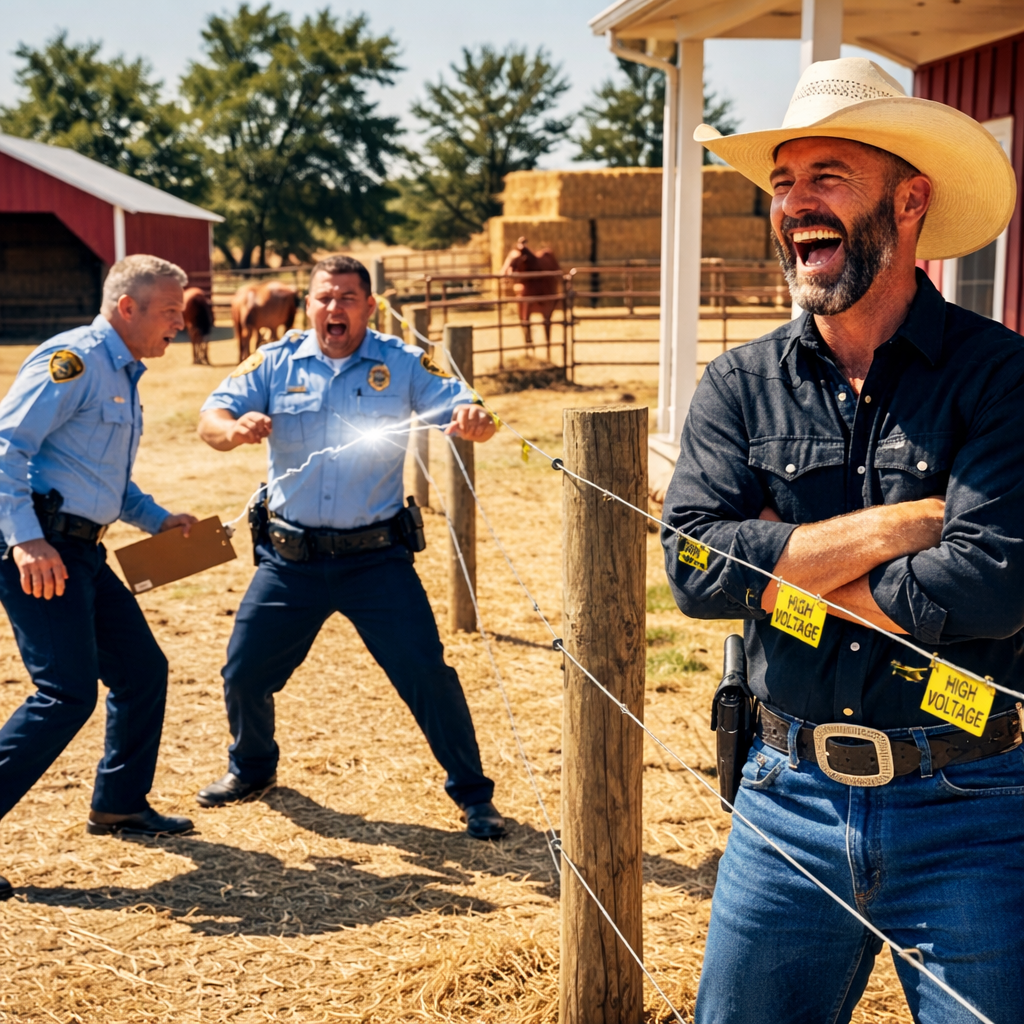
Same two HOA security boys. Same matching polos. Same cheap swagger. The heavier one placed his palm on the top rail and got hit with a bright crack that launched his hat, his clipboard, and what little dignity he had left straight into the dirt. His buddy scrambled backward so fast he dropped his phone. I saved the footage, printed still frames, and told Duke, “He ain’t the last one, boy.”
I was right.
Bradley returned the very next morning with a folder full of fake urgency and a fresh threat. He marched up my driveway talking about illegal electrified barriers, shared aesthetics, and urgent violations. I answered from my porch with coffee in my hand.
“It’s my land, Bradley.”
He told me to remove the fence that day or face civil action.
I reminded him one of his own people had already tried to cut it and got himself zapped under fully visible warning signs.
The twitch that crossed his face told me he knew exactly who I meant. He opened his mouth to deny something when tires hit gravel behind him.
A Channel Five news van.
Best surprise of the whole month.
The reporter, Denise Harper, came at him with a microphone raised and the sort of polite aggression only local news veterans master. She had already received a copy of my footage from a friendly source I did not ask too many questions about. She started asking Bradley whether his HOA had attempted to regulate land outside its jurisdiction, whether his security personnel had trespassed, whether the county had confirmed my fence was legal, and whether he had tried to purchase my northern strip days earlier.
Watching that man sweat on camera was like watching butter melt off a hot biscuit.
He tried to call everything a misunderstanding. Denise kept using the words county deeded property. He started talking about community space. I said quietly, “There is no community space on my land.”
The camera loved that.
By the time he stomped back to his SUV, the story had already escaped his control. Denise told me they might follow up if the matter escalated. I tipped my hat and said I had nothing to hide.
What I did not know then was that Bradley would respond the way all fragile men do once public embarrassment enters the chat.
He hired lawyers.
That was when I stopped thinking like a rancher in a dispute and started thinking like a man preparing a campaign. I laid every piece of evidence on my dining table. HOA letters. Laminated maps. Fence photos. Cut wire. Trespass stills. Dye pack frames. Electric fence warning signs. Audio of Bradley’s offer. Timeline. Reports. Backups on drives. Printed copies for court. My grandfather built that table from old barn timber, and that morning it held enough paperwork to sink a city council.
The last folder was the real weapon.
Inside it sat the audio of Bradley’s land-buy attempt and a sketch I got from a surveyor friend who had grown tired of being lied to by developers. That sketch showed the real reason they wanted my northern strip: a feeder road cutting through my pasture into a future expansion zone. It was not about visual harmony. It was about access. Once they got the strip, a bigger development deal could run right through land my family had held since the Depression.
That was premeditation in ink.
The subdivision people never understood that difference. To them the north edge looked underused, empty, available for improvement. To me it was winter grass, deer passage, drainage memory, and the breathing room that keeps one world from swallowing another. Developers call that kind of strip inefficient because they do not measure land in weather, blood, or inheritance. They measure it in frontage, access, and leverage. Once I saw the road sketch, everything Bradley had done rearranged itself into plain truth. The letters were not complaints. They were setup. The fake safety concerns were not civic responsibility. They were pressure. The trespassing “security” boys were not trying to inspect anything. They were testing the line to see whether I would act like a man already beaten. I think that was what offended me most. Not just the greed. The assumption. The belief that a quiet man on old land must surely be an easy mark because he values peace. Peace and surrender have never been the same thing out here.
I called Daniel Torres.
Daniel and I had served together years earlier. He came back from the military, got older, sharper, meaner where it counted, and somehow became the kind of lawyer bullies regret meeting. He answered the phone with a laugh already in his voice and said, “If you’re calling before breakfast, somebody’s about to get sued into the stone age.”
I told him enough to get him interested.
That was also why Daniel Torres fit the fight so well. Back when we wore uniforms together, he had this gift for seeing the ugly little strategy hidden inside whatever story a bully told about himself. He could look at a blown-up route, a shaky report, or a bad commander’s speech and say, no, the real problem is right there, in the thing he keeps pretending not to want. Sitting at my table with that feeder-road sketch between us, Daniel looked exactly like he had years earlier when the world slowed down around him and turned clear. He did not get excited. He got precise. He built our court filing the same way I built fence: nothing decorative, nothing loose, nothing included unless it could stand under pressure. He even made me rehearse answers out loud. “Do not give them speeches,” he said. “Give them facts. Judges can smell a sermon. They trust timestamps.” So I practiced: yes, that is my land; yes, those are my signs; yes, that is the man cutting my wire; yes, that is Bradley Sloan offering to purchase the strip while threatening complaints. By the end of that day I realized something strange. I was no longer angry in the hot way. I was calm in the dangerous way. The kind of calm that comes when truth has finally been organized.
He came the next morning in his dusty Silverado carrying coffee strong enough to strip paint. The man walked into my kitchen, saw the evidence spread across the table, and whistled.
“Clay,” he said, “this isn’t evidence. This is artillery.”
He sorted everything into piles the way we once sorted gear before patrols. Defense. Offense. Fatal blows. The county map went into defense. The trespass footage and cut wire into offense. The audio and access-road sketch into fatal blows.
When he saw the sketch, he went still.
“This isn’t a fence dispute,” he said. “They want a road.”
We spent two hours building the counterclaim. Trespass. Willful property destruction. Attempted coercion. Misuse of HOA authority. Fraudulent pressure campaign. Emotional distress. Legal fees. Daniel asked how much I wanted.
“It ain’t about money.”
“It never is,” he said. “That’s why the money matters.”
He recommended one hundred thirty five thousand dollars. I looked at that number for a long time. It did not feel like greed. It felt like language. The kind these people would understand.
“Fair,” I said.
Monday morning we walked into Travis County Courthouse together.
The place smelled like old paper, dry air, and floor wax. Clear Hill Acres residents filled the first rows looking stiff and offended on behalf of people who had never once respected boundaries unless they drew them. The same security idiot who got jolted by my fence sat up front pretending not to be himself. Bradley Sloan wore a suit too expensive for a man already losing. His attorney, Kellerman, looked slick enough to drown in his own cologne.
Judge Evelyn Hart took the bench and silenced the whole room just by existing.
Kellerman started first, talking about hazardous electrified barriers and public safety concerns and community standards in the solemn tone lawyers use when they know the facts are weak and the phrasing is all they have left.
Then Daniel stood.
He put Roberta’s laminated parcel map on the screen and walked the judge through the boundary lines. Clear as day. HOA line ending forty three feet south. My fence on my land. No overlap. No easement. No authority.
Judge Hart looked at Kellerman and asked if he contested county records.
He tried to mumble something about discrepancies. She shut that down in one sentence.
Then Daniel played the trespass footage. The courtroom watched one of the HOA’s own security men climb my fence line with bolt cutters like a raccoon in a polo shirt. When the clip cut to the later electric-fence incident, the man in the front row sank so low in his seat he might as well have been trying to tunnel out.
Then Daniel played the audio.
Bradley’s voice filled the courtroom offering to make everything go away, talking about buying my strip, avoiding court, keeping the peace. My voice asked if he was threatening me. His voice ducked and weaved and implied exactly what it needed to imply.
A woman in the HOA section gasped.
The judge turned toward Bradley so slowly it almost looked merciful. “Were you attempting to acquire land while preparing to litigate the owner?”
He opened his mouth and failed publicly.
Then came the sketch.
Daniel put the feeder-road plan on the screen and pointed to the date on it: two months before the first violation letter ever reached my mailbox.
That was the kill shot.
Judge Hart removed her glasses, looked from the sketch to Bradley to the HOA rows, and said, “This is premeditated misuse of authority.”
She then said something I expect Bradley Sloan still hears in his sleep.
“In Texas, Mr. Sloan, we do not steal land with paper any more than we do with wire cutters.”
The verdict landed exactly the way truth should land when it has been patient.
My fence was legal under Texas agricultural law. My land was outside HOA jurisdiction. Clear Hill Acres had trespassed, damaged property, engaged in bad-faith legal threats, and attempted coercive acquisition. Judge Hart awarded me one hundred thirty five thousand dollars in damages, ordered a formal public apology, permanently barred the HOA from further regulatory attempts over my property, and referred Bradley Sloan’s conduct for district attorney review.
Daniel leaned over and whispered, “Told you the boots worked.”
Outside the courthouse the sky looked bigger than it had in months. Daniel clapped my shoulder. We said goodbye like old soldiers do, without drama, and he rolled out in his truck. I drove home feeling the road beneath me like memory.
The ranch felt steadier when I pulled in. Not grander. Not safer. Just steadier. Like the land itself had planted its boots and held.
The fallout came fast.
Even after the verdict, the truth kept doing work I could not have predicted. Men I had never met started mailing copies of their own weird HOA letters to my ranch. Some were laughable, mailbox paint disputes pushed beyond reason. Some were uglier, little pressure moves around easements, access lanes, livestock smells, and “visual nuisance” claims aimed at pushing real agriculture farther from new development money. I read every one that came in. Not because I wanted to become some statewide fence crusader, but because once you have watched a boundary attack move from nuisance to planned theft, you start recognizing the first cough of the disease. Harold Kim was the first person I invited over, but he was not the last. Soon there were Saturday mornings when my porch looked like a county fair for suspicious landowners. Coffee thermoses on the rail. Maps weighted down with horseshoes. Duke moving from boot to boot collecting scratches like a foreman checking attendance. The stories were different in detail and identical in shape. Somebody wanted an acre. Somebody wanted a view corridor. Somebody wanted a road, a trail, a utility line, or just the psychological habit of making a landowner say yes because saying no felt too exhausting. That was what the Fence Line Network really became: a place where no one had to spend six lonely months wondering whether they were overreacting. Sometimes the strongest defense is hearing another rancher say, “No, you are not crazy. They are trying the same trick they tried on me.”
Emails from strangers. Calls from ranchers. Messages from people thanking me for standing my ground because their families had lost ground to developers years earlier. Denise ran another segment that made me sound like some kind of folk hero, which I did not ask for but could not stop. Clear Hill Acres posted their apology at two in the morning, which only made them look guiltier. Denise aired a follow-up asking why an innocent HOA apologized while the county slept. Bradley Sloan resigned before the board could toss him. Word around town said no serious developer wanted to touch the man after he lost a land grab to a rancher with a solar-powered zap fence.
The best part came from a boy.
About six weeks after trial I was walking my line at sunrise when a father and little boy stopped near the fence. The boy could not have been more than six. He stared at the posts, the warning signs, the long boundary line, and whispered, “Daddy, is this the electric cowboy fence?”
I told him it was.
He asked if I had zapped a whole neighborhood.
I laughed and said, “No, son. Just reminded them where their neighborhood ends.”
That little line got repeated all over town.
A few days after that, I got an email from a young rancher named Harold Kim. New development pushing close. HOA letters starting. Boundary confusion. Quiet intimidation. The same old disease in a new county. I told him to come over.
Harold showed up skinny, nervous, hat too big, boots too new, but with the hands of somebody who really worked land. We walked my northern pasture together. Duke supervised. Harold studied the fence, the signs, the cameras, the grounded line, all of it. Then he asked if I had been scared when they first came after me.
“No,” I said. “But I didn’t like it.”
“Why?”
“Because it wasn’t a fair fight. They had committees and clipboards and folks who never touched dirt trying to tell me what my own ground ought to be. That’s what rubs raw.”
He nodded like that answer had been waiting for him.
That night Harold stayed for brisket, beans, and cornbread, and by the time he left the idea had already started forming in my head. Not loud. Just steady. A network. Landowners sharing templates, maps, evidence, cease-and-desist letters, sheriff contacts, surveyor names, camera setups, and the simple reminder that boundary lines are easier to defend when you’re not standing alone.
Daniel loved the idea. He drafted forms pro bono. Denise loved it too and put it on the air as The Fence Line Network. Within a month we had ranchers, goat farmers, couples fighting bogus buffer orders, one Vietnam vet dealing with HOA drones over his barn, and more joining every week. We met over coffee, passed maps around, compared stories, and taught each other how to stop bullies before bullying turned into surrender.
That mattered more than the money.
Money repairs wire. Community repairs nerve.
As for me, I kept living the way I always had. Cattle. Water troughs. Sunrise. Duke. Fence inspections. Only now when I walked the northern line, I felt something different moving with me. Not vigilance. Vindication. The line held legally, morally, and in the minds of everyone who watched the case and finally understood that an HOA is not a government, a developer is not a king, and a rancher who knows his land is hard to move.
I did not start that war.
I built a fence.
And when they came for it with fake authority, real trespass, and polished paperwork, I answered with cameras, county records, legal Texas electricity, and the kind of patience men like Bradley Sloan mistake for weakness until it is far too late.
By the end, they were not asking about aesthetics.
They were begging for mercy.
And my fence was still standing.
THE END