My Wife Served Divorce Papers at Christmas Dinner While Her Family Applauded—Then One Black Card Exposed the Man They Had Mocked for Eight Years
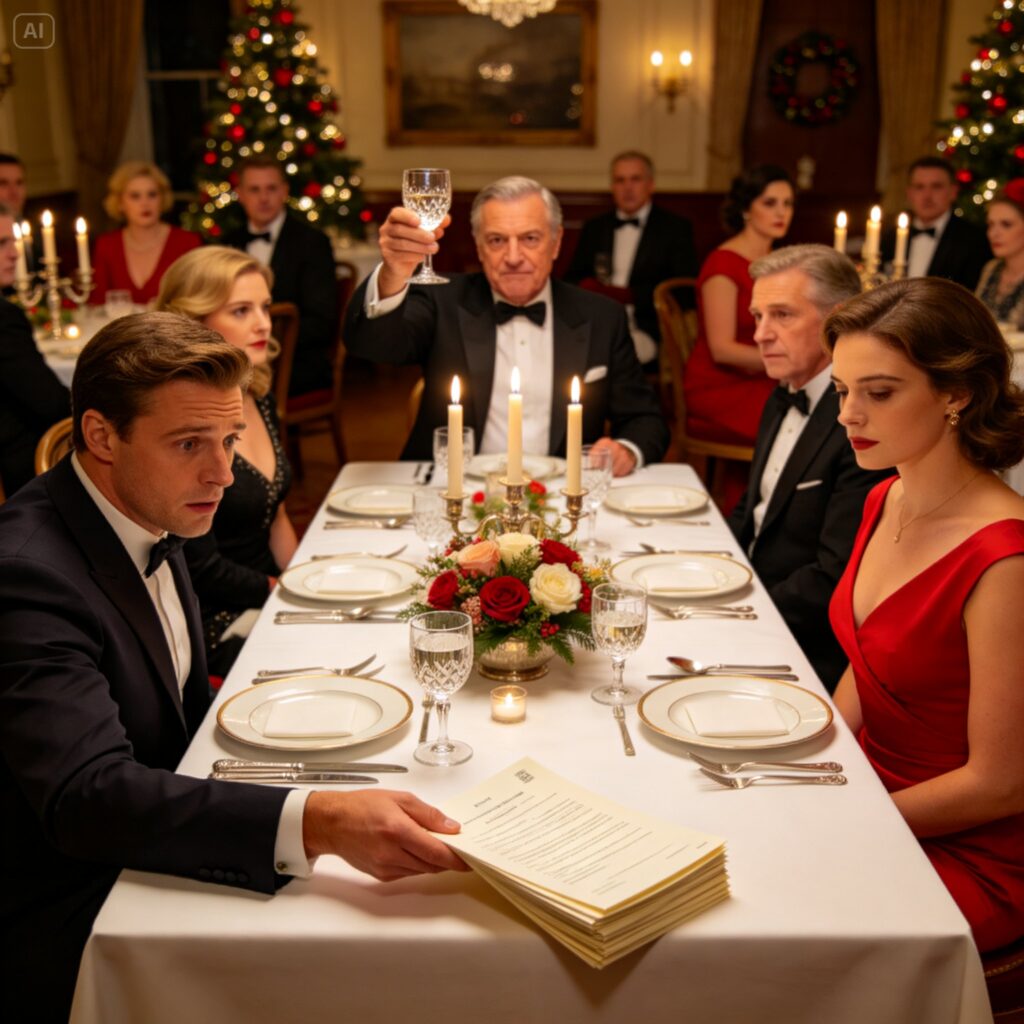
My father-in-law once told me a man’s worth could be weighed by the thickness of his wallet.
He said it over Thanksgiving turkey, with a crystal glass in one hand and a carved silver knife in the other, while the whole Thornberry family sat around a table polished so brightly it reflected the chandeliers above us. My wife was on my left. Her brother was on my right. Forty years of money sat around that room in pressed suits, tasteful jewelry, and smiles trained to hide contempt until it became useful.
“A good provider,” Vance Thornberry had said, tapping his own breast pocket, “should make a reassuring sound when he sits down.”
Everyone laughed.
I laughed too, or at least I pulled my mouth into something that looked close enough to laughter to keep dinner moving. Then I cut my turkey into small pieces and told myself the same thing I had been telling myself for nearly eight years.
Endure it. Love her. Keep going.
My name is Owen Briggs. I was thirty-four that Christmas. I restored antique furniture for a living. People brought me broken things and trusted me to make them whole without erasing their history. I knew what old lacquer smelled like when heat touched it. I knew the sound a warped drawer made before it finally slid straight again.
It was honest work, precise work, quiet work.
To the Thornberrys, it was proof I had failed.
My wife, Delia, had not always agreed with them. When we met nine years earlier at a county fair, she loved everything about me that her family later learned to despise. She loved that I worked with my hands, drove an old truck, and said exactly what I meant. We stood by the Ferris wheel that first night talking until the gates rattled closed. She told me she felt like she could breathe around me.
We married two years later in a courthouse ceremony with twelve folding chairs, a sleepy clerk, and a bouquet Delia bought herself because her mother called courthouse weddings “temporary decisions made to look romantic.”
Vance came. So did Lorine, her mother, dressed in soft cream and disappointment. They stood in the back like donors attending the ribbon cutting for a hospital wing they didn’t like the name of. Delia squeezed my hand and whispered that none of it mattered.
At the time, I believed her.
For the first year, maybe two, she still pushed back when her father mocked me. If Vance asked whether “the repairman” was finally ready to find adult employment, Delia would tell him to stop. If Lorine sighed about how hard it must be for a woman to build a future on unstable income, Delia would pull me closer on the sofa and say, “We’re fine.”
Then the corrections became silences.
Then the silences became agreement.
Families do not always turn people against you in one dramatic moment. Sometimes they wear them down thread by thread. A joke here. A comparison there. A holiday where everyone’s achievements are toasted except yours.
Hollis Thornberry, Delia’s younger brother, was twenty-nine and born fluent in entitlement. He called me “the craftsman” whenever he wanted the room to laugh. Lorine never said anything openly vicious unless she could drape it in concern.
“Owen means well,” she would say, as if discussing a golden retriever with hip problems. “But long-term security matters for a woman.”
And Vance was never subtle. He owned four dealerships across the state and treated success like a weapon that only counted if it could be displayed from a raised platform. He liked speaking in pronouncements. He liked humiliating people while pretending he was educating them. Most of all, he liked reminding me that I had not given his daughter the life he believed she deserved.
I endured all of it because I loved Delia, and because every time I came close to leaving, she gave me just enough of the woman I married to keep me planted. A hand on my wrist under the table. A midnight apology whispered into the dark. A promise that things would calm down.
I kept believing her because the alternative was admitting that the person I married had begun to look at me through her family’s eyes.
By our eighth year, we lived together like polite tenants with shared plumbing. I worked longer hours. Delia spent more time with her parents. We rarely fought because fighting requires investment, and our marriage had been starving for so long it no longer had the energy for flames. It only had ash.
The night before Christmas Eve, I came down the hallway of our house and heard Delia speaking softly on the phone in the kitchen.
“I know, Mom,” she said. “I should have listened to you from the beginning.”
I stopped in the dark before she saw me.
She sighed. Then, after a pause, she said the sentence that settled in my bones like cold iron.
“No, he still doesn’t understand what the real world costs.”
I stood there until the kitchen light blurred. Then I went back to bed and lay awake while she brushed her teeth in the bathroom and slid under the blanket beside me without touching my arm.
The next evening, Christmas night, we drove to the Winthrop in silence.
The Winthrop was the sort of place designed to remind you that some people paid to feel superior even while chewing. Marble floors, enormous mirrors, waiters in dark jackets, and a pianist smoothing Christmas carols into something expensive. Vance had reserved a private dining room for forty-two guests, enough to guarantee witnesses.
The Thornberrys liked an audience for their rituals.
When Delia and I stepped inside, conversations dipped. Not because anyone was glad to see me, but because I had become part of the evening’s furniture and people always glance up when someone moves an object they had already placed in their minds.
Vance sat at the head of the long table in a navy suit with a red silk tie and the easy posture of a man who had never paid retail for confidence. Lorine wore pearls and a smile that looked expensive until you noticed there was no warmth behind it. Hollis was already halfway into a whiskey and scrolling through his phone beneath the table. Cousins, business partners, aunts, uncles, and family friends filled the remaining seats in practiced clusters of status.
Delia took the place set for her beside her mother.
My card said OWEN BRIGGS in discreet black script on cream stock, positioned two seats lower, where I could be included without threatening the symmetry.
That should have told me everything I needed to know.
Dinner began with the usual parade of achievements. Europe trips. Market forecasts. A daughter admitted to Yale. A nephew buying his second vacation home. I sat quietly, cutting my food, answering only when spoken to.
By the time dessert plates were cleared, Vance had worked himself into a glow. His kind always grew louder with praise and wine.
He lifted his glass and looked down the table at me.
“Owen,” he said, in the tone of a host about to introduce the evening’s entertainment, “tell everyone how the chair business is doing.”
A few people chuckled before I answered.
“It’s furniture restoration, Vance.”
“Of course,” he said. “How silly of me. Furniture restoration. The great industrial backbone of America.”
More laughter.
“It’s been a solid year,” I said. “Steady work.”
“Steady,” he repeated, savoring the word like a joke. “That’s what people say when the truth sounds sad.”
Hollis barked a laugh. Lorine hid a smile behind her napkin.
Vance leaned back. “I had lunch with Bradley Kenton last week. You remember Bradley, don’t you? Surgeon. Married to Amelia Price. Bought a place in the hills for four point three cash. That’s what a provider looks like. Tell me, Owen, what did you buy this year? A new sander?”
The table erupted.
I kept my face still. I had been here before in one form or another, though never with so many people. Public humiliation only works if the target cooperates by showing damage. So I gave them nothing. That always irritated Vance more.
Lorine clasped her hands and tilted her head. “No one is trying to be cruel. We simply worry about Delia’s future. A woman needs stability.”
Delia stared at her wineglass.
Something in my chest hollowed out a little more.
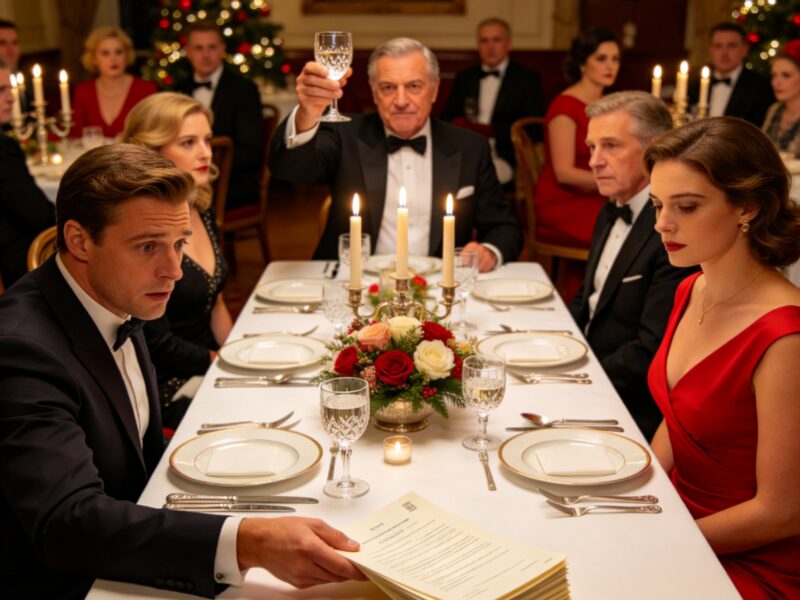
Then, with the timing of someone following a private script, Delia reached into her purse, withdrew a white envelope, and slid it across the table toward me.
The room seemed to pull inward around the soft drag of paper over linen.
I looked at her. “What is this?”
“Open it,” she said.
Her voice was flat. No tremor. No visible shame.
I opened the envelope.
The first page was enough. Petition for dissolution of marriage. Her signature, dated two weeks earlier. Her attorney’s letterhead. Formal language surrounding the end of eight years of trying.
I looked up slowly.
“You’re divorcing me on Christmas.”
Delia finally met my eyes, and whatever tenderness once lived in hers had been replaced by something colder than anger. Embarrassment, maybe. Relief. A person stepping away from a purchase she regretted.
“I should have done it years ago,” she said. “My father was right. You’re never going to become the man I need.”
Vance slammed his palm on the table and rose halfway from his chair, grinning.
“At last,” he declared, “my daughter has come to her senses.”
He lifted his glass higher. “Owen, I’ll be generous. You have until February to get your things out of that house. After that, you can discover what winter feels like without a roof. Homeless by February. That’s got a nice ring to it, doesn’t it?”
He turned to the room.
“A toast. To Delia’s freedom.”
Forty-two glasses rose.
Forty-two people applauded my destruction on Christmas night.
The sound echoed off the private dining room walls until it seemed to come from everywhere at once. Some laughed while they clapped. Others smiled in tight, approving ways, as though they were witnessing overdue corrective action. Delia did not clap. She simply sat there, hands folded, as if she had already stepped outside the marriage and was waiting for the paperwork to catch up.
Humiliation has a taste. Metal, mostly. Like blood without the wound. For a long moment I just sat there with the papers in my hands and listened to people celebrate the end of something they had spent years helping kill.
Then the applause faded.
Someone asked for more wine. Someone else laughed at something Hollis said. The room began moving again, confident that the performance had ended and I would now do what I always did—sit quietly, absorb it, leave with what dignity I could salvage.
Instead I folded the divorce papers carefully and slid them into my jacket.
My hands were no longer shaking.
Because somewhere beneath the humiliation, beneath the grief and the finality and the cold clean fact that my wife had chosen public cruelty over private honesty, something had gone still inside me.
Not numb. Not broken.
Clear.
I thought of my uncle Clement.
Most people who met Uncle Clement Pharaoh thought he was a retired handyman who liked isolation and flannel. He lived in a modest cabin outside the city and taught me how to work wood with patience instead of force. He taught me the difference between fixing a problem and merely hiding it. He also taught me that money is loudest in the hands of people who need witnesses.
On my eighteenth birthday he gave me a matte black card with no numbers, no logo, no bank name, only his full name embossed in silver. Clement Pharaoh.
“Keep it with you,” he had said. “Do not use it unless you truly need to.”
“What does it do?” I asked.
He smiled that small, weathered smile of his. “When you use it, they’ll know exactly who you are.”
I carried it for sixteen years.
After he died three years earlier, I carried it because it was the last strange piece of him I could hold in my hand.
I had never used it.
Until that moment.
A waiter approached to clear dessert plates. He was young, maybe twenty-six, perfectly composed, with the polished attentiveness expensive restaurants teach like choreography.
I raised two fingers slightly.
He stopped. “Yes, sir?”
“I’d like to take care of the table.”
He glanced around, assuming I meant my place setting and Delia’s. “Certainly, sir.”
“The whole table,” I said. “Every seat.”
He hesitated with professional discretion. “Sir, this is a party of forty-two.”
“I’m aware.”
Vance laughed so loudly several guests turned even though they were already watching.
“Did everyone hear that?” he said. “Owen wants to pay for Christmas dinner. That’s charming.”
Hollis leaned back, grinning. “Maybe the restaurant has a financing plan for struggling artisans.”
Lorine shook her head with theatrical pity. “Owen, there is no need to make yourself look smaller.”
Delia’s face tightened with irritation. “Stop,” she said under her breath. “You’re embarrassing yourself.”
I did not answer any of them.
I took out my wallet, worn leather, softened at the corners by a decade of use, and slid out the black card.
For one second I held it between my fingers and felt the weight of my uncle’s silence inside it.
Then I handed it to the waiter.
“Use this.”
He accepted it with trained indifference, glanced down, and stopped breathing.
The change in him was immediate and physical. His eyes widened. His face lost color. He looked from the card to me, back to the card, then at me again as if recalculating the room.
“Is something wrong?” I asked.
He swallowed. “Sir… if you’ll excuse me for one moment. I need to speak with my general manager.”
He turned and walked swiftly through a side door marked PRIVATE.
Vance snorted into his drink. “Declined already? That was fast.”
The relatives nearest him laughed on cue.
I sat with my hands folded while the room returned to its low confident murmur, though now there was curiosity threaded through it. People sensed something had shifted but did not yet know in whose favor.
Two minutes later the door opened again.
The waiter returned, followed by an older man in a charcoal suit with silver at his temples and the controlled expression of someone trained to deliver delicate news without disturbing the upholstery. His name tag read ADRIAN DUNMORE, GENERAL MANAGER.
He walked straight past Vance. Straight past Lorine. Straight to me.
Then he extended his hand.
“Mr. Briggs,” he said, “please accept my apologies. Had we known you were joining us this evening, your arrival would have been handled quite differently.”
I stood and shook his hand.
Across the table, Vance’s smile twitched.
“What exactly is going on?” he asked.
Adrian did not turn toward him. “Sir, we have confirmed the card and notified the estate team in accordance with standing instructions.”
My pulse was pounding, but my voice came out level. “Standing instructions?”
“Yes, Mr. Briggs.” He lowered his tone slightly, though in the room’s sudden silence every word remained audible. “Your uncle left very specific directives. The moment you presented that card, we were to activate formal ownership recognition protocols.”
I stared at him. “Ownership of what?”
He looked directly into my face, and there was no performance in his expression now, only professional respect and a hint of relief that a long-promised moment had finally arrived.
“The Winthrop, sir. And everything beneath Pharaoh Hospitality.”
The room froze.
I have never heard silence arrive so violently.
Adrian continued.
“Your uncle Clement Pharaoh founded Pharaoh Hospitality forty-two years ago. It began with one dining room and grew into thirty-seven restaurants and twelve luxury hotels across the United States. He retained sole ownership through a private estate structure. Upon his death three years ago, those holdings transferred to his designated heir.”
He paused.
“You.”
Vance half rose from his chair. “That’s absurd.”
No one looked at him.
Adrian took a breath. “Our legal department has confirmed your identity with the estate attorneys. Mr. Briggs, as of this moment, and in truth for the last three years, you are the sole owner of Pharaoh Hospitality Group and its subsidiaries.”
Hollis dropped his phone. It struck the table hard enough to make glasses jump.
Lorine’s hand flew to her throat.
Delia stared at me with a face emptied of certainty.
I heard myself ask, “I own the company?”
“Yes, sir.”
“How much is the company worth?”
Adrian’s expression remained carefully neutral. “Based on current valuation, north of four hundred million.”
The number did not register all at once. It moved through the room first, detonating inside other people’s faces before it reached me. Four hundred million. To the Thornberry family, money was language and religion. A number like that did not merely challenge their assumptions. It dismantled the staircase they had arranged themselves on.
Delia spoke first, voice thin and unsteady.
“Owen… why didn’t you tell me?”
I looked at her. Really looked. The woman who had once leaned against my shoulder at county fairs. The woman who had whispered that none of her father’s cruelty mattered. The woman who had just handed me divorce papers in front of forty witnesses because she believed I had nothing left to offer.
“I didn’t know,” I said.
Her mouth parted.
Then I asked the question that had been waiting behind my ribs for years.
“But if I had known, would it have mattered?”
Delia had no answer.
Adrian stepped back respectfully, still holding the black card with both hands as though it were a legal relic. “Shall I keep the evening’s billing internal to the ownership account, sir?”
Vance found his voice before I did.
“No,” he said sharply. “No. There is some mistake. Owen restores furniture out of a rented workshop. He is not some hotel baron. This is theater.”
Adrian turned to him with polished frost. “Sir, there is no mistake. Mr. Briggs’ authority is fully verified.”
Then, because fate has a dark sense of humor, he added, “There is one more matter the estate team asked us to mention if relevant. Pharaoh Commercial Properties also controls the lease on Thornberry Automotive’s headquarters building.”
Vance went white.
I felt the room lean toward me.
“I’m your landlord?” I asked.
Adrian inclined his head. “Through a subsidiary holding entity, yes, sir.”
I almost laughed then, not from joy, but from the obscene precision of it. Eight years of being told I was unworthy by a man paying rent to a structure I had owned without even knowing it.
Vance gripped the edge of the table. “You can’t be serious.”
I turned to him at last.
“You told me I’d be homeless by February,” I said. “That’s interesting timing.”
His jaw tightened so hard a muscle jumped near his temple.
I continued, and now the whole room was listening with the concentration usually reserved for verdicts.
“Here is what is going to happen. My marriage is over. That much was made public for me. As for your lease, I’ll have counsel review everything tomorrow morning. If the building no longer aligns with our standards or strategic interests, you’ll be notified accordingly.”
“Owen,” Delia whispered.
I ignored her.
I took my coat from the chair and nodded to Adrian.
“Put dinner on me. Every bottle, every course, every dessert. Consider it my final Christmas gift to the Thornberry family. I’d hate for anyone here to think the craftsman couldn’t provide.”
No one laughed.
I turned toward the door.
Delia pushed back her chair so suddenly it scraped the floor. “Owen, wait.”
I kept walking.
She caught my sleeve near the doorway, and I stopped just long enough to face her.
Her eyes were bright with shock, maybe tears, maybe calculation. “I didn’t know,” she said. “I swear I didn’t know any of this.”
“That isn’t the point.”
“It changes things.”
There it was. Clean. Naked. Immediate.
I gently removed her hand from my sleeve.
“No,” I said. “It reveals them.”
Then I looked back at the room. Forty-two faces. Some embarrassed. Some frightened. Some already trying to rearrange themselves into future allies. Vance standing rigid in rage. Lorine holding a napkin to her lips. Hollis incapable of meeting my eyes. Adrian near the table, still and watchful.
My uncle once told me that a man’s worth isn’t measured by the size of his wallet, I said. “It’s measured by how he treats people when he thinks no one important is watching.”
I let the silence after that do its work.
“Tonight I saw exactly what all of you think people are worth.”
Then I left.
Outside, snow was falling in fine white lines under the streetlamps. The air hit my lungs so cold and clean it felt medicinal. I stood on the curb with divorce papers in my inside pocket and stared up while flakes melted against my face.
For the first time in years, breathing did not feel like compromise.
The next week moved quickly.
I packed one suitcase and left the house before Delia returned from her parents’ estate. There was nothing there I wanted badly enough to argue over. Furniture had taught me that when the joinery is rotten, salvaging the finish is vanity.
Delia called eighteen times in the first three days. Then her attorneys called.
Apparently she wanted to revisit the timing of the divorce, perhaps reopen financial disclosures, perhaps delay proceedings until “all marital circumstances were fully clarified.” But Vance’s favorite document came back to haunt them. Years earlier, when he still believed I might somehow climb upward by proximity to his daughter, he had insisted on an aggressively drafted prenuptial agreement to protect the Thornberry family from me. It excluded premarital assets, inheritances held separately, and outside business interests not commingled during marriage.
He had built a wall to keep me out.
Now it kept Delia from reaching in.
My attorney, Marian Cole, handled everything with chilly grace. Delia got exactly what she had expected me to receive when she slid the papers across that table.
Nothing.
The lease review for Thornberry Automotive took longer, because unlike Delia, paperwork had to pass through layers of compliance and counsel. I did not personally storm into Vance’s office with eviction language and a smirk. Life is usually less theatrical than that, even when it deserves to be otherwise. What I did was instruct the commercial division to evaluate whether the lease renewal aligned with portfolio standards, tenant conduct expectations, and long-term development plans.
It didn’t.
Three months later, Vance received formal notice that the lease would not be renewed.
He called me once.
I answered because curiosity is a vice I indulge when well rested.
“Owen,” he said, voice heavy with the effort of sounding controlled, “this is vindictive.”
“No,” I replied. “Vindictive would be doing it in public on Christmas.”
He went silent.
Then he said, “We can negotiate.”
“I’m sure you say that to all your landlords.”
I ended the call.
He relocated the headquarters to a smaller property on the outskirts of the city. Within a year, two of his dealerships closed. I did not celebrate it. Failure looks less satisfying up close when innocent employees lose hours because one proud man thought cruelty was leadership.
Lorine sent me a letter six months after the divorce was final. Three pages. Cream stationery. Apology braided to revisionist history. She claimed she had always liked me. She claimed Vance’s harshness had influenced the whole family. She claimed Christmas had gotten “out of hand.”
Out of hand.
As if public humiliation were a dropped tray instead of a chosen performance.
I read the letter once and burned it in the metal bucket beside my workshop.
Hollis reached out through social media with a message so transparently opportunistic it almost impressed me.
Hey man. Crazy how life turns. Would love to catch up. I’ve got a few hospitality concepts that might be worth discussing. Could be huge.
I blocked him.
Delia called once more, four months after everything ended. Late on a Tuesday night. Her voice was soft in that dangerous way voices get when regret has finally stripped away pride.
“I made a mistake,” she said.
“Yes.”
A shaky breath. “I didn’t understand what I had.”
I looked around my workshop while she cried quietly into the silence. A stripped oak sideboard on the bench. clamps hanging from the wall. my uncle’s old square resting beside a tin of wax. For years I had thought love meant waiting inside someone else’s confusion until they found their way back. That night I understood something better.
“You had a husband who loved you when there was no reason to expect reward,” I said. “That was what you had. Money only changed the lighting.”
“Owen, please—”
“I can’t unsee the way you looked at me when you thought I was worth less.”
I hung up before nostalgia could make a coward of me.
Then I went to work.
Taking control of Pharaoh Hospitality was less like becoming a king and more like inheriting a fleet already at sea during bad weather. There were boards to meet, financial structures to understand, general managers to retain or replace, labor issues, capital projects, expansion plans, legacy contracts, and a thousand subtle internal rules created by a founder who preferred invisibility to announcements.
I did not take a corner office and begin barking orders. That was Vance’s style, not mine. I visited properties. I walked kitchens and loading docks and linen rooms. I asked housekeepers what broke most often. I talked to bartenders about peak hours and menu blind spots. I learned which managers treated staff like extensions of furniture and which ones created loyalty without demanding fear. I remembered names. I listened more than I spoke. Money changes how people greet you, but attention changes how they trust you.
Some executives found me unsettling because I still wore work boots on site visits and asked maintenance supervisors better questions than finance directors. Others relaxed once they understood that my uncle had not chosen me by accident. I knew how to build things that lasted because I had spent my whole adult life repairing what other people neglected.
On weekends, I kept restoring furniture.
The first time a board member heard that the owner of a four-hundred-million-dollar hospitality group still spent Saturdays with lacquer thinner on his hands, he looked at me the way Vance once had, as if skilled labor were a costume someone successful should outgrow.
I let him think that until quarterly review, when I removed him.
A year after Christmas, I was sanding the underside of an old oak writing table in my workshop when the paper caught on something uneven inside a drawer cavity. I frowned, took a flashlight, and found a narrow false panel at the back. It slid free with a little pressure from a chisel.
Behind it was an envelope.
My name was written across the front in my uncle Clement’s hand.
I sat down on the stool before opening it.
Owen,
If you’re reading this, then you finally used the card.
I had to stop for a moment and breathe. Even dead, the man knew how to arrive at exactly the right time.
I read the rest slowly.
He wrote that he had kept the inheritance from me on purpose. He said money reveals, but it also distorts, and he wanted me to become myself before wealth had the chance to interrupt the process. He wrote that anyone can look generous from a high balcony. The test of character is how you behave when no one expects repayment. He said he had watched me care for my mother, work without complaint, love people who did not always deserve the tenderness, and build a life with my hands before I ever touched his empire. That, he wrote, was why he left everything to me.
Not because I needed the money.
Because I had already learned not to worship it.
The last lines stayed with me longest.
The people who love you when you have nothing are the only people worth trusting when you have everything. Stay good. Stay awake. Stay kind without becoming blind.
I folded the letter and sat alone in the workshop until dusk seeped blue through the high windows.
The strange thing was that wealth changed almost nothing I trusted. I still arrived early. I paid attention to craftsmanship, to invoices, to the way people spoke to servers when they thought status protected them. Money enlarged the room around me, but it did not improve the view. Character still did that. And once you have watched a room applaud your ruin, you never confuse elegance with decency or applause with truth, or inheritance with wisdom, or comfort with love.
For years I had believed I was invisible to the people who mattered most. Christmas taught me a harsher truth and a kinder one. Some people never see you at all; they only measure the distance between what you are and what they can use. But invisibility can be a gift when you are still becoming. It gives you room to build before fortune starts inviting impersonators.
My name is Owen Briggs. I restore furniture because broken things deserve patient hands, not ridicule. I inherited a hospitality empire because a quiet man in a flannel shirt saw who I was long before anyone else thought I was worth noticing. My in-laws mocked me. My wife divorced me in public. An entire room applauded the death of my marriage because they believed my empty wallet proved my empty value.
They were wrong.
And the night they found out was the first night in years that I walked out of a room feeling richer than money could explain.
THE END