I Found My Pregnant Daughter Dying in the Arkansas Woods—Then Her Husband Confessed, and We Used Her Mother in Law’s Own Lies to Destroy Her
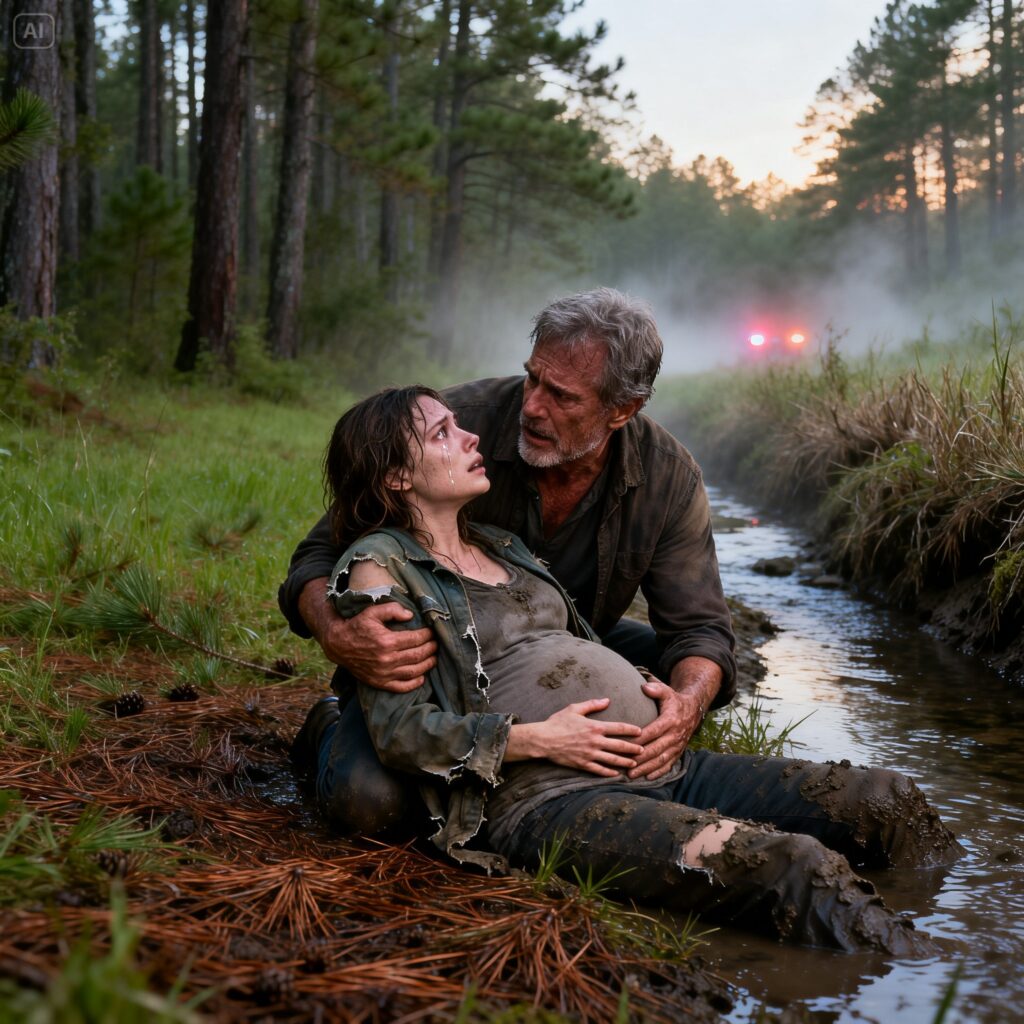
When I found my daughter Emma in the woods behind Miller’s Creek, I thought I was too late.
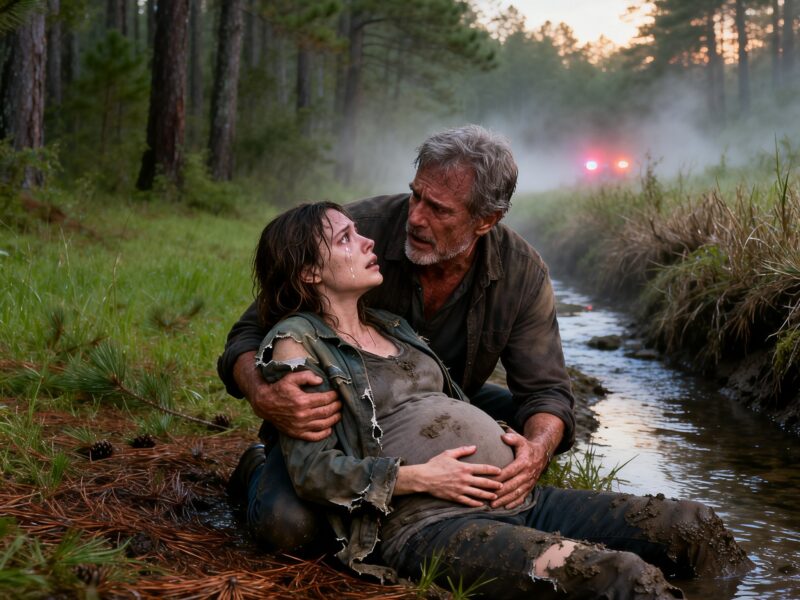
The pines were already swallowing the last of the evening light, and the cold had started to rise from the wet ground in that mean Arkansas way, the kind that sneaks through denim, through boots, through the part of your body that still thinks a bad night can turn ordinary again if you just keep moving. I had been calling her name for nearly an hour, pushing through blackberry tangles with a flashlight in one hand and my phone in the other, trying not to imagine what sort of silence waits in the trees when a father starts bargaining with God.
Emma was twenty six, six months pregnant, and careful by nature. She texted when she stopped for gas. She called if she was running ten minutes late. She did not vanish at sundown without answering three calls and a knock at her own front door. The minute Caleb told me she had gone out after an argument with his mother, something inside my chest turned heavy and exact. It was not panic. Panic is wild. This was older than that. It was the hard certainty that some people only feel a few times in life, when the world tilts and you know you are standing on the edge of the story that will divide everything into before and after.
Miller’s Creek sat just past the back line of Caleb’s rental property, all low brush, pine roots, ditch water, and muddy ruts from old trucks. As a boy I hunted squirrel in those woods with my father, and later with my brother Ray. Grandpa used to say land remembers the weight of what people do on it. I had laughed when I was ten and repeated it when I was forty and thought I was joking, but that night I felt it. The woods were holding something.
Then my light caught the shape of a boot in the weeds.
I dropped to one knee so hard I barked my shin on a root. Emma lay half twisted in a ditch under a row of pines, one arm folded wrong beneath her, her jacket ripped at the shoulder, her hair damp with mud and leaves. One side of her face had already darkened with bruising. Her lips looked split from cold and thirst. For one terrible second I saw the stillness before I saw the breath. Then I saw it, small and shaky, and the whole world rushed back through me so hard I nearly fell over.
“Emma,” I said, and my voice did not sound like mine.
I wrapped my coat around her and touched her shoulder. She flinched as if even a father’s hand hurt. Then her eyes opened. She looked right at me, and whatever strength she had left seemed to gather itself for one last climb toward the surface.
“Dad,” she whispered.
“I’m here,” I said. “Stay with me. Stay awake.”
Her breathing trembled. She swallowed once, twice. The words came out dry and broken and clear enough to freeze my blood.
“It was my mother in law,” she said. “She said my blood was dirty.”
For a second the whole woods went silent. No insects. No wind. No creek. Just that sentence, hanging in the cold like a verdict.
Then I moved. I called 911, gave them the location, and stayed on the line while I kept my hand on my daughter’s back and told her to breathe. I asked her the sort of stupid questions people ask when they are trying to keep somebody conscious. What day is it. What did you eat for lunch. Do you hear me. Do you know I’m here. She answered when she could. Once she asked about the baby, and that nearly killed me.
The ambulance lights reached us through the trees like red water. By the time the medics got her onto the stretcher, I had already seen enough to know this was not an accident. Bruising along both arms where fingers had held too hard. Dirt packed into one knee. Blood soaking through the front of her sweater low and to the left. One medic looked at another with the expression professionals wear when they understand the truth before they are willing to say it out loud.
At St. Vincent’s in Pine Bluff, the emergency room smelled like bleach, wet coats, and old coffee. They took Emma straight back. I filled out forms with shaking hands, signed where they told me, and sat in a plastic chair under a television nobody was watching. At some point a doctor with tired eyes and careful words came to tell me that Emma had blunt force trauma, dehydration, and signs of severe stress that could trigger early labor. The baby still had a heartbeat. The next twenty four hours would matter.
That was when Caleb showed up.
He stood outside Emma’s room like a man waiting to be told whether he was still part of his own life. Pale face. Sweat under the collar. Hands that would not stay still. He had always had a weak sort of politeness to him, the kind that makes people think a man is harmless when what he really is is unfinished. Emma used to defend him. Said he was sensitive. Said he hated conflict. Said his mother bulldozed everybody and he had spent his whole life stepping aside.
He looked at me and then at the floor. “I didn’t know she’d do that,” he said.
There are sentences that make no sense until the person says them. Then suddenly every bad feeling you have carried for years snaps into a single clean line. I stepped closer.
“Do what.”
He licked his lips. His eyes filled, but he did not cry. “My mom just wanted to teach her a lesson. I thought she was scaring her. I didn’t know she would leave her there.”
I stared at him for a long moment. Behind the glass, my daughter lay in a hospital bed with dried leaves still caught in her hair.
“You drove them there,” I said.
He did not answer.
“You drove my pregnant daughter out to the creek road with that woman.”
His mouth opened. Closed. Then he whispered, “She made me.”
Something old woke up inside me then. Not rage exactly. Rage is bright. This was darker and steadier than rage. It felt like opening a tool chest my grandfather had locked years ago and finding every instrument still exactly where he left it.
I stepped away from Caleb before I did something stupid, pulled out my phone, and texted my brother Ray.
It’s our turn. Time for what Grandpa taught us.
Ray arrived in the hospital parking lot at 12:40 in the morning wearing a denim jacket over a thermal shirt and the face he wears when the world has finally given him permission to stop pretending it is better than he knew it was. He was four years younger than me, broad shouldered, quiet, and precise in a crisis. Our father used to say Ray could walk into a house fire and somehow come out holding the one thing nobody else realized mattered.
He leaned against my truck while I handed him Emma’s phone.
“She left it in her purse,” I said. “The deputy bagged it, but I asked them not to process anything until she gave consent. She nodded yes before they took her upstairs.”
Ray scrolled in silence. The parking lot hummed under sodium lights. A helicopter thudded somewhere in the distance. Every few seconds his thumb stopped on another message and his jaw tightened.
Linda’s texts went back months.
At first they hid behind smiles. Advice about family traditions. Suggestions about baby names that sounded more like tests than kindness. Questions about what Emma planned to tell the child about “certain roots.” Then the edge sharpened. Linda said some families carried strength and some carried stain. She said names mattered because blood mattered. She said Barnes men had married well for generations and should not throw that away for sentiment. She called the baby tainted. She said no grandchild of hers would be born carrying that kind of heritage if she had anything to say about it.
Emma had answered more politely than I would have. Sometimes with patience, sometimes with pain. Once with anger. Mostly she had kept hoping Caleb would step in.
He never did.
The final messages were from that afternoon. Linda told Emma to meet her by the creek road so they could settle things privately. Caleb knew. Caleb would drive. Caleb wanted peace. Emma replied that she was done being talked down to and only agreed because she believed Caleb would finally stand with her.
Ray locked the phone and handed it back. “We do this clean,” he said.
That was our grandfather’s rule.
Grandpa Eli Carter had raised hogs, fixed fences, served in Korea, and spent the rest of his life teaching his grandsons that there are two kinds of revenge in this world. The first kind is for fools. It burns fast, feels good for ten seconds, and leaves you standing in the ashes with your own fingerprints on the crime. The second kind takes patience. You collect records. You keep your mouth shut. You let liars build their own gallows out of decisions they insist on making in daylight.
Grandpa never taught us violence.
He taught us sequence.
At 3:07 a.m., Emma woke enough to speak to Detective Marla Greene. Ray and I stood outside the half closed door and listened without moving. Emma’s voice was weak but steady. Linda had accused her of trapping Caleb, poisoning the family line, and bringing shame into the Barnes name. When Emma tried to leave, Linda shoved her near the truck. Caleb grabbed Emma by both arms while Linda screamed that the baby had to be taken care of before it was too late. Emma twisted free, struck the tailgate, and hit the ground hard. Linda kicked her once in the side. When Emma started bleeding, Caleb panicked. Linda ordered him to drive. They left Emma in the ditch because Linda said a frightened pregnant woman with mixed blood and hormones would never be believed over a church treasurer and her own son.
Then Emma told Detective Greene the detail that changed everything.
She had started an audio recording on her phone when Linda began ranting.
The file was buried in a notes folder beneath shopping lists and prenatal reminders. Wind noise swallowed parts of it. Footsteps scraped over gravel. Emma cried at one point. But the voices came through clean enough. Linda’s voice was sharp, controlled, and unmistakable. Caleb’s was weaker, but his words were there. He told Emma to stop fighting. Linda said the baby could still be fixed. Emma begged them to let her go home.
When the recording ended, nobody in the room said anything for five full seconds.
By sunrise, Ray had copied the file three times, sent one copy to my lawyer, another to Detective Greene, and kept a third offline because Grandpa also taught us never to trust a single container with the thing that matters most. I called Sheriff Dan Mercer before breakfast. Dan had known our family thirty years and had the rare lawman’s habit of respecting evidence more than reputation. He listened, asked two questions, and said, “If the audio is as clear as you say, I’ll move today.”
By noon he had enough for arrest warrants.
But Linda Barnes was gone.
Deputies reached her house just in time to learn she had emptied cash from a hallway safe, taken two suitcases, and switched off her phone. Caleb was picked up at a gas station two counties over with a duffel bag, a half tank of gas, and the same weak face he wore at the hospital. He lied three different ways in six minutes and got caught in all of them. Linda stayed ahead of the deputies all day.
At dusk Ray got a call from our cousin Wade, who did maintenance at New Hope Baptist Church. Linda’s gray Buick was parked behind the fellowship hall.
Ray and I drove there in my truck without speaking much. The sun had dropped, leaving the church in that blue half dark where white clapboard looks almost silver. New Hope sat on a rise above the road, all neat shutters and graveled parking lot, the kind of place that smelled like lemon cleaner, hymn books, and casseroles when you stepped inside. Linda had spent years serving as church treasurer there. She had balanced budgets, organized charity drives, and taught Sunday school girls how to fold tablecloths for fellowship meals. That was the kind of woman people thought they knew.
We parked beneath the oaks and circled to the side window.
Through the glass I saw her at a folding table under fluorescent lights, feeding papers into a metal trash can where a small fire glowed bright and hungry. Her posture was calm. Efficient. She did not look like a woman running. She looked like a woman cleaning up after an event.
Then she lifted her head and saw me through the window.
She smiled.
Everything in my body tightened at once. I wanted to go through the door so hard I could already hear the hinge screws stripping. Ray caught my arm before I moved.
“Not one mistake,” he said.
He was right. One bad decision and Linda would spend the next year describing herself as a terrified church woman cornered by violent men from the family she had only tried to help. That is how people like her survive. They drag everyone else down to the ugliest version of themselves and then point at the mud as proof.
So we called Sheriff Mercer and waited.
The deputies came in fast and quiet with their lights off. Mercer entered through the side door first, one hand up, voice level. He ordered Linda away from the can. She did not scream or cry. She stood in her pearl earrings and navy coat with soot brightening one side of her face, looking offended by interruption.
“Linda Barnes,” Mercer said, “you are under arrest for conspiracy to commit aggravated battery, assault on a pregnant woman, evidence tampering, and attempted homicide pending review.”
She turned her head toward me as if he had not spoken at all.
“You people always make everything ugly,” she said.
Those were the last words she spoke outside a courtroom.
The papers she tried to burn included printed emails about prenatal appointments, notes in her handwriting about stress and fetal distress, and a typed page of medical terms she had clearly researched online. Placental abruption. Premature labor. Maternal trauma. It read like the planning notes of a woman too cowardly to get blood on her hands but perfectly willing to orchestrate pain from a safe distance.
The county prosecutor later argued Linda had planned the attack for weeks. He was right. She believed Emma should lose the baby before birth and hoped fear, physical force, and isolation would do what she could not do openly in front of witnesses. She wrapped racial hatred in church language and family honor because that made it easier for people like Caleb to obey.
Caleb was charged too. His lawyer tried to paint him as a weak man controlled by his mother. Maybe there was truth in that. But weakness is not innocence. He drove Emma to the creek road. He held her while Linda threatened her. He left her bleeding in the cold.
Emma stayed in the hospital eight days. Every morning I sat beside her and read whatever she wanted. News articles. A cookbook she had ordered online. Texts from friends trying to make her laugh. Once she asked me to read the same paragraph from a novel three times because she said my voice made the room feel still. She hardly spoke about Caleb. The betrayal ran deeper than the bruises. What hurt most, she told me one afternoon, was realizing how long she had been translating his silence into kindness. She had spent two years making excuses every time Linda insulted her. Marriage takes patience, she used to say. Love means choosing peace. By then she understood what that kind of peace had cost.
The community responded in the way communities sometimes do after they have failed to notice danger early enough. Food appeared on my porch. Church women who had once praised Linda’s discipline now whispered apologies in the grocery store. Men I barely knew offered to sit outside my house at night. Sheriff Mercer stationed a patrol unit near the hospital for the first three evenings because rumors spread faster than facts in our county, and he did not intend to let the Barnes family turn sympathy into interference.
Ray handled the parts of the storm that required a cooler head than mine. He met the prosecutor twice, organized timelines, printed screenshots, and built binders with tabs so neat the district attorney laughed when he saw them. “Your grandfather military?” he asked. Ray said, “Farmer,” and the prosecutor nodded like that explained even more.
Grandpa’s lessons kept surfacing in small moments. Back up every file. Write down exact times. Save receipts because they place people where memory will later lie. Never answer a manipulator while your blood is hot. I heard those rules like a second voice in my head for weeks. It was not mystical. It was just inheritance, the useful kind.
Before the attack, I had tried to tolerate Linda the way people in small towns often tolerate poison when it wears perfume. She knew exactly how long to hold someone’s hand in prayer so everybody nearby noticed. The first time Emma brought Caleb home, Linda complimented our place three times in ten minutes and managed to insult our family on the fourth. She asked whether Emma had ever considered how hard mixed traditions could be on children. She said it lightly, like concern. My wife, who was still alive then, told me later that Linda was the sort of woman who used soft voices the way other people used knives. Emma fell in love with Caleb anyway. Maybe because good daughters sometimes believe love will make weak men brave. I did not forbid the marriage. I only warned her that silence can become a form of agreement if it lasts long enough. She nodded, hugged me, and said I worried too much. I would have given anything to have been wrong.
In the weeks after the arrest, more pieces surfaced. Linda had called Emma’s obstetric office twice pretending to verify appointment dates for “family scheduling.” She had asked a pharmacist in town whether severe emotional distress could trigger labor if a woman was already high risk. She had searched county property maps for unused roads near Miller’s Creek, which the prosecution later tied to a computer in the church office she controlled. Detective Greene found all of it because she was thorough and because Linda had made the mistake so many arrogant people make: she assumed planning looked like intelligence. Real intelligence includes caution. Linda only had vanity.
The prosecutors also uncovered the private campaign she had run against Emma inside the church. Nothing public enough to invite immediate scandal. That Emma was moody. That pregnancy had made her unstable. That some women used ancestry as a shield whenever they were corrected. A Sunday school teacher admitted Linda had asked whether mixed babies were more prone to “complications,” and when the woman looked shocked, Linda had laughed and said she was only asking because she cared so deeply about family health. That was her genius, if evil can be called genius. She always built herself a side door. Every hateful statement came wrapped in an excuse she could sprint toward if somebody objected.
Emma learned about some of that before trial and chose not to hear all of it. “I know enough,” she told me. “I don’t need every ugly detail.” I understood. There is a point beyond which information stops serving truth and starts feeding injury. So I filtered what came to her bedside. I gave her what strengthened the case and kept back what only sharpened the memory. A father cannot stop his child from suffering once the suffering has happened. But he can still stand between her and whatever fresh cruelty tries to arrive afterward wearing the name of evidence.
One afternoon, about a week after Rose was born, Emma asked me why Linda hated us so much. Not her specifically. Us. I thought for a long time before answering. Then I told her what I believed. Linda hated any proof that her world was small. She had spent her life arranging people into neat little boxes marked worthy and unworthy, clean and unclean, proper and improper. Emma married into that system and refused to shrink herself to fit it. Then the baby made the truth permanent. Rose would exist whether Linda approved or not. Some people can survive disappointment. They cannot survive irrelevance. Emma listened, nodded once, and looked down at her daughter sleeping in her arms. “Then she picked the wrong family,” she said. That was the first time I heard steel in her voice again.
Three weeks after the attack, on a rain hammered Thursday before dawn, Emma went into labor.
The hospital room filled with monitors, nurses, clipped commands, and the terrible, holy fear that comes whenever a family knows joy and disaster are standing too close together to tell apart. Emma gripped my hand until my knuckles turned white. Ray waited in the hall with coffee going cold in his fist. My sister in law prayed under her breath near the window. And then, after hours that felt like a second lifetime, a baby girl arrived furious, tiny, and very much alive.
Five pounds even.
Emma named her Rose Mae Carter after my mother and Ray’s wife. When the nurse placed that child in my arms, wrapped like a fragile bundle of heat and breath, I thought about the ditch in the woods and all the things that almost did not happen because evil had come so close. I looked at Rose’s face, red and wrinkled and outraged at the world, and I felt the sharp clean edge of gratitude cut through every other emotion in me.
It failed, I thought.
Whatever Linda had meant to erase, it failed.
The trial started nine months later in a courthouse that always smelled faintly of polished wood, old paper, and damp coats. By then the county already knew the outlines of the case, but outlines do not prepare people for details. The jury heard the audio recording first. You could feel the air change when Linda’s voice filled the room, calm and venomous, speaking about blood as if she were sorting livestock rather than human beings. Then came the text messages. Then the medical evidence. Then the church records proving Linda had moved money and documents in the days before the attack. The prosecutor built his case the way my grandfather would have approved: one fact, then the next, then the next, until the truth became too heavy to move.
Emma testified on the third day.
She wore a blue blouse, a silver necklace my mother left her, and the expression of a woman who had spent too long surviving to care whether cruel people found her polite. She did not look at Linda once. She told the jury how the insults had escalated after she announced the pregnancy. She described Caleb’s silence, Linda’s obsession with bloodlines, the argument at the truck, the fall, the kick, the cold ditch, and the moment she realized that if she did not record them nobody would understand what those nice church voices were capable of when nobody important was listening.
The defense tried to rattle her. Suggested stress had distorted her memory. Suggested pregnancy had made her emotional. Suggested Linda’s comments were metaphorical, cultural, misunderstood. Emma answered each question with the kind of clean steadiness that makes liars visibly age in front of you. At one point the defense attorney asked whether she might have exaggerated Linda’s words because of longstanding tension with her mother in law.
Emma looked him dead in the eye and said, “A woman does not leave her pregnant daughter in law in a ditch because of misunderstanding.”
Nobody asked a stupid question for several minutes after that.
Caleb took a plea deal before he ever reached the witness chair. Seven years in exchange for testimony and full cooperation. The prosecutor said his testimony helped establish planning, but I never thanked him for it. Men like Caleb spend their lives believing confession is a form of courage when it usually arrives only after every useful lie has failed. Emma never forgave him. She did not need to. The law could sort out his sentence. Forgiveness was not part of anybody’s burden but hers.
Linda went to verdict.
The jury returned after four hours.
Convicted on all major counts.
When the judge sentenced Linda to eighteen years, she stood perfectly straight and acted as if she were the one being wronged. Even then she would not look at Emma. She looked instead toward the spectators’ benches, toward church friends and cousins and townspeople, as though one of them might still rescue the version of herself she had spent decades polishing. None of them did.
People in our county still talk about that trial. Some say Linda snapped. Some say grief over losing control of her son made her unstable. Some say prejudice took hold of her like a sickness. I do not accept any of that. Madness is chaos. What Linda did was orderly, reasoned, scheduled, and chosen. She researched medical terms. She arranged the meeting. She used her son as a pair of hands. She tried to destroy evidence. That is not a mind lost in darkness. That is a person who believed cruelty would be protected if she wore the right clothes while committing it.
As for Grandpa’s lesson, it was never about revenge.
People hear that line about what Grandpa taught us and imagine rifles on walls, shovels in moonlight, some old rural code written in threat. That was never our family. Grandpa taught us patience, documentation, and endurance. Keep the evidence. Hold your temper. Stand still long enough for truth to do its work. Let a cruel person keep choosing until the shape of their soul is visible even to strangers.
Emma lives in a small house ten minutes from mine now. White siding. Blue shutters. A swing on the porch that creaks in the evenings. Rose is almost two and loud as thunder when she wants something. Emma laughs again. Not every day. Healing is slower than movies pretend and less dramatic than pain, but it is real. Some mornings I stop by with groceries or coffee and find them both in the kitchen, flour on the counter, music playing low, ordinary life unfolding in the exact place evil once tried to leave a permanent mark.
That may be the part I treasure most.
Ordinary life returned.
Rose likes picture books about animals and insists every dog she sees is named Duke, no matter what anyone tells her. Emma has started taking online classes in bookkeeping because she says numbers feel honest after everything words did to her. On warm evenings she lets Rose chase bubbles across the yard while I fix whatever small thing the house has decided to become dramatic about. A gutter. A hinge. A loose board on the porch. Simple work. The kind that reminds a man the world can still be improved with steady hands.
Sometimes the case comes back in flashes. The smell of cold pine. The glare of fluorescent lights on Linda’s face at the church. Caleb standing in the hallway like weakness had somehow become an alibi. When that happens, I look at my granddaughter and make myself remember the better ending. Not the sentence. Not the verdict. Not even the arrest.
The better ending is that Emma is alive.
The better ending is that Rose exists.
The better ending is that the truth held.
Last spring, Sheriff Mercer stopped me outside the feed store and said the case had been used in a regional training seminar for deputies handling domestic crimes with racial motive elements. He said Emma’s recording probably changed how half a dozen departments would approach similar reports in the future. I thanked him, got back in my truck, and sat there for a minute with my hands on the wheel. I thought about how close we came to losing everything and how strange it felt that something so private and brutal had become useful beyond us. Then I drove to Emma’s house and watched Rose sleep on the couch with one sock missing and a stuffed rabbit under her chin.
There are nights when I still wake before dawn and see the ditch before I see the room around me. I think age does that to a man. It stores terror in some hidden compartment and takes it out when the world is quiet enough to receive it. But the memory no longer owns me. It passes. The morning comes. Coffee brews. A little girl wakes up demanding pancakes and cartoons. My daughter opens the back door to let sunlight into her kitchen. Life insists on itself.
And every time I hear Rose cry with that strong little voice, every time I watch Emma lift her and settle her on one hip with that tired patient grace mothers seem to invent out of thin air, I remember the night the woods almost took them both.
Then I remember something better.
We did not lose them.
THE END